
From JSTOR Daily: “According to new DNA findings, General Casimir Pulaski, the Polish aristocrat who aided the American Revolution as the Father of the American Cavalry, seems to have been intersex. That is, a person who combines both male and female traits. In Pulaski’s case, the bodily remains include a pelvis and facial structure that are characteristically female, but Pulaski was baptized as a boy, and is usually pictured with facial hair. Exiled from Poland, Pulaski arrived in Massachusetts in July 1777 with a letter of introduction from the Marquis de Lafayette, after hearing the call of the American revolution from afar. That led to a meeting with George Washington. Soon Pulaski was put in charge of the 700 men of the Continental Army’s cavalry, and using European methods of horse-mounted warfare, Pulaski rode into American, and Polish history.”
Hans Christian Andersen wrote about climbing Mount Vesuvius while it was erupting
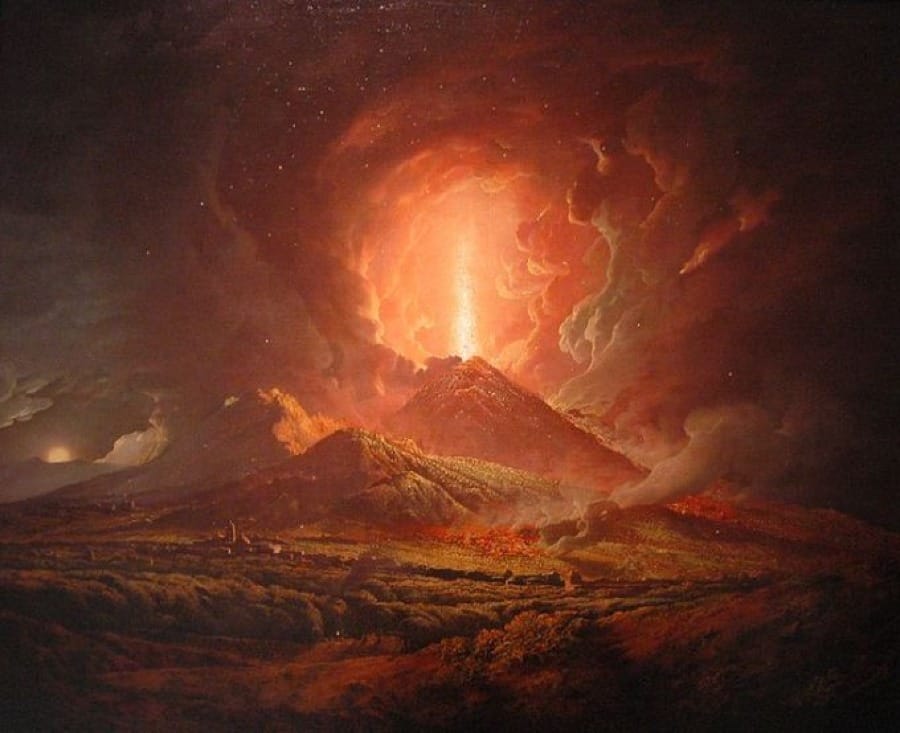
From The Marginalian: “In mid-February of 1834, while touring Europe, 29-year-old Andersen arrived in Naples just as the mighty Mount Vesuvius was in the midst of one of its then-regular and dramatic eruptions, three centuries after the first of them had drowned dozens of Italian villages in hot lava and killed an estimated 3,000 people. In his diary, there is a breathtaking account of his visit to Vesuvius and his crazy quest to climb the mount as it was erupting. “We stood before the mountain itself, whose rounded contours were covered with blocks of lava and ash,” he wrote. “We were now ascending a fairly steep grade, sinking up over our knees into ash. With every other step we slid backward by one. Large, loose rocks went sliding downward when we stepped on them. Coal-black smoke swirled upward; then a ball of fire and gigantic, glowing boulders rolled down onto the plain that we had to cross to get to the lava flow.”
Note: This is a version of my personal newsletter, which I send out via Ghost, the open-source publishing platform. You can see other issues and sign up here.
Continue reading “A Polish aristocrat who helped the US in the 1700s was probably intersex”





:focal(1800x1200:1801x1201)/https://tf-cmsv2-smithsonianmag-media.s3.amazonaws.com/filer_public/93/cc/93cc832f-09f2-461f-9b96-e621a8841c77/opener-mar2024_e13_artfraud.jpg)