Plants
Links that interest me and maybe you

Berlin-based Italian photographer Paride Ambrogi recently combined two of his loves, photography and pasta, in a brilliant, possibly tasty way. Ambrogi made the Ravihole Camera, a working pinhole camera made entirely from fresh pasta dough. Ambrogi made the Ravihole as part of a workshop on fresh-filled pasta in Hamburg, Germany. Alongside the pasta workshop, Ambrogi and his fellow Italian friends who live in Berlin installed a small exhibition dedicated to pasta culture, where Ambrogi brought the Ravihole to share. Ambrogi admits his initial idea for the exhibition was to take black-and-white photos of a friend during the Christmas holidays while making pizzoccheri, a traditional pasta from Valtellina in northern Italy. However, Ambrogi and his friend “drank too many glasses of wine,” and it never happened. So after returning to Berlin after the holidays, Ambrogi had to come up with another idea. (via PetaPixel)
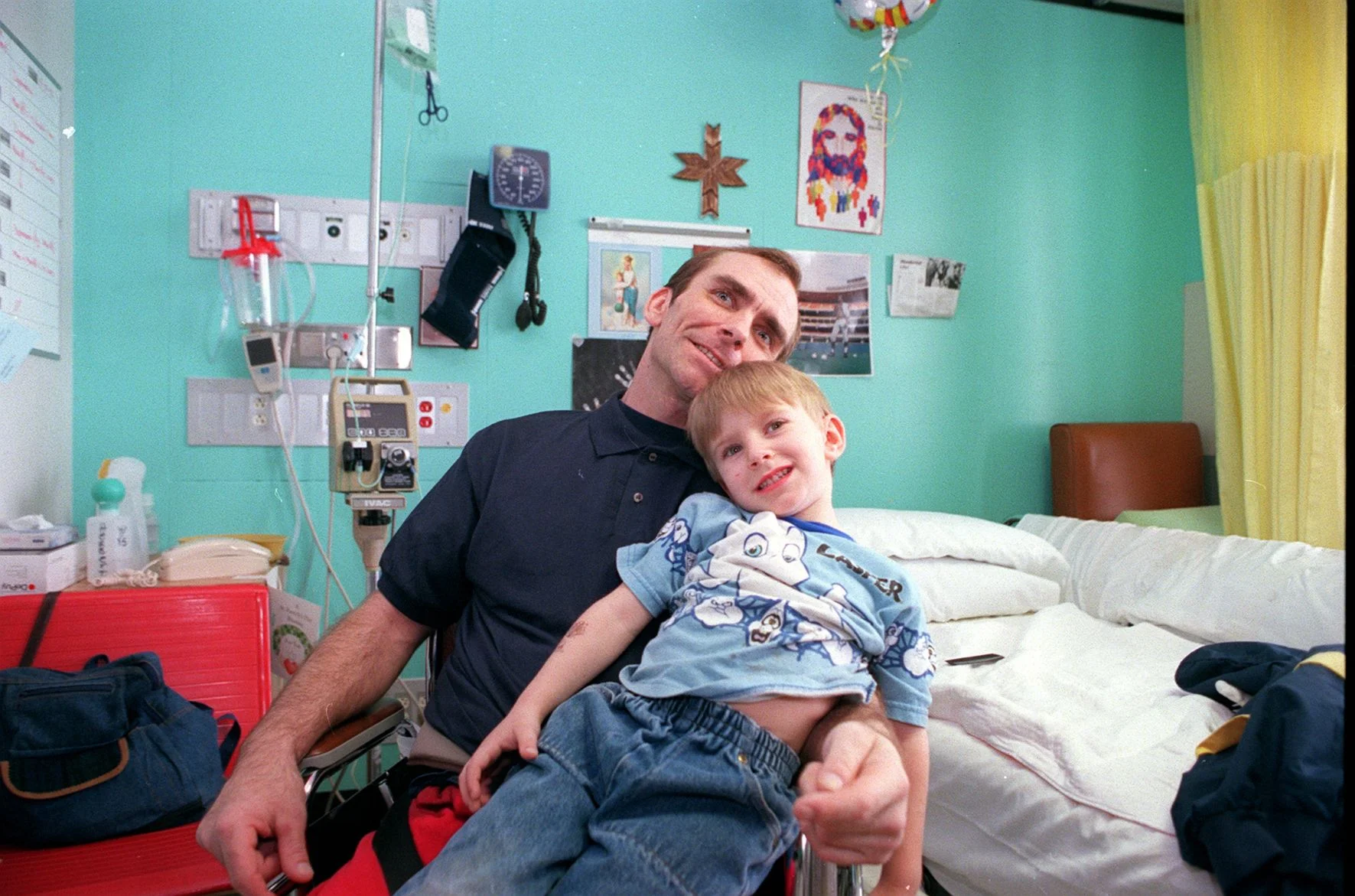
On the morning of December 29, 1995, the roof of a building in which Donald Herbert was fighting a fire collapsed, pinning him down and starving his brain of oxygen for over six minutes. He was rescued from the collapsed structure, but suffered cardiac arrest and was taken to a hospital where he lapsed into a coma. A year later, he regained consciousness for the first time but had speech and vision problems and could not eat or walk without help. Herbert could barely remember anything and he had no longer recognized his relatives and friends. He remained in a minimally conscious state for over nine years until, on April 30, 2005, he awoke and asked where his wife was. He was then able to speak to his friends and family for over 14 continuous hours. He asked how old he was, and how long he had been gone, expressing surprise when he learned that he had been unresponsive for almost ten years. (via Wikipedia)
Note: This is a version of my When The Going Gets Weird newsletter, which I send out via Ghost, the open-source publishing platform. You can see other issues and sign up here.
Continue reading “Italian photographer made a pinhole camera out of pasta”
When Denis Alimov passed through the arrivals hall of El Dorado International Airport in Bogotá on the morning of February 24, 2026, he had the outward appearance of a middle-aged Russian tourist escaping Moscow’s harsh winter: a salt-and-pepper goatee, a light travel bag, a connecting flight from Istanbul, and a reservation at a Cartagena beach resort. Within minutes, Colombian migration officers had him in handcuffs. The Interpol Red Notice — activated as he flew in at the request of federal prosecutors in the Southern District of New York — had been waiting at the gate. Alimov stood accused of orchestrating the attempted assassination of two prominent Chechen dissidents based in Europe, having offered a bounty of $1.5 million on each of their heads — payable whether the target arrived in Russia dead or merely, in the deadpan vocabulary of Russian intelligence, “legally deported.” The FBI had been tracking Alimov for over a year — in part, by reading the Google Translate-assisted exchanges between him and one of his would-be foreign assassins. (via The Insider)

Police responding to reports of a shotgun blast at a convenience store sounds like the opening of countless American crime movies, but when cops in Nebraska responded to a recent such call they found an unusual culprit: a dog. Local TV station KNOP News 2 reported that police in the town of Scottsbluff were called out to a local store recently after reports of a blast involving a shotgun. Upon arrival they found a truck with blast damage in one of its doors and a woman who had been struck in the arm by a pellet from a shotgun. However, investigation showed a canine cause behind the shooting when it was revealed the blast happened as the vehicle had pulled up to the store as a dog had been moving from one side of its back seat to another. Somehow, the dog had triggered the shotgun – which had a live round chambered – to fire, damaging the vehicle and striking a female passerby. (via The Guardian)
Note: This is a version of my When The Going Gets Weird newsletter, which I send out via Ghost, the open-source publishing platform. You can see other issues and sign up here.
Continue reading “Russian hitman busted because he used Google Translate”One of the consistent drumbeats that has accompanied the rise of artificial intelligence, along with “Is it going to kill us?” and “Will it kill us and the planet?” is the idea that AI will lead to an epidemic of job losses, and possibly even the destruction of entire categories of jobs. We can see some of this fear in articles published by the Wall Street Journal and CBNC, with headlines like “AI Is Wrecking An Already Fragile Job Market For College Graduates” and “Right now is a really difficult time to find a job,’ expert says.” One recruiting firm says marketing companies are no longer looking for entry-level employees because AI can do it all; the CEO of another consulting firm told his own children not to focus on jobs that involve writing or data, but to choose those that require “people skills,” like becoming a police officer (good advice until Robocop becomes a reality, I suppose). Anthropic founder Dario Amodei has said that he believes AI could wipe out half of all entry-level white-collar jobs in the near future. Here’s the WSJ:
AI is accelerating trends that were already under way. With each new class after 2020, an ever-smaller share of graduates is landing jobs that require a bachelor’s degree, according to a Burning Glass Institute analysis of labor data. That’s happening across majors, from visual arts to engineering and mathematics. And unemployment among recent college graduates is now rising faster than for young adults with just high-school or associate degrees. Meanwhile, the sectors where graduate hiring has slowed the most—like information, finance, insurance and technical services—are still growing, a sign employers are becoming more efficient and see no immediate downside to hiring fewer inexperienced workers.
Top executives at industry giants like Amazon and JPMorgan have said in recent weeks that they expect their workforces to shrink considerably. Venture-capital firm SignalFire found that among the 15 largest tech companies by market capitalization, the share of entry-level hires relative to total new hires has fallen by 50% since 2019. “For the first time in modern history, a bachelor’s degree is no longer a reliable path to professional employment,” Gad Levanon, chief economist at the Burning Glass Institute, told CNBC. Although college graduates are still less likely to be unemployed than their non-degree counterparts, the advantage is smaller than it’s been in decades. Concerns about the economy, persistent inflation and a slowdown in consumer spending are also likely contributors to an erosion of entry-level opportunities, according to some researchers.
Note: This is a version of my Torment Nexus newsletter, which I send out via Ghost, the open-source publishing platform. You can see other issues and sign up here.
Continue reading “Will AI destroy jobs or create jobs? Yes”
In almost 40 years, Mako Nishimura never lost a fight. She told me this as if it were as obvious as night following day. Nishimura is 5ft-nothing and slight of build. She is also probably the only woman ever to have been a full-fledged yakuza, a member of Japan’s feared and rule-bound criminal underworld. She must have defeated many male gangsters. How, I asked her, did she do it? “First the legs,” she said, hands clasped, maintaining the calm demeanour of a village priest. Nishimura’s relaxed attitude to violence is what first caught the attention of yakuza members in 1986, when she was a 19-year-old runaway and former juvenile-prison inmate living in Gifu, a city near Nagoya. She was getting more deeply involved in serious crime, too, running sex workers and extorting local businesses, as well as selling – and taking – large quantities of methamphetamines. Yakuza life nonetheless appealed. It offered respect, protection and, above all, the opportunity to make big money. (via The Guardian)

Max Hawkins had started to feel trapped by his optimized life. Every weekday, he woke up at exactly 7 a.m. and grabbed a single-origin pour-over. He got on his bike and rode 15 minutes and 37 seconds along the best possible route to Google, where he was a software engineer. He spent eight hours working, then met friends for a beer at a craft brewery or a hang in Mission Dolores Park. But despite his great job and charmed life, something felt off.One afternoon at work, while reading an academic paper, he located the source of his ennui. The study, which tracked the movements of 100,000 anonymized mobile-phone users over six months, had found that human mobility is surprisingly predictable: Our days default to simple, repeatable patterns. The engineer part of Max’s brain thought the research was pretty cool, but he also found it unsettling. “There was something very programmed about the way I was living,” he told me. If his movements were that predictable, where did that leave his free will? (via The Atlantic)
Note: This is a version of my When The Going Gets Weird newsletter, which I send out via Ghost, the open-source publishing platform. You can see other issues and sign up here.
Continue reading “The rise and fall of the world’s only female yakuza gangster”
By Marie Howe

In 1963, a Turkish resident who simply wanted to expand his house ended up making an unexpected and monumental discovery. While knocking down a wall in his basement, he found a mysterious room—then another, and another. Without realizing it, he had uncovered the entrance to Derinkuyu: an underground city capable of housing up to 20,000 people beneath Cappadocia. The part that extends below ground level is, on average, between six and 10 times deeper than the height of the above-ground buildings of the ancient city that used to be there. Derinkuyu means “deep well,” and the name is no exaggeration. Scientists say Derinkuyu’s origins may date back to around the eighth century B.C. The result is a vast underground complex with rooms, stables, cellars, tombs, schools and even churches with refectories. Some of these spaces continued to be used until the 19th century before Derinkuyu fell into oblivion. (via History.com)

A search of the patents registered in the second half of the 19th century by Moses G Crane of Massachusetts reveals a man who was never short of ideas. Crane had three sons who played football at Harvard, but he was not a fan of the sport. Apparently he believed that “to the average person without a college education it is incomprehensible, dull, cruel”, and he was particularly irritated at how hard it was to follow the progress of a small brown ball. And so Crane donned his thinking cap. “If the ball were only made large,” he said, “yes, large enough so that a player on one side could not see who was on the other, you would then have a chance to interest spectators.” In 1894 he found someone who could make his monster ball, at a cost – for materials alone – of some $175, about $4,500 in today’s money, and after several months of experimentation his son Edwin produced some rules. And so the sport of Pushball was born. (via The Guardian)
Note: This is a version of my When The Going Gets Weird newsletter, which I send out via Ghost, the open-source publishing platform. You can see other issues and sign up here.
Continue reading “He was renovating his basement and found an underground city”
There is one time of day when Dawn Faizey Webster can feel normal. It’s after dinner, once she has been changed into her pyjamas and she is lying in bed, watching television. After a certain amount of time or a certain number of episodes, Netflix, the ever-considerate streaming service, asks its viewers “Are you still watching?” If you don’t respond by pressing a button on the remote, it assumes you’ve nodded off and pauses the stream. Dawn can’t press buttons. She can’t move her fingers or toes or her arms or legs. She can’t swallow. She can’t speak. She hasn’t been able to do any of those things since Tony Blair was prime minister. When Netflix suspects she has fallen asleep and the “still watching” message appears, she can only hope to attract a carer’s attention through the baby monitor in her room. Dawn, 53, has been locked in since suffering a stroke in her brainstem in the summer of 2003. (via The Times)
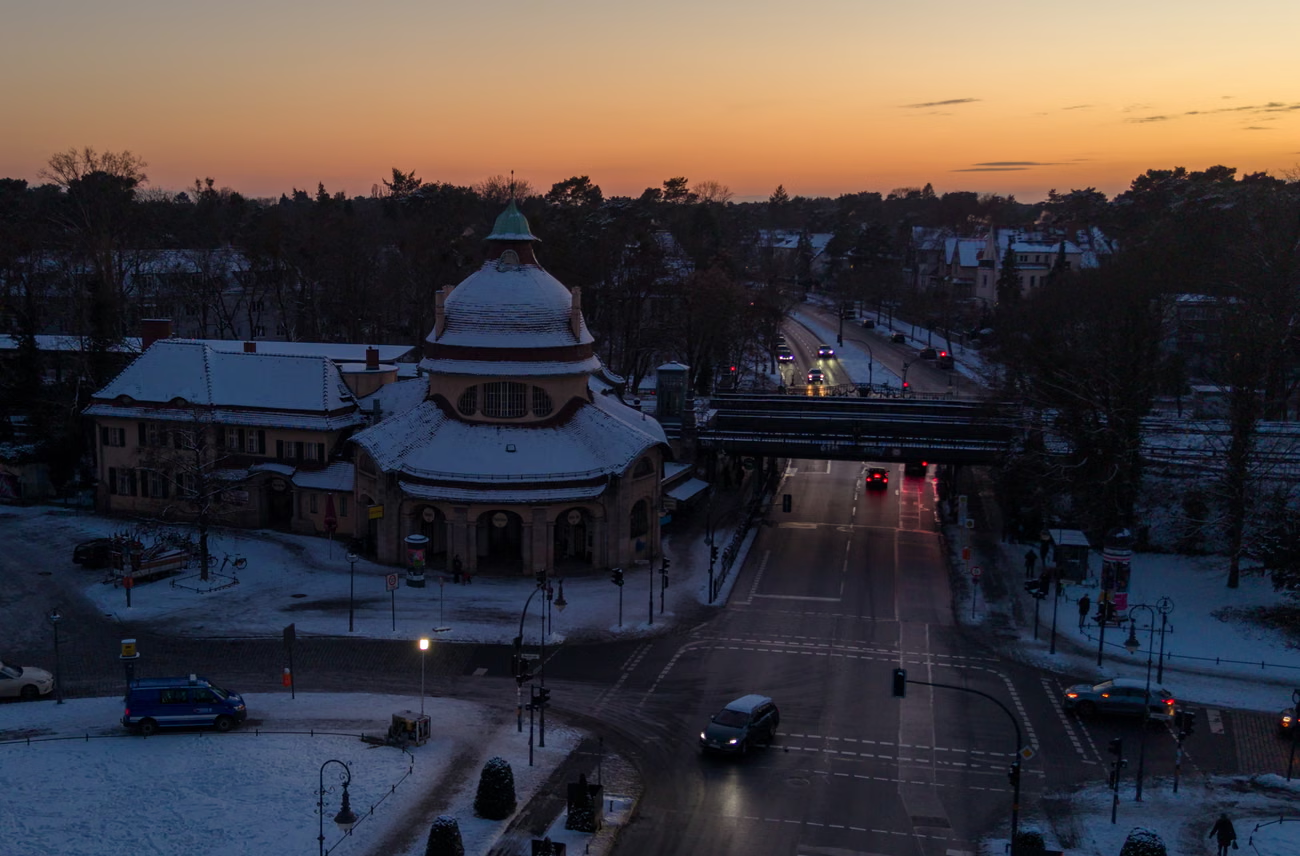
Sebastian Brandt, chief technician of the Immanuel hospital in the leafy, affluent Wannsee district of Berlin, guessed something was wrong as soon as he opened the window of his home and smelled diesel. It was 3 January, a freezing Saturday morning, and luckily the hospital opposite had relatively few patients on this post-holiday weekend. As he looked out, the diesel fumes told him that the emergency generator – a huge, deafening, decades-old machine in the basement – had kicked in. That meant the hospital was no longer getting power from the grid. And that meant Brandt was not going to have a quiet weekend. What Brandt didn’t know was that his hospital was cut off because a couple of hours earlier, at about 6am, approximately 12km away, someone had set fire to five high-voltage cables fixed to the underside of a bridge over the Teltow canal, a long waterway that cuts through the southern part of the German capital. (via The Guardian)
Note: This is a version of my When The Going Gets Weird newsletter, which I send out via Ghost, the open-source publishing platform. You can see other issues and sign up here.
Continue reading “What it’s like to suffer from locked-in syndrome”There is one time of day when Dawn Faizey Webster can feel normal. It’s after dinner, once she has been changed into her pyjamas and she is lying in bed, watching television. After a certain amount of time or a certain number of episodes, Netflix, the ever-considerate streaming service, asks its viewers “Are you still watching?” If you don’t respond by pressing a button on the remote, it assumes you’ve nodded off and pauses the stream. Dawn can’t press buttons. She can’t move her fingers or toes or her arms or legs. She can’t swallow. She can’t speak. She hasn’t been able to do any of those things since Tony Blair was prime minister. When Netflix suspects she has fallen asleep and the “still watching” message appears, she can only hope to attract a carer’s attention through the baby monitor in her room. Dawn, 53, has been locked in since suffering a stroke in her brainstem in the summer of 2003. (via The Times)
Sebastian Brandt, chief technician of the Immanuel hospital in the leafy, affluent Wannsee district of Berlin, guessed something was wrong as soon as he opened the window of his home and smelled diesel. It was 3 January, a freezing Saturday morning, and luckily the hospital opposite had relatively few patients on this post-holiday weekend. As he looked out, the diesel fumes told him that the emergency generator – a huge, deafening, decades-old machine in the basement – had kicked in. That meant the hospital was no longer getting power from the grid. And that meant Brandt was not going to have a quiet weekend. What Brandt didn’t know was that his hospital was cut off because a couple of hours earlier, at about 6am, approximately 12km away, someone had set fire to five high-voltage cables fixed to the underside of a bridge over the Teltow canal, a long waterway that cuts through the southern part of the German capital. (via The Guardian)
Note: This is a version of my When The Going Gets Weird newsletter, which I send out via Ghost, the open-source publishing platform. You can see other issues and sign up here.
Continue reading “What it’s like to suffer from locked-in syndrome”

Master Yan’an has trained at the Shaolin Temple in China since he was 6 years old. He has climbed the roughly 1,500 stone steps up Wuru Peak to the Bodhidharma Cave thousands of times. None of the steps is the same size or height. Some are narrow; some are tall. During the day, tourists who visit the temple usually take one to two hours to reach the peak. It is not advised to climb at night. There are no lights along the trail, and one wrong step could send a hiker tumbling down the steep staircase. But Master Yan’an had an unusual student last summer. San Antonio Spurs All-NBA center Victor Wembanyama was looking for a challenge that would test him in ways he’d never been tested before. He wanted to build his inner strength alongside his already prodigious physical strength. His goals, he said, transcended mere athletic glory. (via ESPN)
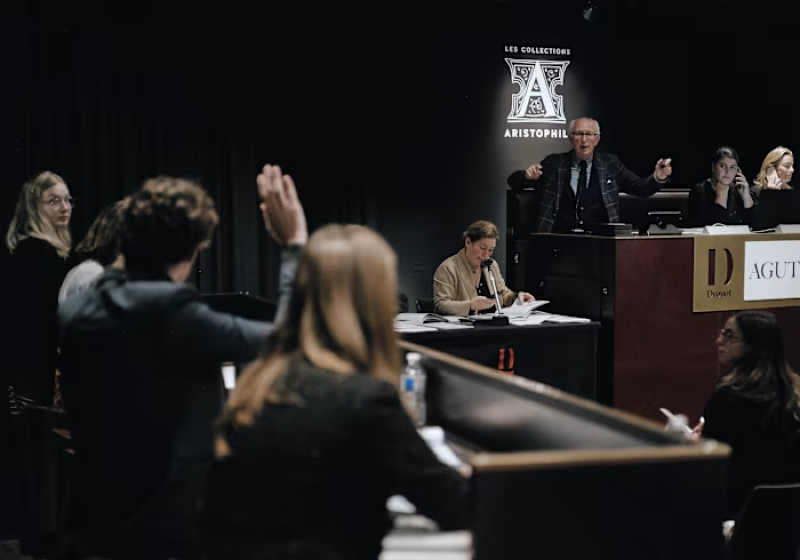
It was Gérard Lhéritier’s most amazing coup. The manuscript of Les 120 Journées de Sodome, the Marquis de Sade’s novel of sexual depravity and violence, had long been considered lost to French cultural heritage. Sade wrote it in 1785 while imprisoned in the Bastille for debauchery, by order of the king and at the request of his mother-in-law. He used his prison time fruitfully, to become a writer of plays, short stories and novels, and he composed The 120 Days of Sodom in tiny, meticulous characters on a strip made from 33 pieces of paper glued together. The scroll, which reached 12 metres in length, was rolled up and left hidden in his cell when he was evacuated just before the storming of the prison on July 14 1789. Lhéritier exhibited the scroll at the Museum of Letters and Manuscripts, which he had founded in Saint-Germain-des-Prés. He later sold the scroll for €12.5mn, divided into 2,500 shares at €5,000 each. (via the FT)
Note: This is a version of my When The Going Gets Weird newsletter, which I send out via Ghost, the open-source publishing platform. You can see other issues and sign up here.
Continue reading “Seven-foot-four basketball player trained as a Shaolin monk”
The seventh of May 1931 was a hot, dusty day in Kentucky. Alongside a dirt road, a service station manager named Matt Stewart stood on a ladder painting a cement railroad wall. His application of a fresh coat of paint was gradually obscuring the sign that had been painted there. The car skidded to a stop nearby. But it was not an armed man that emerged — it was three armed men. The driver of the car had been using this particular railroad wall to advertise his service station in town. Stewart leapt from his ladder, firing his pistol wildly as he dove for cover behind the railroad wall. One of the driver’s two companions collapsed to the ground. The driver picked up his comrade’s pistol and returned fire. Amid a hail of bullets from his pair of adversaries, the painter finally shouted, “Don’t shoot, Sanders! You’ve killed me!” The shooter was Harland Sanders, the man who would go on to become the world-famous Colonel Sanders. (via Damn Interesting)
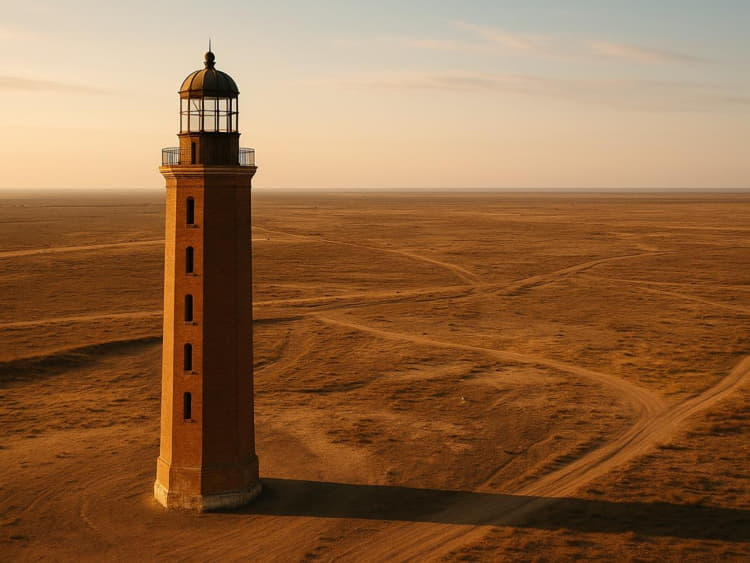
Driving through the steppes of Russia’s Astrakhan region, one of the last things you expect to see is a 20-storey brick lighthouse towering over the arid landscape. It’s the type of structure you normally see near the coastline, but in this case, the nearest coastline is about 30 kilometers (18.6 miles) away. Petrovsky Lighthouse is an architectural anomaly, but one that can easily be explained. In 1741, when Peter the Great of Russia commissioned the lighthouse, the entire area was a part of the Caspian Sea, with islands that housed a port where ships could moor. Originally made out of wood, the lighthouse collapsed during a serious storm and had to be rebuilt. It wasn’t until 1876 that the brick lighthouse was erected. The waters of the Caspian Sea had been receding for a long time, but at the beginning of the last century, the water in the area had become so shallow that the port had to be closed. Petrovsky Lighthouse continued to operate until 1930, by which time the Caspian Sea had receded completely. (via Oddity Central)
Note: This is a version of my When The Going Gets Weird newsletter, which I send out via Ghost, the open-source publishing platform. You can see other issues and sign up here.
Continue reading “This folksy fast-food icon had a few skeletons in his closet”
The year was 1957. The Cold War was in full swing. The U.S. was seemingly lagging behind in the technological arms race and needed to make a show, a display of power and prowess. Project Plowshare was a project in which the nation’s scientists were supposed to find something useful to do with all the nuclear expertise they had acquired throughout World War II and its aftermath. Scientists suggested that using nuclear bombs as huge shovels would offer the “highest probability of early beneficial success.” One such project was an attempt to release 300 trillion cubic feet of natural gas under the Rocky Mountains by blasting apart caverns more than a mile deep with a trio of 33-kiloton bombs. The project team wanted to blow a path for a railway line through California’s Bristol Mountains; use nukes to expand the Panama Canal; and they wanted to use underwater explosions to carve out a harbor in Alaska. (via The Smithsonian)
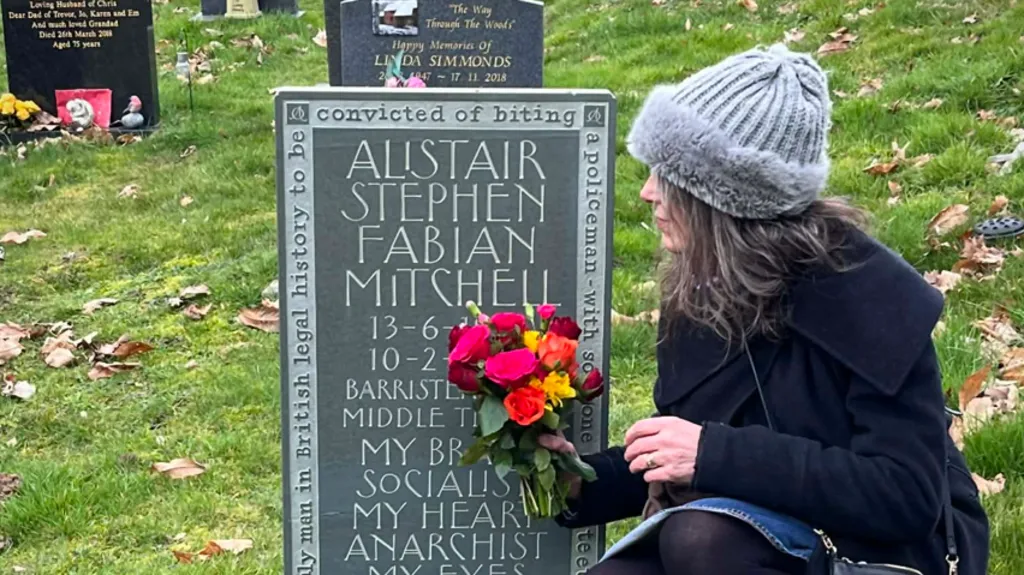
“The only man in British legal history to be convicted of biting a policeman with someone else’s teeth.” That is not an inscription you would imagine be on a gravestone, but it is, in a Shropshire cemetery. Is it true? Yes, says Alistair Mitchell’s widow, Alexandra Preston. Her husband spent time in two prisons before his conviction was quashed. She told the BBC the four years he spent fighting a charge which he knew was false inspired him to become a barrister. The story goes back to 1990 and one of the most violent UK protests of the late 20th Century. Mitchell found himself trapped in Whitehall during the disturbances and was arrested in Oxford Street. He was convicted for assault and a claim he had bitten a police officer. His defence team were able to compare the bite mark with a cast of Mitchell’s teeth to prove someone else’s were responsible. But he was still convicted and spent weeks in prison. (via the BBC)
Note: This is a version of my When The Going Gets Weird newsletter, which I send out via Ghost, the open-source publishing platform. You can see other issues and sign up here.
Continue reading “The US planned to use nuclear bombs for construction projects”