
Richard Dreyfuss and Jack Nicholson
Links that interest me and maybe you

From The Smithsonian: “In the summer of 1978. A helicopter was skimming the treeline a hundred or so miles from the Mongolian border when it dropped into a thickly wooded valley. Then the pilot saw something that should not have been there: a clearing, 6,000 feet up a mountainside, wedged between the pine and larch and scored with what looked like long, dark furrows. It was an astounding discovery. The mountain was more than 150 miles from the nearest settlement, and there were no records of anyone living in the district. The sight that greeted the geologists as they entered the cabin was like something from the middle ages. Jerry-built from whatever materials came to hand, the dwelling was not much more than a burrow, with a floor consisting of potato peel and pine-nut shells. It was cramped, musty and indescribably filthy, propped up by sagging joists—and, astonishingly, home to a family of five.”

From The Telegraph: “He is probably best known for his hit musical The Phantom of the Opera, but Andrew Lloyd Webber has disclosed that, in real life, he shared his home with the poltergeist of Eaton Square. The composer has told The Telegraph that a mischievous spirit took up residence in his home in Belgravia, central London. He eventually called on the services of a priest to persuade it to leave the 19th-century property. Lord Lloyd Webber mentioned the poltergeist when asked by The Telegraph whether any of the theatres he owns are haunted. Lloyd Webber said he had never seen a ghost, but added: “I did have a house in Eaton Square which had a poltergeist. It would do things like take theatre scripts and put them in a neat pile in some obscure room. In the end we had to get a priest to come and bless the house, and then it left.”
Note: This is a version of my personal newsletter, which I send out via Ghost, the open-source publishing platform. You can see other issues and sign up here.
Continue reading “Russian family was cut off from all human contact for 40 years”

From the WSJ: “University of Florida officials went back and forth with documentary filmmaker Jo Franklin, an alumnus, over details for a planned gala in her honor at the Four Seasons Hotel in Washington. She had pledged $2 million to her alma mater, and her guest list included the entire staff of the PBS NewsHour. A day before the gala, officials learned her seven-figure check had bounced. They boarded a flight to Washington, hoping to straighten everything out. The next day, they found out Franklin hadn’t arrived at the Four Seasons, and the credit card number that she gave the hotel wasn’t working. They soon found out that the school’s esteemed graduate, once a well-known journalist and documentary filmmaker, was a troubled but gifted fabulist. The $2 million gift was an illusion, one in a yearslong string of fantasies concocted by Franklin, who tumbled from a life of apparent success to homelessness.”
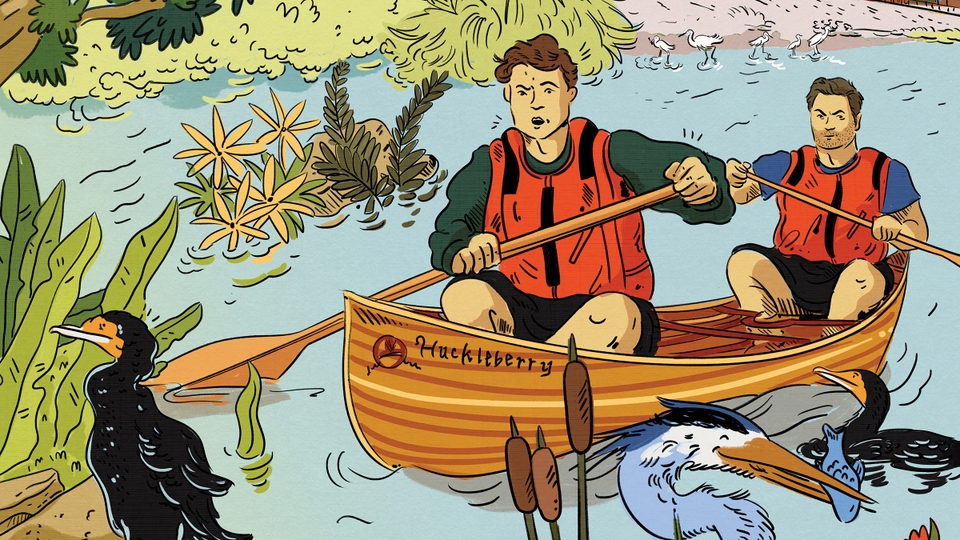
From Outside: “In the 25 years I’ve called the city my home, I’ve done a great many things that I would categorize as fun. I have, of course, worked as an actor. But I’ve also been paid to build various decks and cabins as a carpenter, plus one exquisite post-and-beam yoga studio. I worked as a production assistant on a few music videos, trained by a tall, handsome, surfing porn actor who taught me to get up and stay up. I constructed an octagon-style wrestling cage for an episode of Friends. I’ve hiked hundreds of miles of trails in Los Angeles County, some while hallucinating, but mostly sober and high on the views from Griffith Park, the San Gabriels, and the Santa Monica Mountains. The point is, the one thing I never dreamed I would do is launch my beloved handmade cedar-strip canoe, Huckleberry, into the concrete-clad L.A. River, just a few miles north of the location of the drag-race scene in Grease.”
Note: This is a version of my personal newsletter, which I send out via Ghost, the open-source publishing platform. You can see other issues and sign up here.
Continue reading “She talked like a millionaire but slept in a parking garage”
From Outside magazine: “Talon Vance, 13, lived in an apartment complex in suburban Colorado Springs with his mom and Aunt. Other relatives lived nearby. Typically, he spent much of the week with his father, half brother, half sister, and grandparents, all of whom lived together not far away in a different town. All of that would change in August 2022: Talon’s mother, Rebecca Vance, had hatched a plan to disappear from Colorado Springs and go permanently off-grid. Christine said to their stepsister that they would be heading into the wilderness to live off the grid. Rebecca had spent much of the pandemic glued to her computer, growing increasingly obsessed with conspiracy theories and the end of the world. She feared vaccines, technology, and the power of global elites, and thought the only escape was to get far away.”

From the NYT: “A childhood memory, from the family table in Mumbai, still plays on a loop in my mind: “Don’t waste your food,” my mother would admonish daily. “Too many starving children everywhere,” my father would chime in. Decades later, now living in New York City, I still can’t toss those leftovers. At least not like some of my friends do, with cool nonchalance, or like restaurants and shops regularly do when they’ve prepared too much. So, I decided to try Too Good To Go, one of several apps that connect eaters with unsold restaurant food. It claims to have 155,000 businesses, like restaurants and markets, that offer surplus meals, often discounted, to about 85 million users.”
Note: This is a version of my personal newsletter, which I send out via Ghost, the open-source publishing platform. You can see other issues and sign up here.
Continue reading “Why did she take her son and try to live off the grid during a Colorado winter?”
From Big Think: “Seven countries each have staked a claim to a slice of Antarctica, but all those claims have been frozen by the Antarctic Treaty of 1959. Together, those claims cover most of the continent at the bottom of the world — except Marie Byrd Land, which is the largest unclaimed territory in the world. At least, it was until 2001, when naval intelligence specialist Travis McHenry said he found a loophole in the Antarctic Treaty: While it prohibits countries from laying claim to parts of Antarctica, it says nothing about individuals. So, McHenry proclaimed himself consul-general of this freezing no man’s land. In 2004, McHenry upgraded the territory to a grand duchy and renamed it Westarctica, and crowned himself Grand Duke Travis I.”
:focal(1800x1200:1801x1201)/https://tf-cmsv2-smithsonianmag-media.s3.amazonaws.com/filer_public/93/cc/93cc832f-09f2-461f-9b96-e621a8841c77/opener-mar2024_e13_artfraud.jpg)
From the Smithsonian: “Norval Morrisseau was certain. “I did not paint the attached 23 acrylics on canvas,” he wrote to his Toronto gallery representative, who had sent him color photocopies of works that had recently sold at auction. Morrisseau, then in his late 60s and suffering from Parkinson’s disease, was the most important artist in the modern history of Canada’s Indigenous peoples—the “Picasso of the North.” By 2001, Morrisseau paintings routinely fetched thousands of dollars on the market. The works he now denied having painted were no exception. The auctioneer had advertised them as being from Morrisseau’s hand and claimed that he had no reason to doubt their authenticity—he had already sold 800 of them without a single buyer’s complaint.”
Note: This is a version of my personal newsletter, which I send out via Ghost, the open-source publishing platform. You can see other issues and sign up here.
Continue reading “He claimed part of Antarctica and then set up his own nation”
In May of 2023, agents from the FBI showed up at Tim Burke’s home in Tampa and seized several computers, hard drives, his cellphone, and other equipment that he uses as a freelance journalist. As I wrote for CJR, the reasons for the seizure were unknown at the time, because the affidavit the FBI used to justify the search was sealed. (It was later partially unsealed so Burke could see it for the purposes of his defense but has not been made public.) In an interview with me in 2023, Mark Rasch—Burke’s lawyer, and a former prosecutor with the Department of Justice—said the government seemed to believe that Burke somehow gained unauthorized access to a server and downloaded content he didn’t have explicit permission to access or copy. The problem, Rasch said, is that this description would also cover a wide range of normal journalistic activity.
Last week, Burke was indicted by a grand jury in Florida on fourteen charges, including conspiracy, accessing a protected computer without authorization, and intercepting or disclosing wire, oral, or electronic communications. The indictment accuses Burke and an unnamed person, referred to in the indictment as CONSPIRATOR 2, of using “compromised credentials” to gain unauthorized access to protected computers and then “scouring” those machines before ultimately “stealing electronic items and information deemed desirable,” in addition to intercepting and disclosing the contents of electronic video communications.
What reportedly triggered the initial investigation into Burke was the leak of behind-the-scenes footage of an interview conducted by Tucker Carlson, then a Fox News host, in which Kanye West, the musician now known as Ye, made some anti-Semitic remarks. That footage was among the video streams that Burke downloaded from a server normally used by broadcasters to distribute streams of their shows to affiliates and other outlets. As Rasch explained to me in 2023, many broadcasters livestream continuously, and these streams are in high definition and encrypted. However, many also use third-party services to distribute low-definition, unencrypted feeds.
Note: This was originally published as the daily email newsletter for the Columbia Journalism Review, where I am the chief digital writer
Continue reading “Indictment of Florida journalist raises troubling questions”
From Toronto Life magazine: “Amira and Nadya Gill were well-known on campus. The ambitious twins seemed to excel at everything they did. Amira was pursuing her master’s in civil engineering, and she was a reservist in the Canadian Armed Forces. Nadya, a former NCAA soccer player, juggled her duties as an assistant coach for the women’s soccer team with law school, and she was an associate editor for the Queen’s Law Journal, and a board member for the school’s student law society. Throughout their studies, they won a number of awards and scholarships. And everyone knew they were Indigenous, a status they wore with pride. But then some holes started appearing in their stories.”

From the SF Standard: “Jermaine Joseph, a city employee for the Port of San Francisco, was doing his maintenance rounds at Crane Cove Park on a sunny morning in May 2022 when he spotted something unusual: nearly 50 abandoned pieces of art arranged on a cement bench. “It was really strategically set out in a nice pattern,” he said. “And looking at the frames and the paper, you could tell someone put a lot of time into them.” Joseph knew the artworks had not been there for long—no morning dew had collected on them. But there was no evidence of an owner anywhere on-site. Thirty-eight of the 48 pieces—which included drawings, prints and paintings crafted with an obviously skilled hand—had variations of the name Ary Arcadie Lochakov.”
Note: This is a version of my personal newsletter, which I send out via Ghost, the open-source publishing platform. You can see other issues and sign up here.
Continue reading “She pretended her girls were Inuit and stole a fortune”A guy posted a tweet about a mural on a medical building that shows someone who presumably represents medicine fending off death, while holding a staff with wings at the top and two snakes wrapped around it. Pretty normal, right? Except that the staff with wings and two snakes has nothing to do with medicine at all — it’s called a “caduceus” and it’s associated with Hermes the messenger (or Mercury, if you are Roman instead of Greek), who is associated with commerce and other things. What this medical god should be holding is the rod of Asclepius, which has no wings and only one snake.

Despite this, lots of medical iconography, especially in the US, uses the caduceus instead of the rod of Asclepius. The US Marine Service started using it in 1857, and in 1902, it came to represent the US Army Medical Service and the US Public Health Service, which adopted it in 1881. Why did they choose the wrong one? Probably because it looks more impressive. After all, it’s got wings. And two snakes instead of just one. Way cooler 🙂
There are also theories that the two-snake rod became popular as a symbol representing medicine because early medications used mercury, and from there it became associated with pharmaceutical side of medicine, and then later was used to represent all of medicine. But some medical professionals don’t like to use the two-snake staff because it is primarily associated with commerce, rather than with the healing arts in general.

From The Guardian: “The last time Diane Foley spoke to her son Jim was in November 2012, when he called her at work in New Hampshire. Foley, a nurse practitioner at the clinic where her husband, John, was a doctor, was relieved to hear her son’s voice. A few months earlier, Jim had left the US for Syria to work as a freelance videographer. That decision, coming less than a year after he’d been kidnapped and detained for six weeks while reporting in Libya, horrified his family. A few weeks later, he was kidnapped by Islamic State. Eighteen months after that, Jim was beheaded by a masked terrorist, the video uploaded to social media and seen with horror all around the world. She never heard his voice again.”

From the New York Times: “Last Thanksgiving I was seated at the head of the dining room table with my family gathered around, enjoying our traditional feast. My sons, 18 and 20, piled their plates high. My mother worked her way through smaller portions and a glass of wine. And I held the hand of my love, who was seated next to me with tears in her eyes as she looked across the table at a woman, her contemporary, who was eating with the help of a caregiver. That woman is my wife, Bridget, aged 59. Before Alzheimer’s devoured Bridget’s neurons along with her essence, Thanksgiving was her favorite holiday. That evening was the first time she and my new partner ate at the same table.”
Note: This is a version of my personal newsletter, which I send out via Ghost, the open-source publishing platform. You can see other issues and sign up here.
Continue reading “After her son was beheaded she met one of his killers”

George Saunders is an author — his books include Tenth of December (a Finalist for the National Book Award) and Lincoln in the Bardo, which won the 2017 Man Booker Prize — and a professor in the creative writing program at Syracuse University. He writes a Substack newsletter called Story Club, and this comes from one of his responses to a would-be author’s letter:
“Even a person raised alone, fed by a machine, out in a cave somewhere, exists in this atmosphere of pressure – because that pressure is intrinsic to the human mind. The mind makes the pressure, the tension, the longing, the hope. We want this thing, we get it…and then we want more. We always feel slightly off, somehow. We find ourselves at peace but not the right kind of peace. And so on. This is what drama is, really: it comes out of the truth that nothing is ever enough for us, that every human situation (even a quiet one, even a happy one, even a deeply contented one) always teeters on the brink of change, because of the restlessness of the mind. And that right there is the stuff of literature.”

From The Economist: “New species are generally found rather than awakened. And they are typically discovered in remote places like rainforests or Antarctic plateaus. But not so a species of bacterium described in a paper just published in Extremophiles. The bug is new to science, but it is not new to Earth. In fact the microbe may have been slumbering for millions of years before being awakened. It lives below Lake Peigneur in southern Louisiana, which in 1980 had a salt mine and an oil-drilling rig run by Texaco. Then the two operations came together accidentally—and spectacularly, when the oil rig’s drill penetrated the third level of the salt mine, creating a drain in the lake’s floor.”

From Wikipedia: “The 23-year-old Yannis Alexis Mardas first arrived in England on a student visa in 1965, and moved into a flat on Bentinck Street, where he first met John Lennon. He found work as a television repairman, but also exhibited light-based artwork at the Indica Gallery, where he impressed Lennon with the Nothing Box: a small plastic box with randomly blinking lights that Lennon would stare at for hours while under the influence of LSD. Lennon later introduced Mardis as his “new guru,” calling him “Magic Alex,” and he told the Beatles he was working on a number of inventions, including a flying saucer. He became one of the first employees of the newly formed Apple Corps, earning £800 a week and receiving 10% of any profits from his inventions.”
Note: This is a version of my personal newsletter, which I send out via Ghost, the open-source publishing platform. You can see other issues and sign up here.
Continue reading “An ancient bacterium was awakened by an industrial accident”
From Strange Company: “On April 9, 1947, the town of Woodward, Oklahoma was slammed by a tornado. Hutchinson Croft was a successful sheep farmer who lived with his wife Cleta and their two children, Joan and Geri. The tornado flattened their home, killing Cleta, but four-year-old Joan and eight-year-old Geri were only slightly hurt and were brought to Woodward’s hospital. Later that night, as the Croft girls lay together on a cot, two men wearing khaki Army-style clothing came into the hospital basement announcing that they had come for Joan. The men told hospital staff that they were friends of the Croft family, and were taking Joan to Oklahoma City Hospital. But she never got there.”

From Now I Know: “The British Army dug a maze of defensive tunnels inside the Rock of Gibraltar during the Second World War, and part of that maze was something called the “Stay Behind Cave,” a two-story bunker. The first floor was a room with bare rock walls and a wooden floor, and up the stairs were two more rooms — a bathroom and a radio transmitting station. The plan was for six British soldiers stationed at Gibraltar to brick themselves into the Stay Behind Cave if Germany were to take over the Rock. The Cave was outfitted with enough supplies to last a year; after that, the soldiers were expected to bury each other in the floor — unless the army could save them beforehand.”
Note: This is a version of my personal newsletter, which I send out via Ghost, the open-source publishing platform. You can see other issues and sign up here.
Continue reading “She was taken in 1947 and no one knows why”