

If you are following the growing artificial intelligence industry at all, you’ve probably come across some facts and figures about how AI is going to use up all of the country’s water, while also using up all the power and causing prices to spike for regular non-AI using humans, and also that the giant data centers required for this industry are taking over all the usable land, and will cause pollution to soar, and/or lead to a wide range of other negative societal effects. I don’t think of myself as an apologist for AI — although I have written about how it can be useful for important things like medical research, and how using it as a tool for writing isn’t always a terrible thing — and it’s possible that anti-data-center arguments have some merit purely as an anti-billionaire measure, but at the same time, many of the arguments I’ve noted above simply aren’t rational. They may contain numbers that sound terrible — billions of gallons of water, megawatts of power, etc. — but when looked at rationally they tend to collapse.
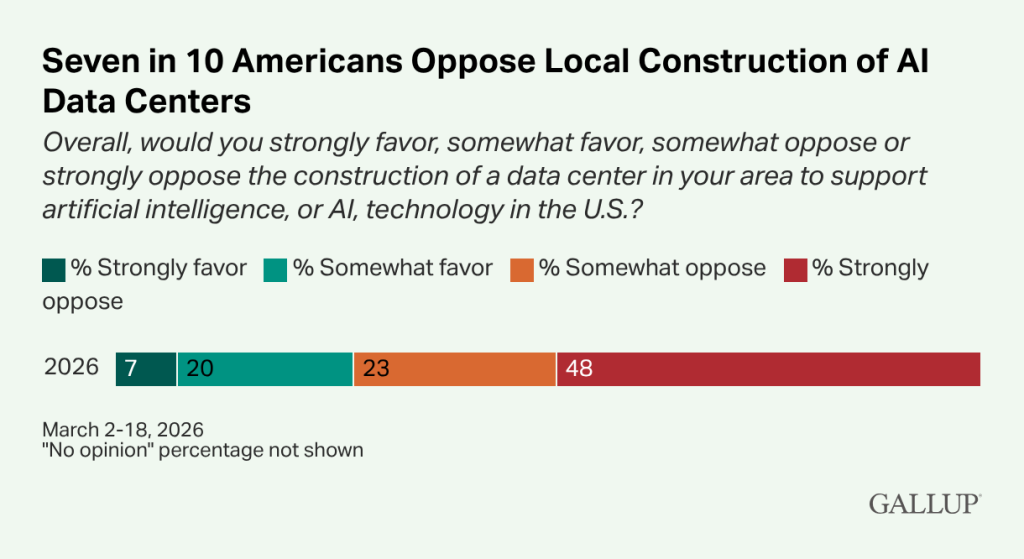
According to a recent Gallup poll, seven out of 10 Americans are opposed to the construction of data centers for artificial intelligence in their local area, and almost half of those surveyed were strongly opposed. In the same March survey, 53% of Americans say they oppose building a nuclear energy plant in their area, far less than the 71% opposed to data center construction. Since Gallup first asked the nuclear power plant question in 2001, the high point in opposition has been 63%. Half of opponents mention data centers’ excessive use of resources, including almost 20% mentioning either their use of water or energy. Sixteen percent mention a related environmental concern of pollution, including noise pollution and air and water pollution. Most of the remaining opposition stems from general or specific concerns about artificial intelligence.
If you want to keep up with the revolt against data centers, there’s a dedicated website called Data Center Watch, which says it is run by a “boutique research firm tracking the growing opposition to data center development.” According to the site, local residents blocked or delayed about 20 projects around the US in the second quarter of last year, representing nearly $100 billion in proposed investment. Residents across the US are attacking and/or trying to block data center projects, according to a report from the Wall Street Journal:
Note: This is a version of my Torment Nexus newsletter, which I send out via Ghost, the open-source publishing platform. You can see other issues and sign up here.
Continue reading “Data center criticism is based on bad science and scare quotes”