Hi there. My name is Mathew Ingram, and until recently I was the chief digital writer for the Columbia Journalism Review in New York. I live in Canada. I post things I've written for work here, but also a daily newsletter called When The Going Gets Weird, which you can find here, and one about technology and culture called The Torment Nexus.
From the WSJ: “A tiny Pentagon office had spent months investigating conspiracy theories about secret Washington UFO programs when it uncovered a shocking truth: At least one of those theories had been fueled by the Pentagon itself. The congressionally ordered probe took investigators back to the 1980s, when an Air Force colonel visited a bar near Area 51, a top-secret site in the Nevada desert. He gave the owner photos of what might be flying saucers. The photos went up on the walls, and into the local lore went the idea that the U.S. military was secretly testing recovered alien technology. But the colonel was on a mission—of disinformation. The photos were doctored, the now-retired officer confessed to the Pentagon investigators in 2023. The whole exercise was a ruse to protect what was really going on at Area 51: The Air Force was using the site to develop top-secret stealth fighters, viewed as a critical edge against the Soviet Union. Military leaders were worried that the programs might get exposed if locals somehow glimpsed a test flight of, say, the F-117 stealth fighter, an aircraft that truly did look out of this world. Better that they believe it came from Andromeda.”
There’s a Japanese art that is like bonsai but for rocks instead of trees
From Why Is This Interesting: “Suiseki, the Japanese art of collecting and displaying viewing stones, is centuries old, and originated in China. There, the art form is known as gongshi (“scholar’s stones”) and seeks to provide viewers with stones selected for their tasteful asymmetry, evocative textures, and even resonance when struck. In Suiseki, the stones are similarly chosen for their majesty and evocative qualities, representing landscapes and objects. Much like bonsai, the presentation of these viewing stones is part of their narrative allure. Known as daiza, their bases seek to present the stones in various ways: nestled in sand, perched in custom dishes, or placed in specially carved wooden bases, the stone’s natural grooves gracefully seating in the recess. A suiseiki is traditionally a part of a set, and alongside its base is its storage box (kiri-bako), which often includes the stone’s place of origin (such as the Kamo river), and lineage of historical provenance. Having a complete set commands a premium for collectors, with a recent furuyaishi stone fetching $38,000 at auction.”
Note: This is a version of my When The Going Gets Weird newsletter, which I send out via Ghost, the open-source publishing platform. You can see other issues and sign up here.
This isn’t an AI newsletter per se, in the sense that I don’t always write about it. That said, however, I do write about it fairly often, mostly because I don’t think there’s anything else happening right now — apart from maybe crypto — that blends the surprising and the terrifying and the confusing and the potentially evil so perfectly as AI. That’s the Torment Nexus sweet spot! (You can find out why I called the newsletter that in this post, in case you don’t know the story already). Is the kind of artificial intelligence — or whatever you want to call it — that we see all around us now an incredible technological advancement? No doubt about it. Regardless of what you think of AI’s current abilities or potential, it’s still mind-boggling to think of how far we have come in the three years since ChatGPT and other tools first appeared on the scene. Are they intelligent in any real sense of that word? Sure. Are they conscious? Who knows. Is AI an unalloyed good? Of course not. Does it spell doom for mankind as we know it? Maybe, but probably not.
I’m not here to take sides in the “Is AI Good Or Evil” debate, to be honest. There are people much smarter than me who already have both sides of that covered, and most of them (although not all) have a much deeper understanding of the technology and its limits than I do. In fact, one of the things I find so fascinating about AI right now is that there is so much disagreement even within the field itself, and even among those who helped create the technology we are currently using, like former University of Toronto professor and former Google AI staffer Geoffrey Hinton and Meta chief technologist Yann LeCun and McGill University lecturer Yoshua Bengio. Are we close to AGI? Geoff says yes, Yann says no (and prominent AI critic Gary Marcus says hell no). Does AI pose a mortal danger to humanity as we know it? Yoshua and Geoff both say yes, Yann says no. I’ve written about this before, and also about the question of AI and consciousness.
In the same vein, I was interested to see two recent studies of AI that seemed to point in completely opposite directions. In one, published by Apple’s Machine Learning Research project and titled The Illusion of Thinking, scientists raised some significant doubts about AI’s “intelligence,” pointing out that even the latest more sophisticated AI engines from companies like OpenAI and Anthropic and DeepSeek couldn’t solve — or took much longer than they should have to solve — a puzzle that an eight-year-old could probably figure out without too much trouble (a block and peg puzzle known as the Tower of Hanoi). They seemed to have a tough time with some other simple puzzles as well, including the “river crossing” puzzle, in which the test subject has to get three conflicting objects (fox, chicken, and bag of grain) from one bank to another even though they can only take two at a time. In fact, the AI engines had difficulty even after the researchers gave them clues that pointed towards the solution! Here’s a summary of the paper:
Note: This is a version of my Torment Nexus newsletter, which I send out via Ghost, the open-source publishing platform. You can see other issues and sign up here.
From the Journal of Urology: “First century Rome saw the introduction of vectigal urinae, a tax introduced by Roman emperor Vespasian for the collection and distribution of urine, an expensive raw commodity. It was used in the tanning industry, where it was mixed with the hide to soften it, loosen the hairs and dissolve the fat. It was also used as bleach where tunics were immersed in urine and whitened. Wealthy Romans were willing to pay large sums of money for toothpaste in which urine was the key ingredient. It was thought that Roman urine would not be effective but rather Portuguese urine provided an ideal whitening effect, and so large quantities of the ‘stronger’ Portuguese urine were imported for this purpose. It is said that when Vespasian’s son Titus protested against the vectigal urinae, his father held up a gold coin and said “It doesn’t smell!” To this date, Vespasian’s name is associated to public urinals in France (vespasiennes), Italy (vespasiani), and Romania (vespasiene).”
In 1935 the US Army bombed a Hawaiian volcano to stop the lava flow. But did it?
From the USGS: “The eruption in question began on November 21, 1935. Six days later, an unusual breakout at an elevation of 8,500 feet on the north flank of Mauna Loa sent lava to the north. On December 23, fearing that the flow would reach the headwaters of the Wailuku River, which supplied water for the town of Hilo, Thomas Jaggar, founder of the Hawaiian Volcano Observatory, called on the Army Air Service to bomb the lava flow source. His hope was that the lava tubes or channels could be destroyed, thereby robbing the advancing flow while feeding another flow that would re-cover the same area. The flow was bombed on December 27, and lava stopped flowing during the night or early morning of January 2, 1936. Jaggar publicly praised the Army for its responsiveness and technical accuracy in delivering the bombs to his selected targets. In turn, Jaggar was praised for his successful experiment and saving Hilo. But at least one scientist questioned the effectiveness of the bombing.”
Note: This is a version of my When The Going Gets Weird newsletter, which I send out via Ghost, the open-source publishing platform. You can see other issues and sign up here.
From SFGate: “The evidence of Petro Zailenko’s quiet legacy can be found all over this corner of the Northern California redwood forest. Signs throughout Hendy Woods State Park, nestled deep in Mendocino County’s Anderson Valley along the Navarro River, bear his name and facts — or theories, at least — about him. They say he was a Russian immigrant born in 1914 who may have been wounded and captured by Nazis during World War II. They say that in the late 1950s or early 1960s, he jumped ship from a Russian fishing trawler in San Francisco and made his way north to Anderson Valley. There, he briefly worked at a lumber mill — until, apparently, someone asked to see his immigration papers. That’s when Zailenko fled into the woods, afraid he’d be deported. For the next 18 years, he lived among the redwoods and came to be known locally as the Hermit of Hendy Woods. When he died, the coroner listed his occupation as hermit and his address as a “Hollowed out tree stump in Hendy Woods State Park.”
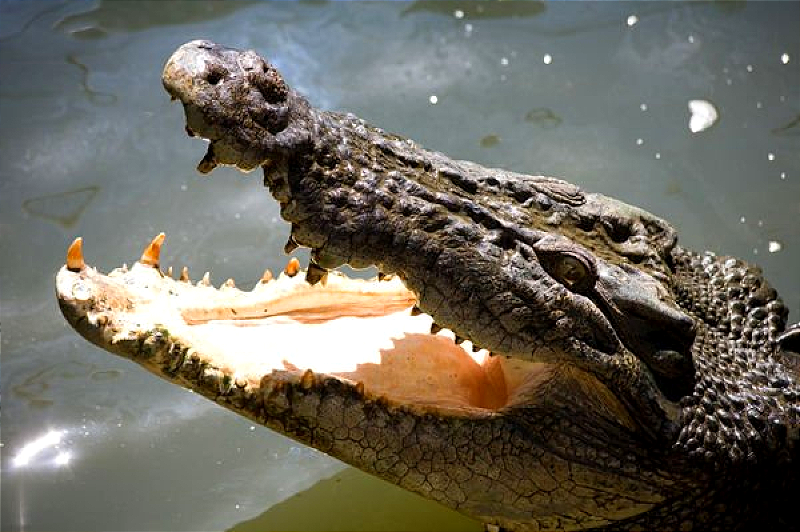
Crocodiles have an extra aorta in their hearts to help them digest their huge meals
From ABC.au: “Crocodiles and alligators eat so much in a single meal that they need to divert gas-rich blood away from their lungs into their stomachs to digest it, US research suggests. The study, which was conducted in American alligators, shows they can eat 23% of their own mass at once. This is equivalent to a 60 kilogram woman eating 14 kilograms of beef – bones, teeth and all – in one sitting. The scientists focused on the extra left aorta that crocodilians have on the side of their otherwise very mammal-like hearts. Normally, blood pumped by the right side of the heart flows through the reptile’s pulmonary artery into the lungs, where a transfer of carbon dioxide occurs. But when a crocodile or alligator gorges this blood is shunted to the stomach instead. There, the carbon dioxide is converted into gastric acid, a digestive juice, and bicarbonate, which functions as a sort of built-in antacid when the time is right. The gastric acid boost means crocodilians produce 10 times more digestive juice than mammals.”
Note: This is a version of my When The Going Gets Weird newsletter, which I send out via Ghost, the open-source publishing platform. You can see other issues and sign up here.
From Tempo de Conhecer: “There is a book whose reading — or mere possession — proved fatal for many. Not because it contained subversive ideas but because the object itself was deadly. It is a 19th-century book known as Shadows from the Walls of Death — a dark title for an even more lethal content. The work was published in 1874 by Robert Kedzie, a physician and professor of chemistry in the United States. His goal was not to kill, but to warn. At the time, many household wallpapers contained arsenic-based pigments, especially the famous “Paris green.” The problem was that, over time and with humidity, these pigments released toxic gases, such as arsine, which could cause headaches, vomiting, seizures, and even death. Kedzie collected 86 authentic samples and bound them into a book. People who handled the book without protection began to fall ill, and there were reports of deaths linked to direct exposure to the book’s pages.”
We breathe through only one nostril at a time but scientists aren’t sure why
From Medical Discovery News: “most people don’t realize that when you breathe through your nose, you do so more from one nostril than the other and your body knows to switch to the other nostril every few hours. This nasal cycle is controlled by the autonomic nervous system which also controls things we don’t think about like heart rate and breathing. Our bodies deliberately send more blood to an erectile tissue between the two nostrils to increase its size and direct the air flowing through one of the nostrils. After a few hours, the airflow switches to the other nostril. Why do we do this? Some scientists believe the alternating airflow allows each nostril to maintain optimal moisture levels so no one side gets dried out. It may also protect against respiratory infections or allergies. Others believe it’s tied to our olfaction or sense of smell. It’s possible that the quicker and slower airflow in each nostril optimizes us to the vast range of smells. Some smells take longer to detect and transmit to the brain.
Note: This is a version of my When The Going Gets Weird newsletter, which I send out via Ghost, the open-source publishing platform. You can see other issues and sign up here.
A Canadian legend passed away this week when former Canadian astronaut and cabinet minister Marc Garneau died at the age of 76, after a battle with not just one type of cancer but two (lymphoma and leukemia), both of which he was diagnosed with earlier this year. He was a former combat engineer in the Canadian Navy and became the first Canadian to go into space in 1984 on the space shuttle Challenger, and after that became the president of the Canadian Space Agency and a mentor to all the Canadian astronauts that followed, including everyone’s favourite singing astronaut, Chris Hadfield. After that he was elected as a member of Parliament and served in a variety of roles for 14 years, including as Transport Minister and Minister of Foreign Affairs.
In a previous lifetime, when I was a reporter with the Globe and Mail newspaper in Toronto, I got to spend some time with both Marc Garneau and Chris Hadfield at Kennedy Space Center in Florida in 2005, for what was referred to as the “Return To Flight” mission — the launch of STS-114, the first shuttle to be sent up after a hiatus of more than two years, following the loss of the space shuttle Columbia, which exploded on re-entry in 2003. As part of the 2005 mission, Macdonald Dettweiler — creator of the original Canadarm, or what was officially known as the Shuttle Remote Manipulator System — spent a lot of time and money expanding the arm’s capabilities, adding a sophisticated camera so that it could scan almost the entire exterior of the shuttle, to see if there were any gaps in the tiles or other anomalies that might cause it to explode.
I attended a number of briefings at MDA’s offices in Toronto, at least one of which was given by my Chris Hadfield, who at the time had been up in space twice and was the first Canadian to do a spacewalk. In July of 2005 I flew down to Florida and drove to Cocoa Beach, a tiny surfing town off the coast about 15 kms south of Kennedy Space Center, known for surfing and for being the home of the sexy genie in the TV show I Dream of Jeannie. By sheer coincidence, I wound up staying at what I thought was a nondescript chain motel, but turned out to be a motel that used to be owned by the five original Apollo astronauts. The story I heard (which I never confirmed) was that they used to stay across the street at the Holiday Inn, and then a friend said that if the whole space thing took off they might want their own hotel, so they built one. The only evidence was a small plaque out by the tiny swimming pool.
From PBS: “It was Coney Island in the early 1900’s. Beyond the Four-Legged Woman, the sword swallowers, and “Lionel the Lion-Faced Man,” was an entirely different exhibit: rows of tiny, premature human babies living in glass incubators. Barkers, including a young Cary Grant, called out to passersby, enticing visitors to come see the preemies. Visitors paid a few coins to enter and would approach rows of incubators along the wall, peering through the glass windows at the tiny, shriveled preemie babies living inside. The brainchild of this exhibit was Dr. Martin Couney, an enigmatic figure in the history of medicine. A French-born doctor, Couney created and ran incubator-baby exhibits on the island from 1903 to the early 1940s, and though he died in relative obscurity, he is credited with saving the lives of thousands of the country’s premature babies.”
A park ranger on a hike in Texas accidentally discovered a brand new genus of plant
From Atlas Obscura: “Cathy Hoyt, the supervisory park ranger for Big Bend National Park, and volunteer botanist Deb Manley go for walks together once a month around Big Bend, which is in western Texas near the Mexico border. It’s a big park – over 800,000 acres. So in early March of 2024, they went out on their regular monthly walk to go look at some plants, but then they saw something they didn’t recognize. It was very small, less than the size of a quarter, tiny and fuzzy, with little ribbon-like flowers sticking up out of the middle that had pink and white stripes on them. So the first thing Manley did was consult a guidebook to plants in the area called, Flowering Plants of Trans-Pecos Texas and Adjacent Areas. But it wasn’t in there. Then she tried putting photos of this fuzzy little plant up on an app called iNaturalist, but nobody recognized it.”
Note: This is a version of my When The Going Gets Weird newsletter, which I send out via Ghost, the open-source publishing platform. You can see other issues and sign up here.
I had never heard the name Drew Struzan before, but I certainly know his work — he has painted almost every iconic movie poster I can remember from my misspent youth, including the early Star Wars posters, one for the original Blade Runner, plus posters for everything from Raiders of the Lost Ark and The Goonies to Hook and Hellboy and The Shawshank Redemption. Apparently he is 78 years old and his Alzheimer’s has progressed to the point where he can no longer draw or paint, which is sad.
About his career, Struzan has said: “I was poor and hungry, and illustration was the shortest path to a slice of bread, as compared to a gallery showing. I had nothing as a child. I drew on toilet paper with pencils – that was the only paper around. Probably why I love drawing so much today is because it was just all I had at the time.” In addition to movie posters he would also create album cover artwork for a long line of musical artists, including Tony Orlando and Dawn, The Beach Boys, Bee Gees, Roy Orbison, Black Sabbath, Glenn Miller, Iron Butterfly, Bach, Earth, Wind & Fire, and Liberace.
Struzan once lamented on the decline of traditional art in an e-mail exchange:
I love the texture of paint made of colored earth, of oil from the trees and of canvas and paper. I love the expression of paint from a brush or a hand smearing charcoal, the dripping of paint and moisture of water, the smell of the materials. I delight in the changeable nature of a painting with new morning light or in the afternoon when the sun turns a painting orange or by firelight at night. I love to see it, hold it, touch it, smell it, and create it. My gift is to share my life by allowing others to see into my heart and spirit through such tangible, comprehensible and familiar means. The paint is part of the expression.
From Der Spiegel: “It’s two hours after midnight. The extreme mountaineer Kristin Harila is trudging through the death zone on K2, the second tallest mountain in the world, following the beam of her headlamp. To her left, the mountainside plunges almost vertically, hundreds of meters into the depths. Above her on the right is an enormous hanging glacier groaning and cracking menacingly in the freezing cold. She is only about 400 meters from the top. One final steep ascent and Harila will have reached her goal. The Norwegian woman is aiming to complete a staggering, record-breaking project. Within just three months, she has climbed all of the highest mountains in the Himalaya and Karakorum. When she reaches the peak of K2, Harila will have summitted all 14 8,000-meter peaks on the planet, faster than anyone ever before. But suddenly, their path is blocked. A man is hanging there from a rope. He is upside down.”
Scientists have discovered a superconductor hidden inside pencil lead
From SciTechDaily: “MIT scientists have identified a bizarre new material: a superconductor that also acts like a magnet. Using a special stacking of graphene layers from graphite, they observed this dual behavior — something thought to be impossible until now. For over a century, scientists believed that magnets and superconductors were fundamentally incompatible, like mixing oil with water. But a groundbreaking discovery from MIT physicists is now turning that idea on its head. In a recent study published in Nature, the research team revealed something remarkable: a new material called a chiral superconductor. It carries electricity with zero resistance, and it’s magnetic. This strange combination has never been observed in such a direct way before. Even more surprising? The researchers found this exotic behavior in a very familiar substance: graphite, the same material used in ordinary pencil lead.”
Note: This is a version of my When The Going Gets Weird newsletter, which I send out via Ghost, the open-source publishing platform. You can see other issues and sign up here.
I’ve never met Marc Andreessen, although at one time in the distant past we were Twitter friends — I enjoyed the long threads he used to do, and I wrote about a few of them at Gigaom in a previous lifetime (including one about how newspapers should “burn the boats” by getting rid of their print operations). I recall thanking him a number of years ago on the anniversary of the creation of Mosaic, the first graphical web browser, something I also wrote about recently at The Torment Nexus. And I’ve been thinking a lot lately (as I’m sure many other people are) about the future of the open web — something I also wrote about in another recent Torment Nexus newsletter. So it was interesting to come across an interview that Andreessen did with his a16z co-founder Ben Horowitz, in which he talked about his life before the web, and how he came to work at the National Center for Supercomputing Applications in Illinois, which started him on the path towards eventually becoming a billionaire venture capitalist.
I’m aware that being a billionaire — especially a tech billionaire — is somewhat problematic in this day and age, for a variety of reasons, and I know that some people think Marc is an bad person for other reasons. I don’t really have much to say about any of that, except to say that I don’t think being wealthy is inherently bad (although many wealthy people seem determined to prove me wrong), and I have no idea whether he is using his money for good or evil, or some combination of the two. All I know is that his invention of a graphical web browser (and subsequent iterations of it, like Netscape) changed my life, as it changed millions or possibly billions of other people’s lives around the world. So it was interesting to me to hear about how it came about, and along the way it reinforced one of my mottos, which is a variation on “better to be lucky than smart.” My version is: “it’s better to have good timing than be smart, but if possible, do both.”
Andreessen was clearly a good programmer, but he also happened to be in exactly the right place at the right time, and he hitched his wagon to an unassuming rock that would become a hurtling meteor, namely the internet and Tim Berners-Lee’s invention of hyperlinking and the web. This is reinforced throughout his discussion with Ben. As both note, he was a farm kid from the boonies in Wisconsin, more familiar with tractors than programming. But he was interested in computers and wound up at the University of Champaign-Urbana in Illinois and got a job at the NCSA, where they had some of the best computers — and the best internet connectivity — in the world. So there’s young Marc, using a Unix workstation that cost $50,000 in 1992 dollars (equivalent to about $115,000 now), with a fat internet connection from the NSFnet, which he gives credit to former vice-president Al Gore for helping to create.
Note: This is a version of my Torment Nexus newsletter, which I send out via Ghost, the open-source publishing platform. You can see other issues and sign up here.
From the New York Times: “Interpol had been looking for a disgraced finance executive for weeks when Christo Grozev, an investigative journalist, found him, hiding in Belarus. He identified the secret police agents behind one of the most high-profile assassination plots of all: the 2020 poisoning of the Russian opposition leader Aleksei Navalny. That revelation put Grozev in President Vladimir Putin’s cross hairs. He wanted Grozev killed, and to make it happen the Kremlin turned to none other than the fugitive financier, who had been recruited by Russian intelligence. The fugitive enlisted a team to begin the surveillance. The members of that team are behind bars now. The financier lives in Moscow, where several times a week he makes visits to the headquarters of the Russian secret police. Grozev — still very much alive — imagines the man trying to explain to his supervisors why he failed in his mission.”
He won the Nobel Prize for physics and then he changed his mind
From The Atlantic: “Adam Riess was 27 years old when he began the work that earned him the Nobel Prize in Physics, and just 41 when he received it. Earlier this year, Riess, who is now 55, pulled a graph-paper notebook off a bookshelf in his office at Johns Hopkins University so that I could see the yellowing page on which he’d made his famous calculations. He told me how these pen scratches led to a new theory of the universe. And then he told me why he now thinks that theory might be wrong. For nearly a century, astronomers have known that the universe is expanding, because the galaxies that we can see around us through telescopes are all rushing away. Riess studied how they moved. He very carefully measured the distance of each one from Earth, and when all the data came together, in 1998, the results surprised him. The galaxies were receding more quickly than expected. This “immediately suggested a profound conclusion,” he said.
Note: This is a version of my When The Going Gets Weird newsletter, which I send out via Ghost, the open-source publishing platform. You can see other issues and sign up here.
From MIT: “Arnhildur Pálmadóttir was around three years old when she saw a red sky from her living room window. A volcano was erupting about 25 miles away from where she lived on the northeastern coast of Iceland. Though it posed no immediate threat, its ominous presence seeped into her subconscious, populating her dreams with streaks of light in the night sky. Fifty years later, these “gloomy, strange dreams,” as Pálmadóttir now describes them, have led to a career as an architect with an extraordinary mission: to harness molten lava and build cities out of it. Pálmadóttir today lives in Reykjavik, where she runs her own architecture studio and the Icelandic branch of the Danish architecture company Lendager, which specializes in reusing building materials. The architect believes the lava that flows from a single eruption could yield enough building material to lay the foundations of an entire city. She has been researching this possibility for more than five years as part of a project she calls Lavaforming.”
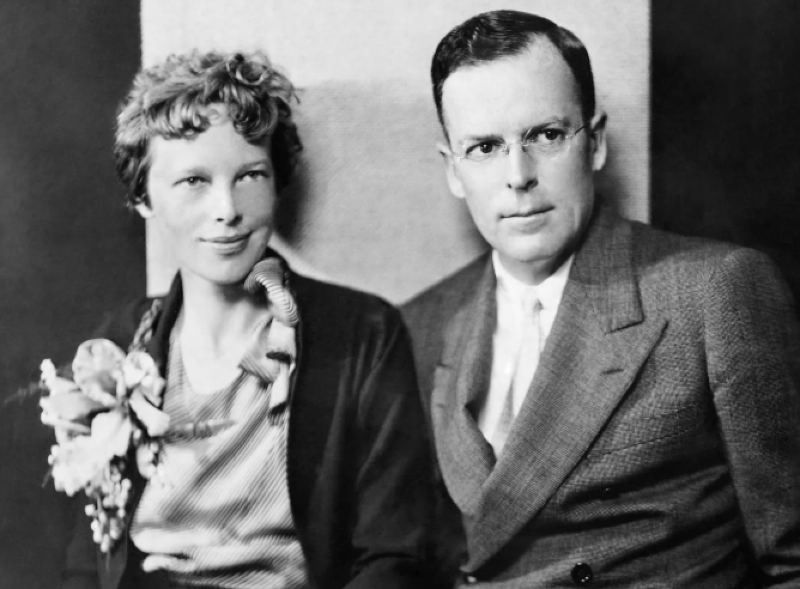
Amelia Earhart was pushed to make riskier flights by her publicity-hungry husband
From The New Yorker: “Rather then spending time practicing in the powerful Electra, Earhart had been crisscrossing the country, giving lectures, making sponsorship appearances, and attending promotional events. For a while, she had a gig as the aviation editor at Cosmopolitan, in which she published a column about flying; she also launched a line of pilot-inspired women’s clothing. Seen from today’s perspective, Earhart was at once a pioneering aviator and a proto-influencer. Her husband of half a dozen years, George Palmer Putnam publicly blamed a blown tire, skirting any mention of pilot error. An heir to the Putnam publishing empire, he was more than Earhart’s husband; he was her manager, dealmaker, and publicist. Some found him dashing, but others thought of him as a hustler. He’d launched Earhart into fame with that Atlantic crossing in 1928 with the intention of publishing a quickie memoir.”
Note: This is a version of my When The Going Gets Weird newsletter, which I send out via Ghost, the open-source publishing platform. You can see other issues and sign up here.
From Damn Interesting: “Paris, 29 May 1832. All through the night, a young Frenchman named Évariste Galois stayed awake, quill in hand, frantically scrawling notes and equations across dozens of sheets of paper. He had only been studying mathematics seriously for a few years, but he had proven to be a veritable prodigy. After quickly exhausting the knowledge of his teachers, he’d branched out into his own research, extraordinarily prescient. By all rights, Galois ought to have been lauded and laurelled by the scientific community for his work. Above all, he should have been recognised and rewarded by France’s prestigious Academy of Sciences. But Galois—at least, by his own reckoning—had received little but dismissal from the mathematics community. Now he sat feverishly scribbling, trying to commit as many of his ideas to paper as possible.”
Williams Syndrome is like reverse autism: people who have it are almost too friendly
From the BBC: “Imagine walking down the street and feeling an overwhelming love and warmth for every single person that you met. That is a familiar experience for people with Williams Syndrome, a rare genetic condition that affects approximately 1 in 7,500 individuals. People with WS, often dubbed the ‘opposite of autism’, have an innate desire to hug and befriend total strangers. They are extremely affectionate, empathetic, talkative and gregarious. But there is a downside to being so friendly. Individuals often struggle to retain close friendships and are prone to isolation and loneliness. People with WS are also sometimes too open and trusting towards strangers, not realising when they are in danger, leaving them vulnerable to abuse and bullying. “It’s very easy for someone to fool a person with Williams Syndrome and take advantage of them, because they are so trusting,” says Alysson Muotri, a professor of paediatrics and cellular and molecular medicine at the University of California.”
Note: This is a version of my When The Going Gets Weird newsletter, which I send out via Ghost, the open-source publishing platform. You can see other issues and sign up here.
From The Guardian: “A Chinese paraglider who was accidentally propelled more than 8,000 metres high by an updraft has been banned from the activity for six months after a video of his ordeal went viral. Peng Yujiang began from an elevation of about 3,000m in the Qilian mountain range in northern China, where he intended to test a new second-hand equipment purchase without making a proper flight, according to an investigative report by the Gansu Provincial Aviation Sports Association. However about 20 minutes into his practice he was caught in a strong updraft, which sent him soaring more than 5,000m higher, in line with flight paths and nearly the height of Mount Everest. Video from Peng’s mounted camera showed him above the clouds and covered in icicles as the temperature dropped to a reported -35C, as he tried to control his equipment.”
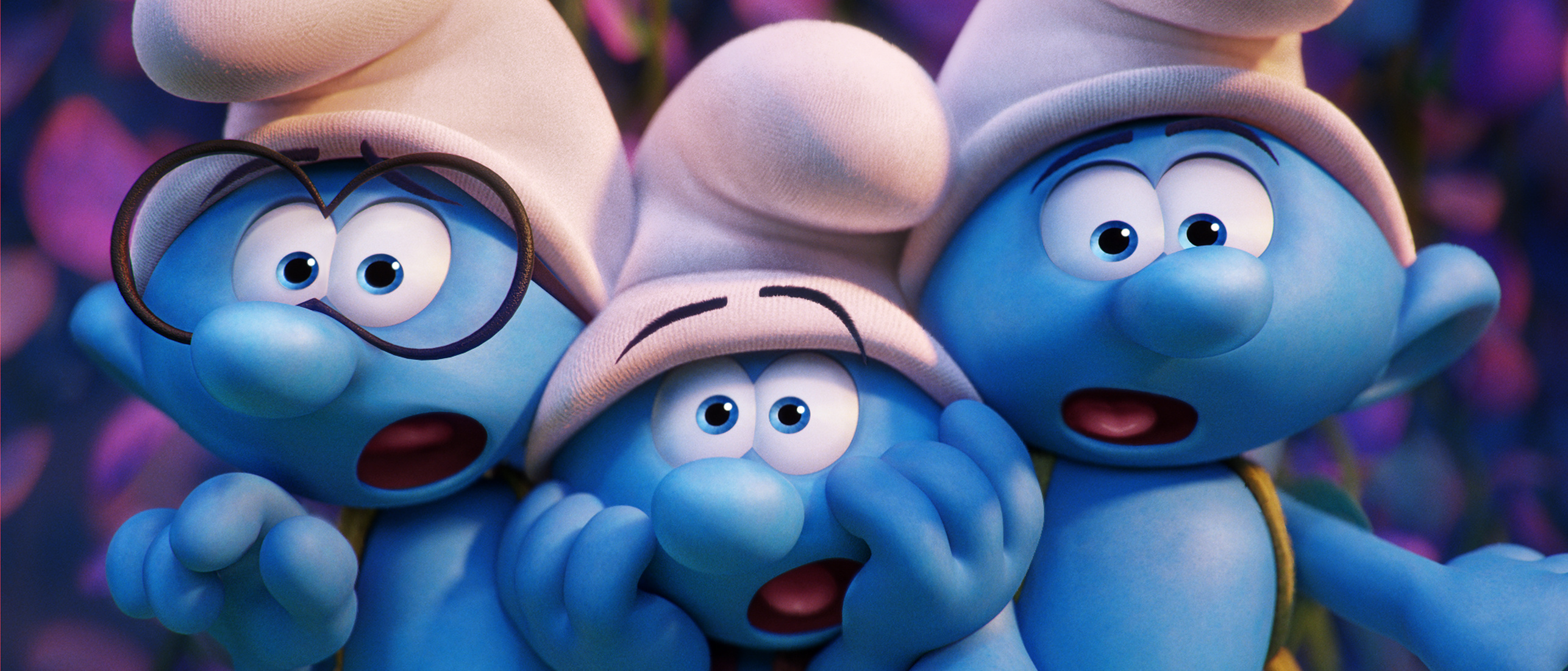
The hats that Smurfs wear are connected to freed slaves and ancient Rome
From Pipeline Comics: “The hat that Smurfs wear, with a peak that is slumped over, isI called a Phrygian cap, and this style of headgear is over 2000 years old. Phrygis, in case your curious, is the name of an ancient group of people who lived in the Balkans region of eastern Europe — Greece, Turkey, Romania, etc. Their language and culture went extinct by the 5th century AD. Near the end, the Romans thought of them as being lazy and dull. The hat was adopted during the French Revolution as “the red cap of liberty” by the revolutionaries. And while the artist Peyo — creator of the Smurfs — was Belgian, he was working with French publishers, so drawing inspiration from a French symbol isn’t too crazy. The thing that Peyo maybe didn’t realize and the French revolutionaries definitely didn’t realize, though, is that it’s the wrong hat.”
Note: This is a version of my When The Going Gets Weird newsletter, which I send out via Ghost, the open-source publishing platform. You can see other issues and sign up here.
From the New York Times: “Kelly Wakefield, a professional gardener, was doing her spring cleanup of a public park in St. Albans, Vt., when she stumbled upon a mysterious metal box under a pile of leaves. She shook the box and heard the telltale jangle of coins. She opened the metal box and was floored by the bounty inside. She ran to her truck and drove straight to her mother’s house. What exactly had she found? Was any of it real? Did she need a lawyer? Wakefield, 46, soon learned that she had stumbled upon a treasure chest intentionally hidden by Michael Cloherty O’Connell, the author of two history books that led readers on scavenger hunts around the Northeast. The box contained coins, antiques, a Civil War-era bullet, a map and a note from the author himself. It is now in a safe deposit box, Wakefield said, and has yet to be appraised.”
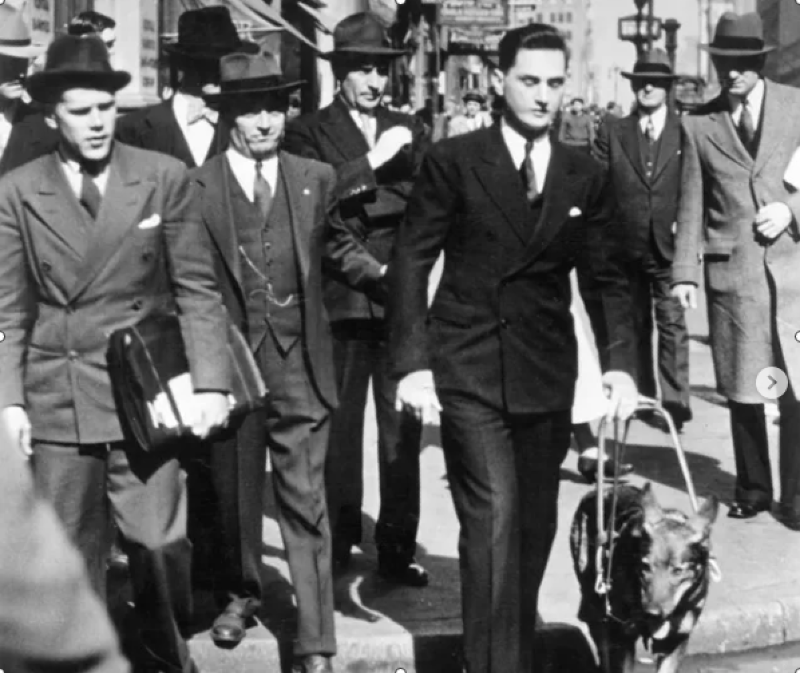
Why we call dogs that are trained to help the blind “seeing eye” dogs
From Neatorama: “Have you ever wondered why a blind person’s guide dog is called a seeing eye dog instead of just a guide dog? That’s because they came came from the organization The Seeing Eye, founded in 1929 by Morris Frank. Frank lost his sight in one eye at age six, and the other at 16. He heard about an innovative program in Germany that trained dogs to guide blind people. Frank ended up going to Switzerland to work with dog trainer Dorothy Harrison Eustis and came back with a female German shepherd he named Buddy. The real innovation in training Buddy and other guide dogs was “intelligent disobedience.”Buddy was trained to disregard her owner’s commands when the situation called for it, such as in dangerous traffic. In 1928 Frank gave a demonstration in New York City to show reporters how Buddy could guide him safely in walking through Manhattan. The next year, Frank and Eustis opened the dog training program that’s still in operation today.”
Archeologists studied a Da Vinci sketch and found secret tunnels underneath a castle
From Popular Mechanics: “The artworks of Leonardo da Vinci are vast and storied. But even amongst such a well-studied body of work, there can still be a few surprises left to discover. And recently, a team of researchers discovered one of those surprises — one drawing of a castle tunnel from a 1400s-era castle. The drawing was of Sforza Castle, and it included depictions of numerous underground tunnels — tunnels that had never been found. The team — which included experts from Polytechnic University of Milan, Codevintec, and Sforza Castel—teamed up to employ ground-penetrating radar and laser scanning that mapped multiple feet under the castle. In doing so, they discovered not only that the tunnels Leonardo alluded to in his drawings existed, but that they may only be a small piece of an intricate system weaving throughout the site.”
Hi everyone! Mathew Ingram here. I am able to continue writing this newsletter in part because of your financial help and support, which you can do either through my Patreon or by upgrading your subscription to a monthly contribution. I enjoy gathering all of these links and sharing them with you, but it does take time, and your support makes it possible for me to do that. I also write a weekly newsletter of technology analysis called The Torment Nexus.
This 1,200-year-old school is the oldest continuously operating university
From Wikipedia: “The University of al-Qarawiyyin is located in Fez, Morocco. It was founded as a mosque by Fatima al-Fihri in 857–859 and subsequently became one of the leading spiritual and educational centers of the Islamic Golden Age. It was incorporated into Morocco’s modern state university system in 1963 and officially renamed “University of Al Quaraouiyine” two years later. The mosque building itself is also a significant complex of historical Moroccan and Islamic architecture that features elements from many different periods of Moroccan history. Scholars consider al-Qarawiyyin to have been effectively run as a madrasa until after World War II. UNESCO and the Guinness World Records, have cited al-Qarawiyyin as the oldest university or oldest continually operating higher learning institution in the world.”
There are dozens of Christian saints who would be considered transgender today
From The Conversation: “There are at least 34 documented stories of transgender saints’ lives from the early centuries of Christianity. Originally appearing in Latin or Greek, several stories of transgender saints made their way into vernacular languages. Of the 34 original saints, at least three gained widespread popularity in medieval Europe: St. Eugenia, St. Euphrosyne and St. Marinos. All three were born as women but cut their hair and put on men’s clothes to live as men and join monasteries. Eugenia, raised pagan, joined a monastery to learn more about Christianity and later became abbot. Euphrosyne joined a monastery to escape an unwanted suitor and spent the rest of his life there. Marinos, born Marina, decided to renounce womanhood and live with his father at the monastery as a man. Eugenia’s story appeared in two of the most popular manuscripts of their day – Ælfric’s “Lives of Saints” and “The Golden Legend.”
He had less than 30 seconds to sink a basketball from four different spots for $10,000
Acknowledgements: I find a lot of these links myself, but I also get some from other newsletters that I rely on as “serendipity engines,” such as The Morning News from Rosecrans Baldwin and Andrew Womack, Jodi Ettenberg’s Curious About Everything, Dan Lewis’s Now I Know, Robert Cottrell and Caroline Crampton’s The Browser, Clive Thompson’s Linkfest, Noah Brier and Colin Nagy’s Why Is This Interesting, Maria Popova’s The Marginalian, Sheehan Quirke AKA The Cultural Tutor, the Smithsonian magazine, and JSTOR Daily. If you come across something interesting that you think should be included here, please feel free to email me at mathew @ mathewingram dot com