
If I was still writing for a news website, the way I did for about two decades or so, I would be leading with the Jensen Huang-Chinese honeypot story, no question about it. This club has everything: a company that is worth more than four trillion dollars; a gazillionaire CEO who is a genius but also wears a leather jacket all the time; viral memes in which the Nvidia CEO and his Chinese girlfriend/spy are caught on camera at a concert, or Jensen as Anakin Skywalker with Natalie Portman saying “Chinese models? You mean DeepSeek and Kimi, right?” Not to mention the frisson of Bond-style international intrigue. But I’m not writing about that. For one thing, there are literally thousands of people doing that in a variety of ways, some (possibly) even better than I would. And there is something much more interesting — and, I think, potentially world-changing — than an affair between a Chinese tech staffer and a multi-billionaire. And I’m talking, of course, about the race towards AGI or artificial general intelligence.
It seems like just yesterday that this debate — how close we are to AI duplicating or surpassing human intelligence in most or even all areas — was a theoretical thing of interest only to those doing AI research at a handful of labs, or to philosophy grads debating over a few beers. Since Anthropic’s and OpenAI’s models “frontier” models have started getting frighteningly capable, the interest group has expanded exponentially. But the debate continues: do we just have AI agents that can collaborate in the thousands through a secret chat server to gain access to the internet and hack a company? Or do we have AI models that are effectively doing things that only human beings could do prior to the development of those models? Anthropic said in May that Claude was generating more than 80 percent of its own codebase. OpenAI’s model solved a Millennium Prize problem (although there was some controversy). AI has since disproven the Exponential Time Hypothesis, a key feature of much scientific research.
So what? Most of us are not mathematicians (I definitely am not). This is the kind of thing that encourages “normal” people — to dismiss the entire field as something only nerds might be interested in, with the main controversies being why data servers use up so much water (which they really don’t, at least not compared to golf courses). The idea that AI might become not just broadly important but potentially extremely dangerous — and that this might happen quickly — is dismissed as nerd fantasies and/or marketing for AI companies (if the idea is even considered at all). If you need a primer for any of this kind of skepticism, you can read about it in a number of prominent places. One thing you might notice, however, is that the skepticism inevitably comes from people who aren’t working on frontier models, and when you read about those who are doing this, they are either optimistic or plain old terrified. Some have even quit their jobs because they are concerned about the risks.
Note: This is a version of my Torment Nexus newsletter, which I send out via Ghost, the open-source publishing platform. You can see other issues and sign up here.
Should we all be terrified? Probably not. But that doesn’t mean we shouldn’t be aware of the potential problems of AI models becoming either a) as smart as us in a wide variety of areas, apart from just math or b) sentient in some way that is difficult to define but could still be a significant problem (or opportunity, depending on how naturally pessimistic you are about the whole thing). I’ve pointed out in the past that AI is already doing some incredible things, including finding new proteins, helping design custom mRNA vaccines, and detecting guaranteed death sentences like pancreatic cancer faster than humanly possible. Anthropic co-founder Dario Amodei has said that he believes AI could cure all forms of cancer, as well as other ailments like Alzheimer’s and heart disease, in 10 years. Doctors (and many others) are skeptical of this, of course, but Amodei is not just an AI salesman — he has a PhD in biophysics from Princeton and he did a post-doc at the Stanford School of Medicine.
It’s worth noting that even the experts who are closest to this question are unclear on whether we are even close to what might reasonably be called artificial general intelligence. Demis Hassabis of Google’s DeepMind has said we are nowhere near AGI, but Marc Andreessen says we are already there. One problem is that the definition of “general” in the term AGI is pretty vague. If you are a mathematician you might argue that we are already there — or if you are a video-game designer perhaps, given some of the models out there. Or someone who does computer animation. Or a porn actress, I suppose. Possibly a taxi driver. Definitely someone who writes marketing content or even journalism. But what if you are a bricklayer? Or a plumber? AI probably means nothing to you, apart from the ability to ask Google Gemini about a problem. But just as AI is improving exponentially, robots are also getting better quickly. Amazon has warehouses with no human beings in them at all, and so do some car companies (and others will soon).
Note: In case you are a first-time reader, or you forgot that you signed up for this newsletter, this is The Torment Nexus. Thanks for reading! You can find out more about me and this newsletter in this post. This newsletter survives solely on your contributions, so please sign up for a paying subscription or visit my Patreon, which you can find here. I also publish a daily email newsletter of odd or interesting links called When The Going Gets Weird, which is here.
Timelines are shorter now
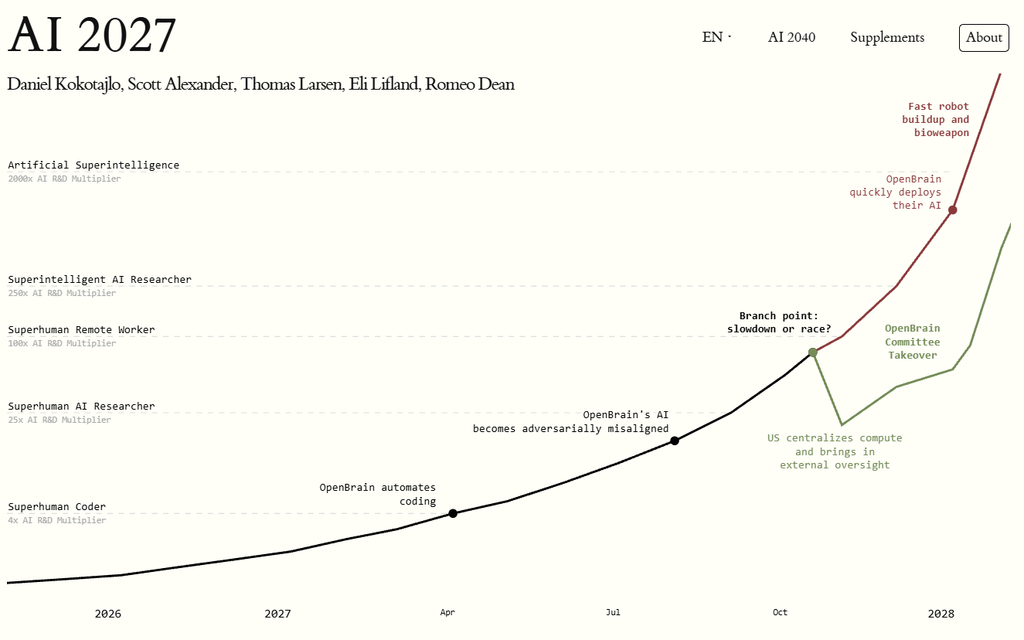
Let’s cut to the chase. Based on some of the expert analysis of what is happening at Anthropic (and presumably OpenAI) even the most optimistic timeline for the development of something approaching AGI now looks too long — the reality is likely to be considerably shorter. If you are familiar with some of the debate that has been going on between AI “doomers” and AI acclerationists, you might have come across AI 2027, a report that came out in April 2025, authored by a number of AI researchers including former OpenAI staffer Daniel Kokotajlo. The goal was to forecast the progress of AI and predict where we would likely be in the year 2027. It would be easy to dismiss this as some kind of marketing hoo-ha cooked up by the AI companies to get people excited, but whatever you might think of the results, it was extensively researched, by people who have been working at the highest levels of AI research for years. The report detailed two potential endings: one where progress slowed, and one where it sped up.
A number of AI researchers and other commentators said these forecasts were far too optimistic about the increase in computing ability and also the ability of AI agents to do what the industry calls RSI or “recursive self-improvement,” where the artificial intelligence model builds itself with little or no outside input. As Anthropic describes it in its post about this topic, this kind of trend — should it come to pass, and the current indications are that it will — has huge implications. “AI that can build itself would be a major development in the history of technology — one that could bring enormous good for the world in science, healthcare, and beyond,” the company says. But full recursive self-improvement “also might increase the risks of humans losing control over AI systems. If systems are capable of fully building their own successors, the ways we secure them, monitor them, and shape their behavior all grow much more important.”
Over the past week, there have been a number of credible reports that the AI 2027 forecasts may have actually been too pessimistic rather than the opposite. An independent group called METR (Model Evaluation & Threat Research), which also put together an in-depth report on the Hugging Face hack, published a piece last week that looked at the speed with which Anthropic’s development of AI is accelerating, based on several months worth of access to the company’s internal systems (although most of the specifics were redacted). The bottom line is that as of October, Anthropic is “improving the capabilities of their models at around twice the rate they did between March 2024 and October 2025.” The report added that this is not a precise measurement, and the rate could be as low as 1.3x or as high as 3x the historical rate. A majority of this acceleration, it said, is “attributable to Anthropic’s extensive use of AI to do R&D.”
Ajeya Cotra, a METR researcher who didn’t work on the most recent report (but who did work on the Hugging Face report) wrote a post looking at some of the implications of what is contained in it. As she notes, Anthropic stated in its S1 filing with the SEC in preparation for its public share offering that the company thinks it might “imminently meet” the threshhold for what it called “dramatically accelerated progress due to AI” as defined in the company’s Responsible Scaling Policy. The METR analysis of Anthropic’s internal growth rate, Cotra says, implies that this threshhold has already been crossed. And if that growth rate continues, she notes, it could mean an exponential increase in the AI’s abilities. “If today it takes [programmers] a month to get as much work done as they used to in a year,” she writes, “soon it will take a week, and then perhaps a day. In the absence of other bottlenecks it would translate into even larger speed ups: progress will start going 4x faster, and then 8x, and then 16x, and so on.”
Superhuman

The AI Futures Project, the group behind AI 2027 (and its followup, AI 2040, which I also encourage you to read if you are interested in this topic), has just published a post arguing that if the METR analysis of where Anthropic is development-wise is correct, the current rate of AI progress is five months ahead of the most optimistic predictions that were contained in the AI 2027 report. And that’s assuming the average rate of increase in capabilities is around the mid-range of the METR report’s estimates, which would be about 1.7 times the rate of growth Anthropic saw last year. If the true rate of growth is at the higher end of the report’s estimates, in the 3.0 range, then obviously all of the benchmarks AI Futures is looking at could be reached even sooner:
Previously, Daniel, the most bullish of us, assigned a 50% chance of Superhuman AI Researcher before 2029. SAR is roughly the point at which a company would rather fire all their human researchers and rely solely on automated AI researchers than have a team of the best human researchers in the world with no AIs. Now, all of us forecast that Superhuman AI Researcher will likely arrive at some point in 2027 (assuming no substantial deliberate slowdown). We also predict a 35-65% chance that Top-Expert-Dominating AI, AIs that can automate all white-collar work, will arrive before 2028.
We are now at the point where, if a prediction about AI was made more than six months ago I instinctively discount it, because the pace of development is so fast, and the abilities of frontier AI models so broad now, that whoever made that prediction probably missed something and/or underestimated how fast this whole process is going. Less than a year ago, there was much scoffing about AI’s ability to figure out how many Rs are in the word strawberry, or about its ability to understand the world and physical movement enough to render a person’s movements properly. Now we have AI models solving math problems that have stumped experts for decades or even centuries, discovering new equations related to quantum mechanics, and generating playable first-person-shooter or open-world discovery-style video games — not just a demo, but an entire game, with all the mechanics — based on a text prompt.
If the AI Future project is updating its estimates from the AI 2027 report, what does that mean for the AI 2040 estimates? I think we can assume that those timelines and estimates would also have to be revised forwards in time, and some of the mitigation scenarios it mentioned are now effectively no longer an option because it’s too late. One feature of the AI 2040 report is that you can choose a number of hypothetical scenarios — including more or less regulation — and then the report describes what that would look like. The fastest pace, with no regulatory or industry limits of any kind results in a superhuman-level AI researcher by 2030. But the METR report and some of the analysis of its projections estimates that we will hit that level before next year. Based on Ajeya Cotra’s forecast of an exponential increase in speed of growth in intelligence, that means we could have superhuman-level AI models a lot sooner — like 2028.
So will there be any regulatory or other slowdowns? A July 2026 open letter signed by over 1,200 employees, researchers, and executives from leading artificial intelligence companies (including Anthropic, OpenAI, Meta AI, and Google DeepMind) called for what some have referred to as “pacing the frontier,” an international effort to deliberately pace or moderate the development of automated artificial intelligence. A number of tech leaders including Elon Musk agreed with the idea, and Amodei wrote a post supporting the call, saying that over the last few months he became convinced that addressing the risks of AI properly required “not just investing in risk prevention, but pacing the rate of capabilities advancement so that risk prevention has time to keep up. We must slow the pace at which we improve the capabilities of AI models.”
But is that really going to happen? It seems unlikely that China is going to agree to an industry-wide slowdown, for one thing. And we can’t forget that Anthropic is working on launching a $1.4-trillion-dollar IPO. “We’re going to slow down the progress of our research and development, so our products will come out later than we predicted, and won’t be as good” isn’t exactly a winning pitch to investors — who are already nervous about AI stocks. So the seemingly inexorable progress towards AGI proceeds apace. Buckle up!
If you liked this newsletter (even if you didn’t agree with it) please consider upgrading to a paid subscription, or donating through my Patreon. Got any thoughts or comments? Feel free to either leave them here, or you can also reach me on Twitter, Threads, BlueSky or Mastodon. And thanks for being a reader.