
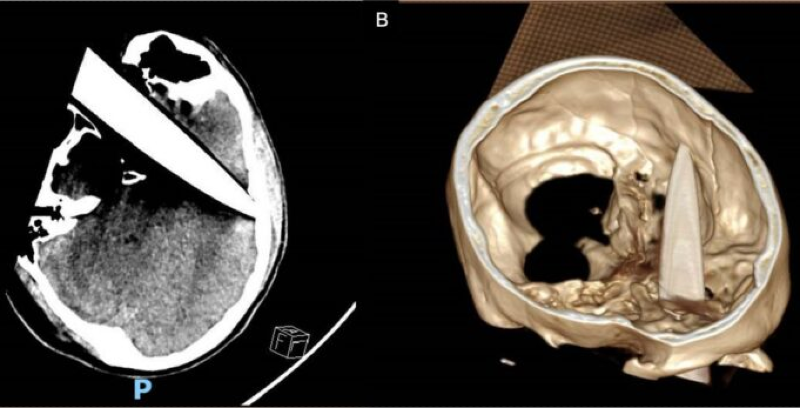
A man in his 20s showed up to a UK hospital with the hilt of a knife sticking out of his face. The 15 mm-wide blade hidden within went completely through his right eye and through his brain, with the tip of the blade hitting the top of his skull. Despite the ghastly injury, the man was alive and conscious when he arrived. He could still talk and move all four limbs. His doctors described him as being in a state of agitation. On the Glasgow Coma Scale, he scored a 12, indicating a “moderate” brain injury. He could open his left eye when told, but otherwise kept it closed and he could talk and answer questions, but was confused. The blade was entirely through the right eye socket and eyeball. It traversed the left frontal and temporal lobes of his brain, passing through in front of—and without apparently injuring—the corpus callosum, which connects the two sides of the brain and is full of nerve fibers. The blade also missed the left internal capsule, which holds another bundle of nerve fibers. (via Ars Technica)
The “Green Man” that Pittsburgh residents tell scary stories about was a real person

According to legend, the Green Man was a laborer who was either struck by lighting or electrocuted while working on the railroad in the South Park area. Some versions of the legend say he died, and his ghost haunts the area at night. Others say he was horribly disfigured and only comes out at night. Most versions agree that he glows green. There is a railroad tunnel along Piney Fork Road in South Park Township known to the locals as “Green Man Tunnel”. Since legend says Green Man was an electrocuted railroad worker, many believe that his spirit haunts the former train tunnel. The Green Man was a real man, but he was not green or a ghost. Raymond Robinson was severely disfigured at the age of eight years old after climbing an electric trolley bridge in order to get a better look at a bird’s nest. The high voltage of the bridge caused Robinson to lose his eyes, his nose, one ear, and one arm in the accident. (via Positively Pittsburgh)
Note: This is a version of my When The Going Gets Weird newsletter, which I send out via Ghost, the open-source publishing platform. You can see other issues and sign up here.
The first English version of Euclid’s geometry text published in 1570 had popup models
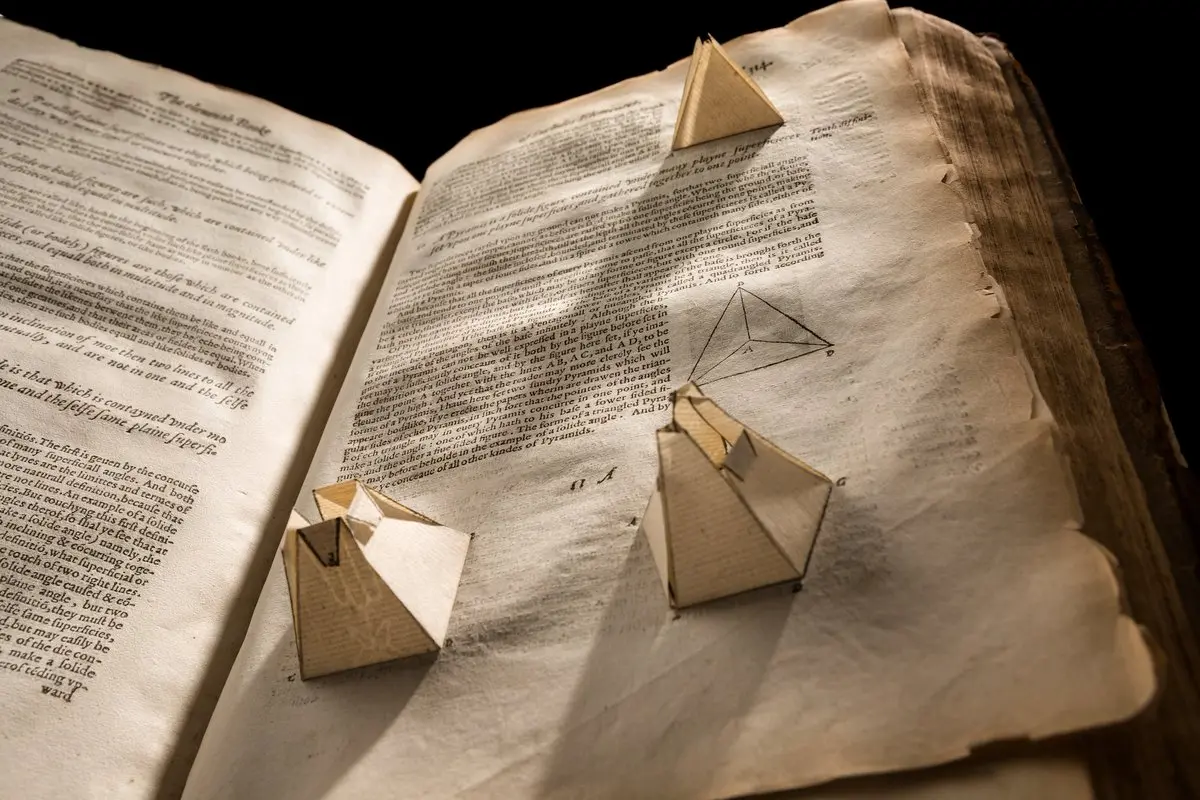
In 1570 a London printer named John Daye issued a heavy folio called The Elements of Geometrie of the most auncient Philosopher Euclide of Megara. It was the first time the whole of Euclid had appeared in English. Turn far enough into it — past the famous preface, past ten books of flat diagrams — and something odd happens. The page stops being flat. Small paper shapes, cut and pasted along one edge, lie folded against the text. Lift them, and they become the solid the sentence beside them is trying to describe. There are two ways to explain a pyramid. One is words. The other is to put one in someone’s hand. For most of the book’s two-thousand-year life, only the first method was on offer. A student in Tudor England meeting Book XI was reading Latin that had often been translated from Arabic that had been translated from Greek, and trying to see, in a flat woodcut, planes meeting at angles in space. (via Abakcus)
Hi everyone! Mathew Ingram here. I am able to continue writing this newsletter in part because of your financial help and support, which you can do either through my Patreon or by upgrading your subscription to a monthly contribution. I enjoy gathering all of these links and sharing them with you, but it does take time, and your support makes it possible for me to do that. I also write a weekly newsletter of technology analysis called The Torment Nexus.
Beavers in Poland conducted an exercise in irony by chewing down a sign warning about beavers

Foresters in southern Poland put up a sign to warn walkers about beavers felling trees beside a pond, but it didn’t last long. The beavers chewed straight through the oak post, leaving the warning face down in the grass. The sign, reading ‘Warning! Damage caused by beavers’, was put up by foresters from the Lubliniec forestry district (Nadleśnictwo Lubliniec), in Poland’s Silesia region. However, photos show the wooden post gnawed through at the base, with the sign lying on the ground. Beavers at a nearby pond have been digging burrows under a road and felling trees, leaving sharpened stumps sticking out of the ground that walkers could easily trip over. The animals behind the kerfuffle were once almost wiped out in Poland. By 1928, hunting had left an estimated 235 beavers in the country, according to Krytyka Polityczna, before postwar reintroduction efforts helped the population climb back to around 150,000 today. (via EuroWeekly)
The purpose of this clay disk from ancient Greece has baffled scientists for a century
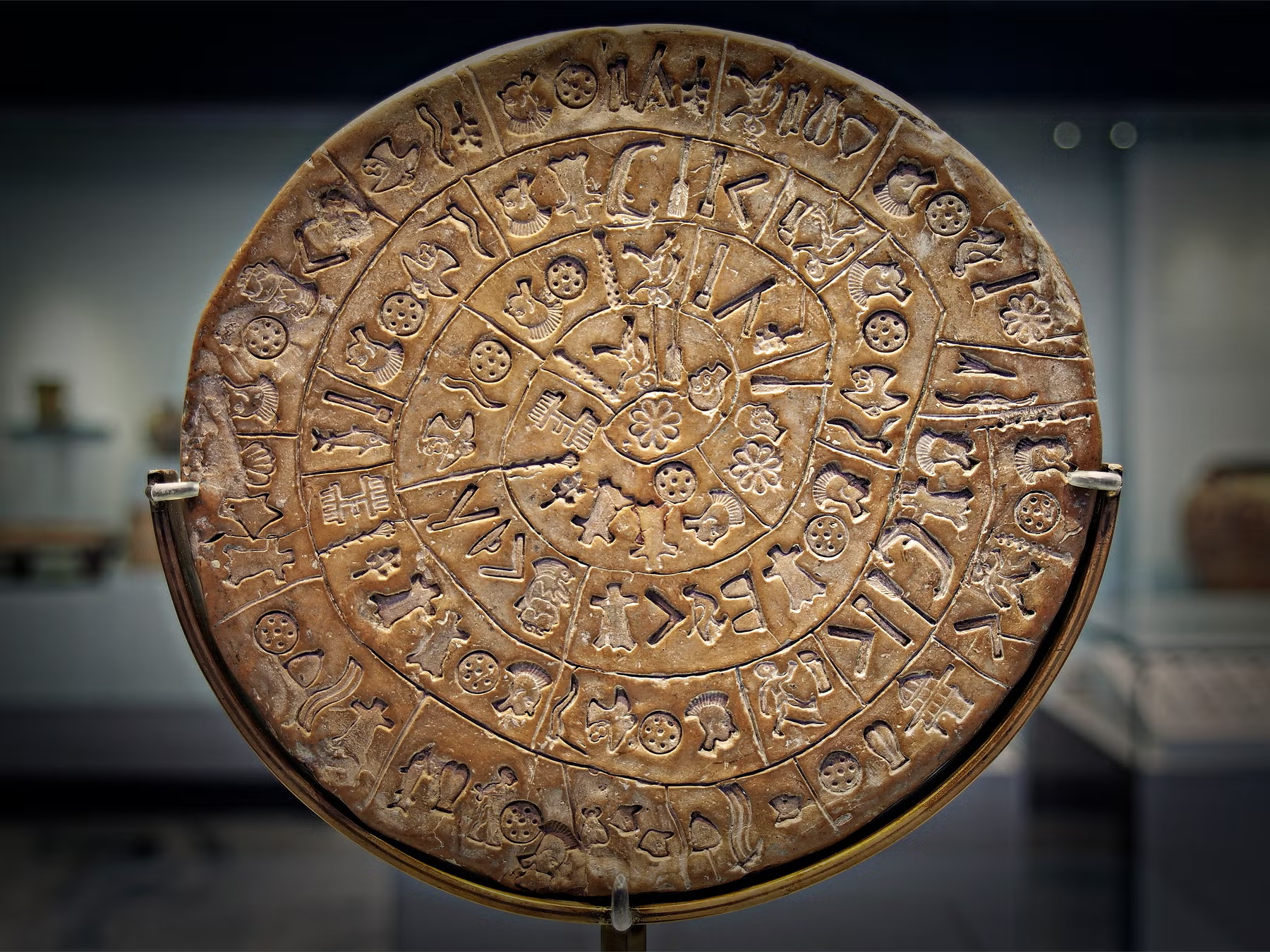
On July 3, 1908, Italian archaeologist Luigi Pernier discovered a disc-shaped artifact that would go on to stump experts for more than a century. Discovered in the Palace of Phaistos on the Greek island of Crete — the second-largest palace credited to the ancient Minoan civilization after the Palace of Knossos—the aptly named Phaistos Disc, measuring roughly 6.3 inches in diameter and housed in the Heraklion Archaeological Museum in Crete, isn’t your typical artifact. Instead of an identifiable language, the object displays 241 symbols, 45 of which are distinct, that are all arranged in a spiral formation, suggesting that the artifact was meant to be read from the edge—much like playing a not-so-friendly game of Monopoly. The symbols are representations of different human forms, animals, objects, weapons, and armor. Other theories suggest that the disc might be a representation of a poem or hymn. (via Popular Mechanics)
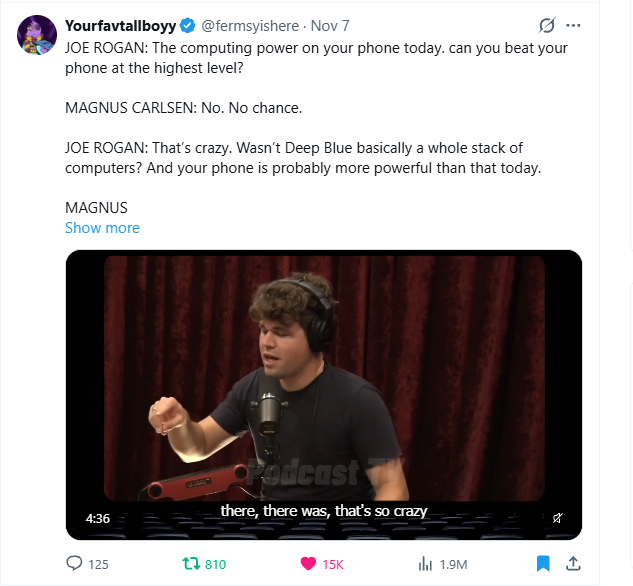
Chess grandmaster Magnus Carlsen says AI taught him something about the game
Acknowledgements: I find a lot of these links myself, but I also get some from other places that I rely on as “serendipity engines,” such as The Morning News from Rosecrans Baldwin and Andrew Womack, Jodi Ettenberg’s Curious About Everything, Dan Lewis’s Now I Know, Robert Cottrell and Caroline Crampton’s The Browser, Clive Thompson’s Linkfest and Why Is This Interesting by Noah Brier and Colin Nagy. If you come across something you think should be included here, feel free to email me at mathew @ mathewingram dot com