

Thomas Goldstein did not look at his cards. He shoved his chips forward — all of them — and told the table, “Let’s find out together.” This was the Bellagio poker room in July 2008, then the closest thing the gambling world had to a capital. Goldstein looked like easy prey. He was slight, pale, bald and bookish. He had the round face of a character actor Hollywood would typecast as an accountant. He was also mild-mannered and unfailingly polite. But Goldstein was doing more than holding his own. He was taking the table apart, and in a way almost no one had seen before. Almost every hand, he raised before any of the shared cards were dealt, to $400 or $500. Most of the time, for one stretch an estimated 19 hands out of 20, he bet without looking at his cards. Then he would bet as much as $35,000 on the river. By the time the game finally broke, at a quarter to seven, the July sun was coming up over the desert and the Bellagio’s night shift was going home. Goldstein had been playing for more than eighteen hours. He left a winner; years later he would say the night had made him some $400,000. (via The Foundry)
The Voynich manuscript has stumped scholars for centuries but they may be reading it wrong
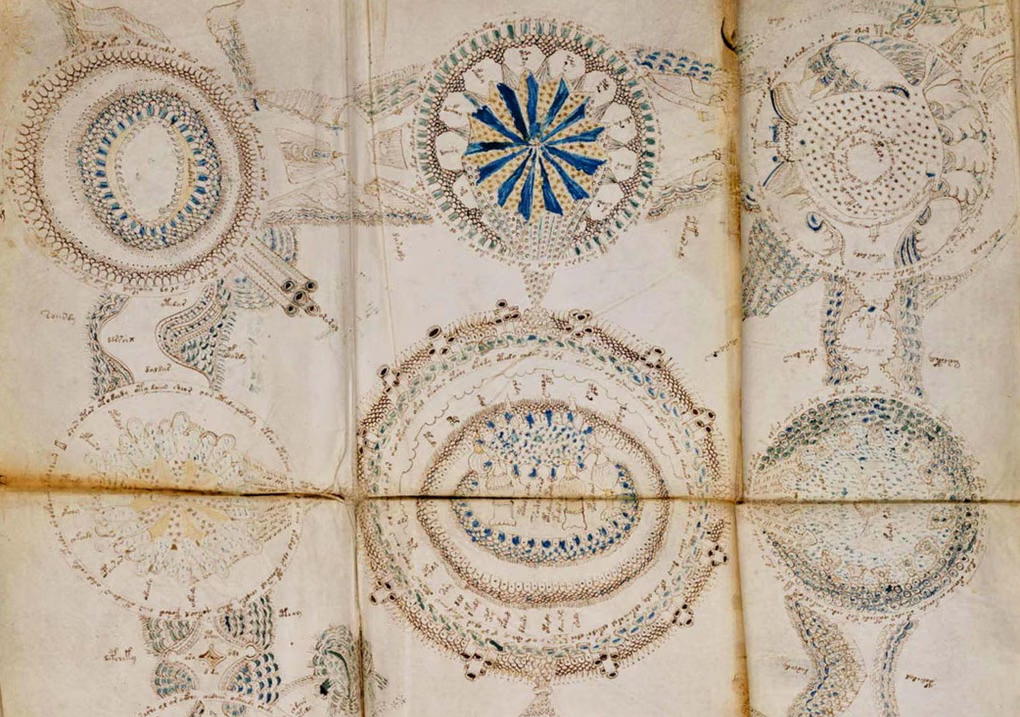
It has been called the world’s most mysterious manuscript: a medieval set of pages filled with botanical drawings, astronomical diagrams, pictures of nude women and indecipherable text. Claimed at various times to be a book in a lost language, a musical score, an instruction manual or just an elaborate hoax, the so-called Voynich manuscript’s true meaning has defied cryptographers and codebreakers for centuries. Now, new research offers an explanation for why a scholarly consensus over this enduring puzzle has been so hard to come by: not only because its truth is so profoundly mysterious – but because everyone has been reading its pages in the wrong order. In an article published in peer-reviewed journal Digital Medievalist, Colin Layfield and Lisa Fagin Davis argue that the manuscript’s folded sheets may have originally been piled on top of each other as “singulions” but were mis-bound in a more typical “nested” arrangement at some point in the mid to late 15th century. (via The Guardian)
Note: This is a version of my When The Going Gets Weird newsletter, which I send out via Ghost, the open-source publishing platform. You can see other issues and sign up here.
He looked at lanes of traffic and cars driving by and it looked like music so he made it that way

Have you ever played Guitar Hero or Dance Dance Revolution? They’re fun video games that use a never-ending scroll with multiple “lanes” that, when struck at the right time, play different notes—whether you hit those with your fingers on a toy guitar or your feet on a floor pad depends on the game. What you’re looking at here is the same concept, but with a major highway as the scroll and real-life cars as the instruments. Does that make any sense? The creative mind behind “The 101 Plays Itself” is music producer Jay Judah, and his website uses public-access Caltrans traffic cameras on U.S. Highway 101 in Los Angeles, or, as locals call it, “the 101,” to create music. Here’s how it works: when cars drive through a predetermined line that Judah’s software superimposed on the video feed, they play a note. Since this portion of the 101 boasts five lanes, the system can play up to five different notes simultaneously. (via The Drive)
Hi everyone! Mathew Ingram here. I am able to continue writing this newsletter in part because of your financial help and support, which you can do either through my Patreon or by upgrading your subscription to a monthly contribution. I enjoy gathering all of these links and sharing them with you, but it does take time, and your support makes it possible for me to do that. I also write a weekly newsletter of technology analysis called The Torment Nexus.
People are using AI to convince themselves that drinking their own urine is a health cure

For years, Facebook has played host to a truly stupefying number of groups for the tens of thousands of people interested in urine therapy — a pseudo-scientific practice involving the use of human micturate to “treat” ailments, ranging from acne to viral infections and even terminal cancer. The members of these groups have done a fine job of cultivating a dangerous ecosystem of quack remedies and misinformation on their own. But with the advent of AI, many are starting to branch out, using the tools to brainstorm new applications and reassure themselves that pee is indeed the cure-all they already believe it to be. In a Facebook group called “Urine Therapy, your sacred plasma medicine,” which has over 45,000 members, some discovered that popular AI chatbots initially push back on wild notions of tinkle as medicine. Acolytes of the urine drinking lifestyle have found it remarkably easy to break through chatbot safeguards — engineering AI to say whatever it is they wanted to hear to begin with. (via Futurism)
A painting bought for $30 at an estate sale brings record $1.3 million bid at auction
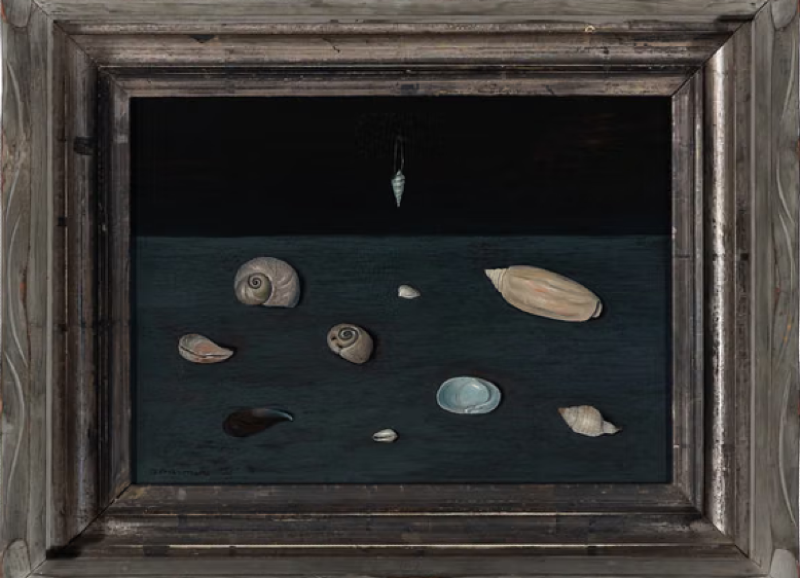
It is the stuff of dreams for a treasure-hunting flea market buyer. On Thursday (1 October) at Freeman’s auction house in New York, a painting by the once-obscure figurative painter Gertrude Abercrombie (1909-77), which was bought at an estate sale in Michigan last summer for a mere $30, blew past its high estimate of $200,000 and ultimately sold for $1.3m. The premium inclusive-price, paid for the 8in-by-11in painting titled Alderman Merriam’s Shells(1951), marked a new world auction record price for the artist. It represents a 33% jump from her previous auction record of $1m, achieved at Sotheby’s by Message for Mercy (1950), also sold in New York, last November, according to data website Arthur Analytics. The auction high for the artist has shot up in recent years. As of early 2025 the secondary-market record for her work was still under $1m, at $864,000. “Keep going to those estate sales,” said auctioneer David Weiss, a Freeman’s senior vice president, at the start of the bidding. (via The Art Newspaper)
A revolutionary leader gets upset when the news channel adds subtitles

Acknowledgements: I find a lot of these links myself, but I also get some from other places that I rely on as “serendipity engines,” such as The Morning News from Rosecrans Baldwin and Andrew Womack, Jodi Ettenberg’s Curious About Everything, Dan Lewis’s Now I Know, Robert Cottrell and Caroline Crampton’s The Browser, Clive Thompson’s Linkfest and Why Is This Interesting by Noah Brier and Colin Nagy. If you come across something you think should be included here, feel free to email me at mathew @ mathewingram dot com