The hottest sport around is something called Banana Ball

If you like baseball and use social media, you’ve likely already encountered the Savannah Bananas. The team is something of a social-media darling, especially on TikTok – the Bananas’ more than 6m million followers on the app significantly outnumber those of every franchise in Major League Baseball (as well as every team in the NFL, NBA and NHL). The factors driving the Bananas’ online success are obvious. In-game clips of players swinging flaming baseball bats, pitching from atop stilts, and performing choreographed dance routines are tailor-made for social media. The Bananas competed in the Coastal Plains League (CPL), a competitive collegiate summer league. Outside of the standard CPL season, however, the Bananas began playing exhibition games which featured significant rule changes: fan-caught foul balls counted as outs, bunts were outlawed, stealing first base was permitted and ‘walks’ were replaced by ‘sprints,’ among other modifications. Games played under this new set of rules were appropriately christened “Banana Ball”. (via The Guardian)

In Sparta a competitive sport involved jumping and kicking oneself in the butt

The Bibasis, a dance of men and women, was of the gymnastic kind. The dance consisted in springing rapidly from the ground, and striking the feet behind; a feat of which the Spartan woman Lampito, in the Lysistrata of Aristophanes, prides herself. She derives her strength and her beauty essentially from this exercise. The text reads: μάλα γ’ οἰῶ, ναὶ τὼ σιώ· γυμνάδδομαί γα καὶ ποτὶ πυγὰν ἅλλομαι (It’s true, I think, by the Twin Gods. I do take exercise, and I jump-kick my butt.) The dance consisted in kicking one’s own buttocks, to music, as rapidly as possible. The number of successful strokes was counted, and the most skilful received prizes in competitions. We are told by a verse from an epigram, which has been preserved by Pollux, that a Laconian girl had won by dancing the Bibasis a thousand times, which was more than had ever been done before. (via Wikipedia)

Note: This is a version of my When The Going Gets Weird newsletter, which I send out via Ghost, the open-source publishing platform. You can see other issues and sign up here.

Continue reading “The hottest sport around is something called Banana Ball”

A Chinese businessman survived six days in open water

Qin Jianping had only intended to stop off in Haikou, capital of China’s Hainan province, for a few days. He drove to a seaside plaza to take an evening stroll along a seawall. He remembers slipping in the darkness, losing his balance, and suddenly falling over the edge into the sea. After plunging into the deep, dark, icy water, Qin quickly fought his way to the surface. He felt disoriented but could still hear the buskers playing for tourists taking a late-night stroll. In those first few minutes, he was confident someone would soon spot him and call for help. But then the waves began slowly dragging him further from shore. It would be another six days before he reached land again. To survive in open water, the 41-year-old entrepreneur says he clung to buoys, ate raw crabs, and attempted to keep warm using his own urine, all the while enduring an onslaught of jellyfish. On the day he was finally rescued by two fishermen, the Chinese authorities and his family had already begun to believe he was dead. (via Sixth Tone)

How many books is too many to have in your apartment? His landlord said 10,000 is

For a young Jewish scholar named Mendel Uminer, books are the wellspring of enlightenment. So when he scored a studio apartment a block away from Central Park on Manhattan’s Upper East Side a year ago, he brought his books with him — all 10,000 of them. What followed, at least for a little while, was a charmed existence in his 600-square-foot temple of knowledge. Towering stacks of Judaica lined the walls, heaps of film criticism and opera history filled the prewar bathroom, piles of plays and poems blocked a window, and Uminer slept on a floor mattress engulfed in dog-eared novels. Waking up around noon, he spent his afternoons on his sunlit chaise, devouring the works of Yiddish writers like Chaim Grade and critics like Edmund Wilson, nourishing his mind while the city churned outside. This past winter, he received a notice from building management. “You are maintaining the Premises in a severely overcluttered condition; permitting the over-accumulation of books in the Premises; creating a fire hazard by over-accumulating combustible books.” (via the NYT)

Note: This is a version of my When The Going Gets Weird newsletter, which I send out via Ghost, the open-source publishing platform. You can see other issues and sign up here.

Continue reading “A Chinese businessman survived six days in open water”

Inside the secret plan to move the famous Bayeux tapestry

A convoy of police cars, lights flashing, tail the large yellow truck up to the back gates of London’s British Museum. It’s just before 3 a.m. on July 10, a date that has been kept under wraps for months. After the truck pulls into the museum’s loading bay, four men open its back doors to reveal a cage-like rectangular crate. Inside it is another crate, inside that crate is a metal shell, and inside that shell, folded back and forth on itself 28 times, is a precious and fragile artifact, nearly a thousand years old.The journey this truck has made over the previous 10 hours, by road and rail from northern France, was undertaken in great secrecy, due to the importance and value of the cargo within (reported to be insured for over a billion dollars). The Bayeux Tapestry is perhaps the most celebrated artwork to have survived from the Middle Ages. It is remarkable purely as an object: a narrative piece some 225 feet long. (via National Geographic)

She went from cleaning a space toilet to planning a Mars exploration mission

Cleaning a space toilet while on work experience was Claire Parfitt’s first introduction to a career away from Earth’s orbit. But she never imagined her time at the National Space Centre in Leicester, when she was 14, would one day see her lead a team exploring future Mars missions. Parfitt, originally from Nottingham, now works for the European Space Agency’s European Space Research and Technology Centre in the Netherlands. The 42-year-old joined the space industry after securing a physics degree and a PhD in spacecraft power systems engineering. She has since worked on missions such as the ExoMars Rosalind Franklin rover, which will explore the surface of Mars. She has also worked on the SMILE mission – officially known as the Solar wind, Magnetospheric, Ionic Link Explorer mission – which uses four science instruments to study how Earth responds to the solar wind from the Sun. (via the BBC)

Note: This is a version of my When The Going Gets Weird newsletter, which I send out via Ghost, the open-source publishing platform. You can see other issues and sign up here.

Continue reading “Inside the secret plan to move the famous Bayeux tapestry”

This famous romance writer was also an aviation pioneer

We now think of Dame Barbara Cartland in her hot-pink guise as a romantic novelist, but in the early 1930s she was a sparkier sort of woman. Her early novels and plays raised eyebrows due to their racy nature and she wrote some rather naughty gossip columns. She was also interested in technology. In the summer of 1931, she was involved in a series of experimental glider flights. Gliders had existed in some form for around 75 years but Cartland funded a project to develop long-distance gliders that could be towed into flight by aircraft. Previously, a glider had to be launched manually from a high place or more commonly, towed along a runway by a mechanical winch. The first major flight of the “Barbara Cartland” glider was on the 20th June 1931. A bag of letters was flown from near Maidstone to a destination near Reading. The journey took just over an hour. Its tow aircraft was flown by Flt Lt Ewen Wanless with Cartland as a passenger. This was possibly the first use of “glider mail”. (via Playing Pasts)

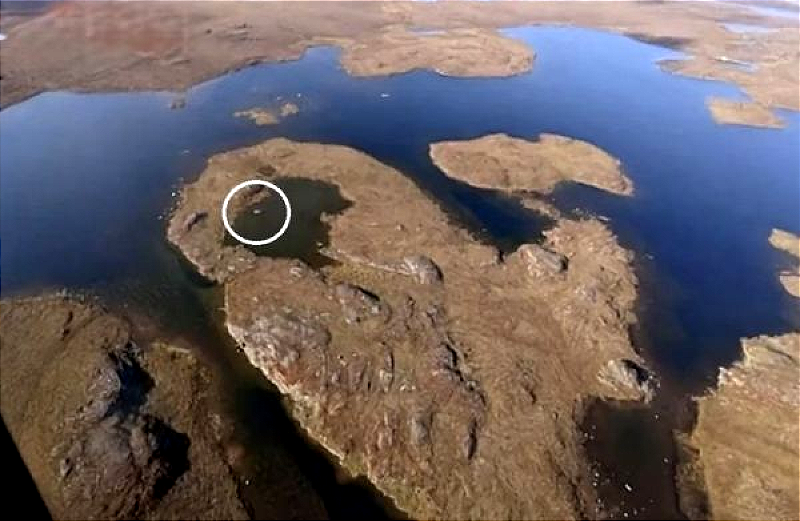
Northern Canada has an island in a lake on an island in a lake on an island in a lake

Turns out that Canada is home to the only known location of the most recursive island in the world. Say hello to Yathkyed Lake, Nunavut. As the name suggests, a ‘recursive’ island or lake is like a nesting doll of nature. There is only one (discovered) island in a lake on an island in a lake on island in a lake and that is located in one of the most remote parts of Canada – Yathkyed Lake, which is north of the Manitoba border and right in the heart of Nunavut. Ironically, the lake is just south of the geographical centre of Canada, if you find the mid-point of the East-West and North-South extremities of the country. Unfortunately, knowing that the world’s most recursive lake exists in Canada is about as far as you can get. Notwithstanding the incredibly difficult terrain and lack of infrastructure, Yathkyed Lake appears to be owned by a Canadian mining company, so it’s not even open to the public. (via Curiocity)

Note: This is a version of my When The Going Gets Weird newsletter, which I send out via Ghost, the open-source publishing platform. You can see other issues and sign up here.

Continue reading “This famous romance writer was also an aviation pioneer”

Data center criticism is based on bad science and scare quotes

If you are following the growing artificial intelligence industry at all, you’ve probably come across some facts and figures about how AI is going to use up all of the country’s water, while also using up all the power and causing prices to spike for regular non-AI using humans, and also that the giant data centers required for this industry are taking over all the usable land, and will cause pollution to soar, and/or lead to a wide range of other negative societal effects. I don’t think of myself as an apologist for AI — although I have written about how it can be useful for important things like medical research, and how using it as a tool for writing isn’t always a terrible thing — and it’s possible that anti-data-center arguments have some merit purely as an anti-billionaire measure, but at the same time, many of the arguments I’ve noted above simply aren’t rational. They may contain numbers that sound terrible — billions of gallons of water, megawatts of power, etc. — but when looked at rationally they tend to collapse.

According to a recent Gallup poll, seven out of 10 Americans are opposed to the construction of data centers for artificial intelligence in their local area, and almost half of those surveyed were strongly opposed. In the same March survey, 53% of Americans say they oppose building a nuclear energy plant in their area, far less than the 71% opposed to data center construction. Since Gallup first asked the nuclear power plant question in 2001, the high point in opposition has been 63%. Half of opponents mention data centers’ excessive use of resources, including almost 20% mentioning either their use of water or energy. Sixteen percent mention a related environmental concern of pollution, including noise pollution and air and water pollution. Most of the remaining opposition stems from general or specific concerns about artificial intelligence.

If you want to keep up with the revolt against data centers, there’s a dedicated website called Data Center Watch, which says it is run by a “boutique research firm tracking the growing opposition to data center development.” According to the site, local residents blocked or delayed about 20 projects around the US in the second quarter of last year, representing nearly $100 billion in proposed investment. Residents across the US are attacking and/or trying to block data center projects, according to a report from the Wall Street Journal:

Note: This is a version of my Torment Nexus newsletter, which I send out via Ghost, the open-source publishing platform. You can see other issues and sign up here.

Continue reading “Data center criticism is based on bad science and scare quotes”

Anthropic discovers that Claude has a “secret thinking area”

As longtime Torment Nexus readers probably know, I have a minor obsession with the topic of artificial intelligence engines and consciousness — in part because such discussions inevitably reveal how little we know about human consciousness, let alone the machine kind. What is consciousness? Where does it reside? How does it emerge? How do we know that Atlantic writer Ted Chiang is conscious, let alone anyone else? And so on. If this isn’t your jam, I completely understand, and if you stop reading and move on, I will not be offended at all (but come back later!) I know that some people feel AI consciousness is a dead end, and that large-language models like Claude and Gemini and ChatGPT are just “stochastic parrots” or souped-up autocomplete tools that stole all their intelligence from others, and that talking about them being conscious or becoming conscious is like wondering if your toaster misses you when you are at work — and that those who discuss it, like Richard Dawkins did, have lost their minds or are the victims of “AI derangement syndrome.” I get that. I am not one of those people.

I’m not saying I believe that AI engines like Claude or ChatGPT are conscious or even that I think they will become conscious! But at the same time, I’m not saying they aren’t or won’t. David Chalmers, a professor of philosophy and neural science at New York University and a prominent researcher in the field of AI consciousness,  told New York magazine recently that the odds have gotten significantly higher that an AI could be conscious — in 2023 he said the probability was around 10 per cent. “I don’t know if I’d say that these systems are conscious yet,” Chalmers said, but “people who are confident that they’re not conscious maybe shouldn’t be. We just don’t understand consciousness well enough, and we don’t understand these systems well enough.” Chalmers and Yoshua Bengio — who worked with Geoffrey Hinton and Yann LeCun on the development of neural networks — have written a paper that concludes that based on various criteria current AI engines are not conscious but future ones could be.

In the world of consciousness research, as I understand it, there are a (large) number of different models of how consciousness might work in human beings — or anywhere else, for that matter — and how we might find evidence of it working, or at least see the signs of it in operation. One of the most popular is called Global Workspace Theory or GWT, and it was developed by cognitive neuroscientist Bernard Baars in the 1980s. In a nutshell (and I am paraphrasing and condensing significantly here) this theory of consciousness suggests that the human brain operates a little like a theater where a play is being performed. Backstage, in the dark, there is a huge amount of unconscious work happening — things like regulating your breathing, recognizing visual input, retrieving memories, and so on. The stage is a kind of global workspace, where if a piece of data is important enough, it is shoved into the spotlight so that the rest of the brain can have access to it, and this is the foundation of consciousness.

Note: This is a version of my Torment Nexus newsletter, which I send out via Ghost, the open-source publishing platform. You can see other issues and sign up here.

Continue reading “Anthropic discovers that Claude has a “secret thinking area””

Did a climber leave his girlfriend to die on the mountain?

The judge, Norbert Hofer, was a specialist. At the Innsbruck Regional Court, in western Austria, he oversaw a jurisdiction designated for mountain, avalanche, climbing, cable-car, and ski accidents. Cases handled by this department rarely draw much public attention, but the trial of Thomas Plamberger, in February, was different. He was charged with homicide by gross negligence in the death of his girlfriend, Kerstin Gurtner, during an attempt to climb Grossglockner, Austria’s tallest mountain. Hofer was an alpinist himself and a mountain-rescue volunteer. He led groups of young people on summer hikes. The case against Plamberger was nearly unprecedented. Hundreds of unfortunates — hikers, climbers, skiers, snowboarders — die in the Austrian Alps each year, but these fatalities rarely result in criminal charges. Gurtner, thirty-three, had frozen to death a few dozen yards from the Grossglockner summit after Plamberger, then thirty-six, parted ways with her at around 2 a.m. on a winter night. (via the New Yorker)

In Italy they store their cheese in a bank vault because people keep stealing it

Northern Italy. In the dead of night, a group of thieves creeps toward a locked vault. Were they looking for jewels or priceless artwork? Gold bullion? No — Parmesan. And they almost managed it. Around 400 wheels of Parmigiano Reggiano were loaded onto their getaway vehicle before police apprehended the thieves. Credito Emiliano SpA is a local bank in the Emilia-Romagna region, the only place where Parmigiano Reggiano can be produced. Local Parmesan-makers, who have been subjected to multiple organized large-scale thefts over the years, have turned to the bank to store and protect their cheese. Such is the cheese’s worth that the bank also permits the wheels of cheese to be used by producers as collateral against loans. The cheese is in a purpose-built, climate-controlled storage facility that can hold 300,000 wheels (which are worth $950–$1,900 each) known as the “Fort Knox of cheese.” (via Longreads)

Note: This is a version of my When The Going Gets Weird newsletter, which I send out via Ghost, the open-source publishing platform. You can see other issues and sign up here.

Continue reading “Did a climber leave his girlfriend to die on the mountain?”

How a former erotic model blew up the Nord Stream pipeline

The waves were more than two metres high, tossing the sailing boat around like a walnut shell. Below deck on the Bavaria C50 yacht, just 15m (50ft) long, a Ukrainian diving crew waited nervously. The skipper had seen much worse and before the war he had sometimes enjoyed taking his clients into mild storms. But now he was concerned. “This isn’t diving weather. Are you sure?” he yelled. They were not. One by one the divers voted to abort their mission and return to port. Then the lone woman among them, in her thirties, stood up. I’ll call her Freya. “Let me go alone, I’ll finish quickly,” she said. Freya’s buddy went into the water first and rigged the bomb, a makeshift device fashioned from a diver’s breathing tank. “This will be fun,” Freya called to him. Then she plunged. Freya — whose name, like those of her fellow saboteurs, has been withheld for security reasons — was born in Kyiv in the mid-1980s and raised mainly by her mother. By the time she finished high school she spoke some English and Spanish, and she chose a university course that would allow her to travel. (via The Times)

Scientists say they have found a way to make quantum time run backwards

Scientists have developed a new way to control quantum systems that can make their behavior appear more consistent with time moving backward rather than forward. The research, published in Physical Review X, introduces quantum control protocols that reshape a system’s “arrow of time,” the concept that time naturally moves in only one direction. The approach could eventually support new methods for extracting energy from quantum systems and preparing quantum states. A quantum system, such as a group of qubits, follows the rules of quantum mechanics rather than classical physics. Using the newly developed control protocols, researchers can suppress the usual emergence of the arrow of time or even reverse its apparent direction, making quantum processes look as though they are unfolding backward. As a demonstration of the technique, the team also created a measurement engine that can harvest energy from the act of making quantum measurements. (via Science Daily)

Note: This is a version of my When The Going Gets Weird newsletter, which I send out via Ghost, the open-source publishing platform. You can see other issues and sign up here.

Continue reading “How a former erotic model blew up the Nord Stream pipeline”

The violent history behind the humble spice called nutmeg

From mulled wine at Christmas to hot cross buns at Easter, nutmeg has become an essential spice in Europe. But its widespread adoption — including in the traditional Dutch breakfast pastry of ontbijtkoek — comes on the back of a sordid history of colonial exploitation. From the seventeenth to the nineteenth century, Dutch cultivation of nutmeg and the related spice mace involved “one of very few historical situations where Asian slaves worked on European-owned farms or plantations,” according to anthropologist Phillip Winn. The Banda Islands, once the world’s only source of nutmeg, were home to between 13,000 and 15,000 people until their conquest by the Dutch East India Company (VOC) in 1621. The roughly 1,000 Bandanese who survived were enslaved alongside other laborers under the  perkenier  system, where hundreds of workers toiled on each plantation (in Dutch, perk). (via JSTOR Daily)

He restores and installs free-to-use pay phones in Vermont using VoIP

Remember pay phones? Those relics of telecom’s distant past were once everywhere — on many busy street corners, in bars and restaurants, even built into airliners’ seatbacks. Now, an engineer in Vermont is aiming to give the old-fashioned device some present-day relevance. Patrick Schlott, 32, is an electrical engineer by training who works at the South Burlington, Vt.–based  eVTOL  maker Beta Technologies. Inspired in part by the free-phone projects  Futel  and PhilTel, he’s restored and installed free-to-use pay phones at over half a dozen locations across Vermont. With Schlott’s phones, users can make coinless calls anywhere in the United States or Canada—with each phone routing its calls through local internet connections via a simple Voice over Internet Protocol (VoIP) gateway. Schlott recently spoke with IEEE Spectrum about the rugged charm of old tech and the joys of reverse engineering. (via Spectrum IEEE)

Note: This is a version of my When The Going Gets Weird newsletter, which I send out via Ghost, the open-source publishing platform. You can see other issues and sign up here.

Continue reading “The violent history behind the humble spice called nutmeg”

A swarm of remote-controlled cockroaches that can swim

Swarms of cyborg insects controlled remotely via electrical implants can now operate underwater, thanks to tiny diving suits supplying them with oxygen – which could one day enable them to explore Mars. Hirotaka Sato at Nanyang Technological University in Singapore and his colleagues first demonstrated in 2021 that Madagascar hissing cockroaches could be remotely controlled with electrodes embedded in sensory organs known as cerci. In 2024, they demonstrated that a swarm of 20 of these cyborg insects could coordinate. Cockroaches breathe through pores called spiracles on their abdomen. But Sato and his team were unhappy with the insects’ inability to search flooded areas, which aren’t uncommon in disaster zones, so they have developed a diving suit to allow them to operate underwater. The researchers 3D printed a watertight resin suit, which protects the abdominal spiracles from water. Tiny hoses run forwards from the suit to connect directly to the thorax. (via New Scientist)

Wheeled vehicles existed for 5,000 years before someone thought of the bus

Buses do not seem like the sort of thing that needed to be invented. Anyone can see that the wheel needed to be invented, and that some further innovations were required to build carriages large enough for a substantial group of people to travel in them simultaneously. Once big carriages were invented, however, we might assume that people automatically started running them on regular timetables between fixed locations. The practice is so universal today, and its advantages so obvious, that it does not seem to require active innovation. Surprisingly, however, this is not true. The world had thousands of wheeled vehicles for millennia before it had a single bus. We know exactly who invented buses, when he did so, and how quickly his invention spread across the world. Wheels started being used for transport some time after 3,500 BC. For a very long time, however, wheels were not a world-changing technology. Early carts were precarious, and roads were too bad for them to be very useful. (via Works In Progress)

Note: This is a version of my When The Going Gets Weird newsletter, which I send out via Ghost, the open-source publishing platform. You can see other issues and sign up here.

Continue reading “A swarm of remote-controlled cockroaches that can swim”

Is there a new quantum processor or is Microsoft lying?

I’ve been writing a lot about artificial intelligence lately, and I wanted to break that cycle by writing about something that’s been bugging me for a little while now: namely, the controversy over Microsoft’s claim that it has developed a new and improved version of a quantum microprocessor based on the theoretical “Majorana” particle. What is said particle, you ask? I am not a quantum physicist by any means (I don’t even play one on TV) but I believe it is technically known as a fermion — a class of sub-atomic particles that obey certain rules. Protons and electrons are types of fermion, and so are quarks and weirder things like leptons (but not bosons). The main feature of a Majorana particle is that it acts as its own anti-particle. In regular physics, every particle has an anti-particle with the same mass but the opposite charge (except for photons, which are their own anti-particle because their magnetic charge is zero and the opposite of zero is still zero). When a particle and its anti-particle meet, they annihilate each other.

In case you were wondering (as I was), the Majorana particle is named after a brilliant Italian physicist named Ettore Majorana, who was born in 1906 and did ground-breaking work on theoretical physics; Enrico Fermi compared him to Isaac Newton. He correctly predicted the existence of the neutron, which won its discoverer the Nobel Prize, but in 1938, he disappeared mysteriously. Majorana was a public supporter of Italian fascism and a member of the National Fascist Party, but at the time he disappeared the Italian government had started requiring all university professors to swear an oath of loyalty to the Fascist regime in order to keep their jobs. It’s possible he didn’t want to do this and went into hiding but there is no record of anything written by him after his disappearance, and some colleagues suspect he committed suicide.

How does any of this relate to Microsoft’s quantum processor? Great question. When it comes to the nitty-gritty of the particle’s behavior I am completely out of my depth, so I’m going to defer to Wikipedia’s description of how Majorana particles could emerge, and also how they can (theoretically) be used in quantum computing:

In superconducting materials, a quasiparticle can emerge as a Majorana fermion, more commonly referred to as a Bogoliubov quasiparticle in condensed matter physics. Its existence becomes possible because a quasiparticle in a superconductor is its own antiparticle. Majorana fermions can be bound to a defect at zero energy, and then the combined objects are called Majorana bound states. This name is more appropriate than Majorana fermion because the statistics of these objects is no longer fermionic. Instead, they are an example of non-abelian anyons: interchanging them changes the state of the system in a way that depends only on the order in which the exchange was performed. The non-abelian statistics that they possess allows them to be used as a building block for a topological quantum computer.

Note: This is a version of my Torment Nexus newsletter, which I send out via Ghost, the open-source publishing platform. You can see other issues and sign up here.

Continue reading “Is there a new quantum processor or is Microsoft lying?”