There are 96 bags of human waste sitting on the Moon

Why do astronauts leave things behind on the Moon? There are many reasons. Often, it is to make room for Moon rocks to be taken back to Earth. As Neil Armstrong and Buzz Aldrin began their return journey to Earth, they disposed of anything they didn’t need. This included the tube that the US flag had been rolled up in, the TV camera they’d used to send footage back to Earth, and the tools they’d used to gather moon rock and dust. In doing this, they created a ‘toss zone’, which lies to the west of the Apollo 11 landing site. In the Apollo missions that followed, many things were left on the Moon, adding up to an estimated 400,000 pounds of stuff. There are a total of 96 bags of human waste on the Moon. Scientists are keen to one day bring this back to Earth, to study how its time on the Moon has affected it, but for now it sits in bags. (via RMG)

Scientists were baffled because she only had half a brain but had perfect vision
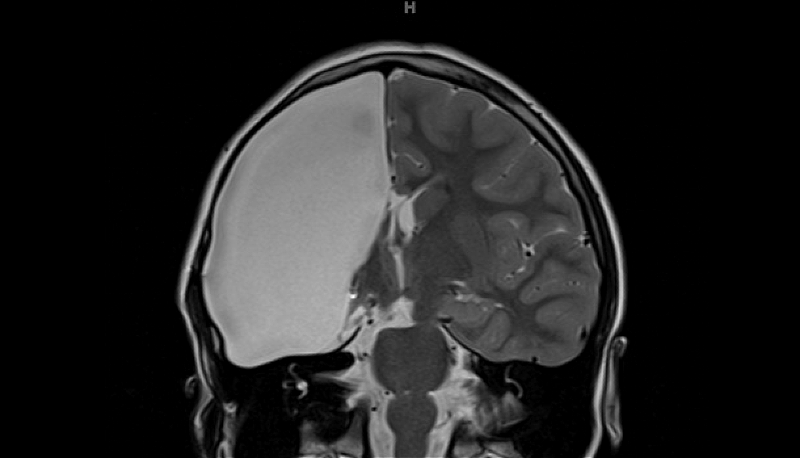
Scientists discovered how a 10-year-old girl born with half a brain is able to see normally through one eye. The youngster, from Germany, has both fields of vision in one eye and is the only known case of its kind in the world. Researchers used an MRI to reveal how the girl’s brain had rewired itself in order to process information from the right and left visual fields in spite of her not having a whole brain. The right hemisphere in the girl’s brain failed to develop in the womb. Normally, the left and right fields of vision are processed and mapped by opposite sides of the brain, but scans showed that retinal nerve fibres that should go to the right hemisphere of the brain diverted to the left. Further, the researchers found that within the visual cortex of the left hemisphere, which creates an internal map of the right field of vision, ‘islands’ had been formed within it to specifically deal with, and map out, the left visual field. (via U of Glasgow)

Note: This is a version of my When The Going Gets Weird newsletter, which I send out via Ghost, the open-source publishing platform. You can see other issues and sign up here.

Continue reading “There are 96 bags of human waste sitting on the Moon”

The Dionne Quintuplets were famous but it ruined their lives

In 1934, Leon Dionne called a local newspaper in Ontario, Canada and asked how much it would cost to print a birth announcement for his brother’s five daughters, all born to the same mother in one delivery earlier that day. At the time, the world had rarely witnessed the medical marvel of quintuplets. The identical sisters became a media sensation. The Ontario government took legal guardianship of the quints and housing them in a nursery called Quintland, which quickly became a roadside attraction that drew nearly three million spectators. By 1938, the quints were bringing in as much as 25 million Canadian dollars in tourism revenue annually, but for the quintuplets, it came at a cost. They spent half of their childhood in a so-called “baby zoo.” A trust fund they were promised was mismanaged, with just a fraction remaining by the time they entered adulthood and their personal lives were mired in tragedy. (via The Smithsonian)

At 15 years old he hacked NASA’s network and stole its space-station software

In 2000, a 16-year-old from Miami pleaded guilty and was sentenced to six months in a detention facility. The juvenile, whose was known on the Internet as “c0mrade,” admitted in U.S. District Court in Miami that he was responsible for computer intrusions from August 23, 1999, to October 27, 1999, into a military computer network used by the Defense Threat Reduction Agency, an agency of the Department of Defense charged with reducing the threat to the U.S. and its allies from nuclear, biological, chemical, conventional and special weapons. In addition to the computer intrusions at DOD, on June 29 and 30, 1999, “c0mrade” illegally accessed a total of 13 NASA computers located at the Marshall Space Flight Center, Huntsville, Ala., using two different ISPs to originate the attacks. As part of his unauthorized access, he obtained and downloaded proprietary software from NASA valued at approximately $1.7 million. (via Justice.gov)

Note: This is a version of my When The Going Gets Weird newsletter, which I send out via Ghost, the open-source publishing platform. You can see other issues and sign up here.

Continue reading “The Dionne Quintuplets were famous but it ruined their lives”

He just climbed and then skied down Everest without oxygen

A Polish adventure skier has made history by becoming the first person to climb up and ski down Mount Everest without the use of additional oxygen. The ascent was Andrzej Bargiel’s third attempt at climbing Everest – the tallest mountain on earth at 29,032ft high – after dangerous conditions forced the 37-year-old to abandon earlier attempts in 2019 and 2022. More than 6,000 people have climbed the mountain, but only about 200 have done it without additional bottled oxygen. A few people have skied back down, but never a continuous downhill without supplementary oxygen. It took nearly 16 hours on Monday for Bargiel to climb through the “death zone”, which is above 8,000 meters where oxygen levels are dangerously low. At the top of the mountain the air is so thin that climbers only get about a third of the oxygen available at sea level. This can cause brain damage, fluid in the lungs, and even death. (via The Guardian)

The oldest and one of the weirdest musical instruments ever invented

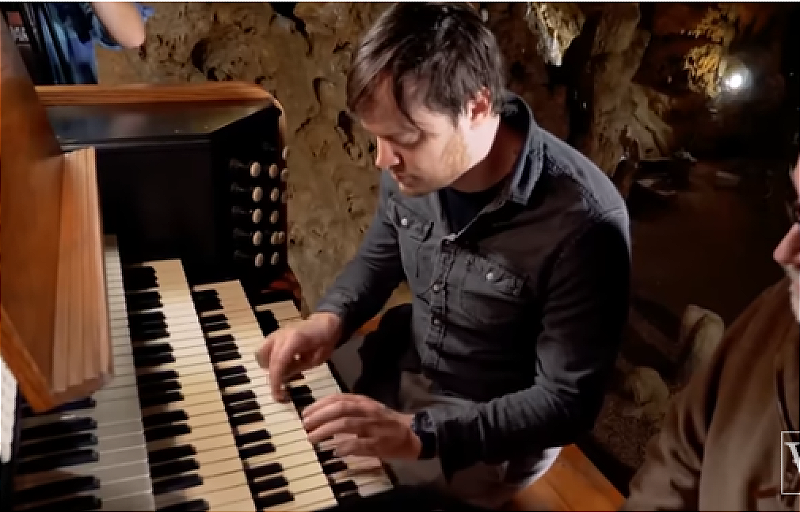
Stalactites hang tight to the ceiling, and stalagmites push up with might from the floor: this is a mnemonic device you may once have learned. It would surely be called to mind by a visit to Luray Caverns in the American state of Virginia, home of the Great Stalacpipe Organ. Not long after the discovery of Luray Caverns itself in 1878, its stalactites were found to resonate through the underground space in an almost musical fashion when struck — a property Leland W. Sprinkle took to its logical conclusion in the mid-nineteen fifties. Conception was one thing, but execution quite another: it took him three years to locate just the right stalactites, shave them down to ring out at just the right frequency, and rig them up with electronically activated, keyboard-controlled mallets. This was not hard for the technically minded Sprinkle, who worked at the Pentagon as a mathematician and electronics scientist. (via Open Culture)

Note: This is a version of my When The Going Gets Weird newsletter, which I send out via Ghost, the open-source publishing platform. You can see other issues and sign up here.

Continue reading “He just climbed and then skied down Everest without oxygen”

Her manual for hitmen became a major First Amendment case

“I first heard of Hit Man in May 1999, when I was a young journalist in Philadelphia. Paladin Press’s insurance company had just settled with the victims’ families for undisclosed millions, a decision that made international headlines. The case was unprecedented; never before had a publisher been accused of “aiding and abetting” murder through the publication of a book. Major media organizations that had rallied to Paladin’s defense — including The New York Times, The Washington Post, and the Society of Professional Journalists — now pondered the ramifications for free speech. Lost in most of the discussion was Hit Man’s mysterious author. Only one detail about her life had come to light so far: She was a divorced mother of two living in a trailer park in Florida. I grew obsessed with her. How did this woman come to write a murder manual? What had happened in her life to bring her to that point?” Vanity Fair

She claimed to be a German princess and her trial for bigamy started a publishing boom

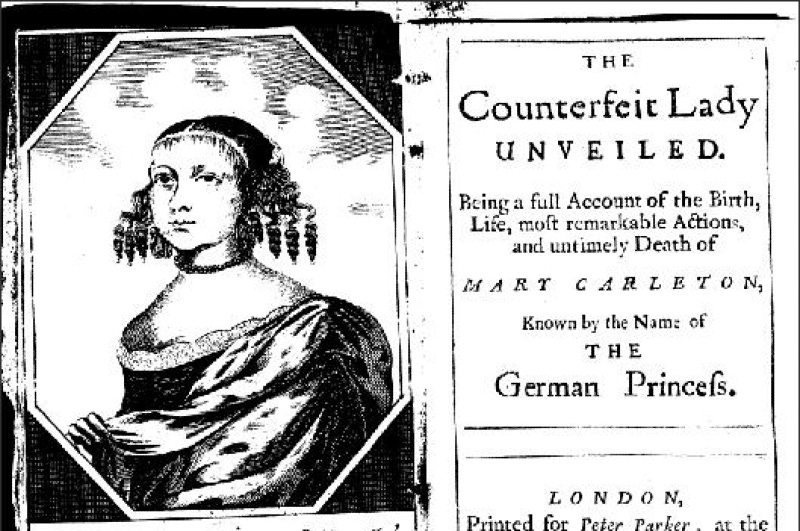
“In early June of 1663, Mary Carleton was tried for bigamy in London’s Old Bailey. A figure of considerable public fascination, Mary had been “viewed” by an estimated five hundred visitors while in prison awaiting trial.1 Officially, she stood accused of having wed John Carleton in London while already married to John Steadman, a shoemaker, in Canterbury. (Over the course of the trial, the possible existence of a third husband, a Dover surgeon named Day, emerged.) Unofficially, she stood accused in the court of public opinion of a far more interesting cheat: impersonating a fabulously wealthy foreigner in order to lure the hapless Carleton — a lawyer’s clerk, eighteen years old — into marriage. Though Mary herself modestly claimed noble rather than royal birth, she became widely known as the German Princess. Mary Carleton’s exploits produced a publishing boom: 1663 alone witnessed the printing of more than a dozen pamphlets about the case, a pair of autobiographical self-defenses by Mary herself, two rebuttals by John, and printed reports of the trial.” Public Domain Review

Note: This is a version of my When The Going Gets Weird newsletter, which I send out via Ghost, the open-source publishing platform. You can see other issues and sign up here.

Continue reading “Her manual for hitmen became a major First Amendment case”

Ever wondered where the name Purolator came from?

If you are Canadian, the name Purolator is probably a familiar one — and possibly even if you are American, but for a different reason. For those who don’t know, it’s the name of a Canadian courier company, which is now majority owned by Canada Post. For some reason I started wondering where the name came from, since it’s kind of an odd word, so I looked it up, and it was originally the name of an American company that made oil filters (apparently it was supposed to be a contraction of the phrase “pure oil later” or something like that). The founders of the company invented the first commercially available oil filter in the 1920s. It still exists but it is a subsidiary of a German industrial supply company now.

For some reason, Purolator decided to buy a Canadian package delivery company called Trans Canada Couriers in 1967 (maybe it seemed like an extension of the oil filter business because they use a lot of trucks?) and they renamed it Purolator, even though it had nothing to do with the oil filter business. In 1987 the package company was bought by Canadian investors — and eventually wound up being acquired by Canada Post — but they decided to keep the name. Pretty glad I looked it up, because I love weird corporate stories like that! Like Nokia, for example, which started out running pulp mills and making rubber, and Nintendo which was founded as a maker of playing cards in the late 1800s.

She pioneered the field of forensic science using dolls

From Scientific American: “Frances Glessner Lee discovered her true calling later in life. An heiress without formal schooling, she was in her 50s when she transformed her fascination with true crime and medicine into the foundation of a new field: forensic science. In the late 1920s she drew inspiration from a family friend, a medical examiner who was involved in notorious cases—including the infamous trial of Nicola Sacco and Bartolomeo Vanzetti. For Glessner Lee, the puzzle of untangling the truth about violent deaths proved irresistible. She recognized that solving crimes demanded both rigorous methods and professional training. She helped found the Department of Legal Medicine at Harvard. Her most unusual teaching tool: intricately crafted dollhouse dioramas that depicted grisly crime scenes. She pioneered new death investigation techniques, forged unlikely alliances, faced social and cultural obstacles, and helped foster what would become our lasting obsession with true crime.”

Scientists have created prototypes of human embryos from skin cells

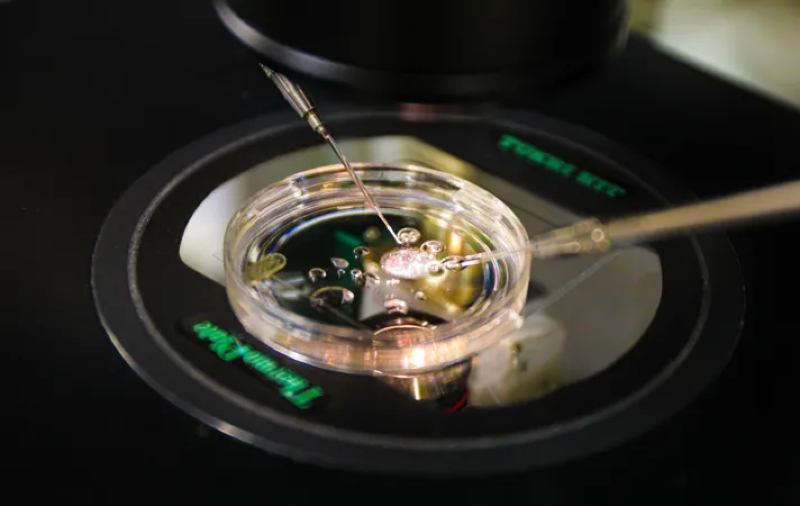
From the BBC: “US scientists have, for the first time, made early-stage human embryos by manipulating DNA taken from people’s skin cells and then fertilising it with sperm. The technique could overcome infertility due to old age or disease, by using almost any cell in the body as the starting point for life. It could even allow same-sex couples to have a genetically related child. The method requires significant refinement – which could take at least a decade – before a fertility clinic could even consider using it. Experts said it was an impressive breakthrough, but there needed to be an open discussion with the public about what science was making possible. The Oregon Health and Science University research team’s technique takes the nucleus – which houses a copy of the entire genetic code needed to build the body – out of a skin cell. This is then placed inside a donor egg that has been stripped of its genetic instructions.”

Note: This is a version of my When The Going Gets Weird newsletter, which I send out via Ghost, the open-source publishing platform. You can see other issues and sign up here.

Continue reading “She pioneered the field of forensic science using dolls”

So what’s so great about reading books?

If you pay attention to the news at all, you may have seen a host of alarming headlines recently about how the number of Americans who say they read for pleasure has declined sharply over the past 20 years, from a peak of 28 percent in 2004 to 16 percent in 2023. That conclusion comes from a study done by a number of sociologists at the University of Florida, who looked at two decades worth of responses to a benchmark survey called the American Time Use Survey, which asks 10,000 randomly selected Americans every year how they spent the day prior to when they took the survey. The Florida researchers looked at how many people said they read “for personal interest,” including books, magazines, newspapers, audiobooks, and e-readers (they also asked how many read a book with a child). It’s worth noting that — like a lot of consumer surveys — the American Time Use Survey relies on people answering the questions truthfully, and because of the way it is conducted, it also relies on people who are a) willing to pick up the phone when it’s an unknown number, and b) willing to answer a survey.

This dramatic decline in the numbers of people reading for pleasure is “deeply concerning,” according to one of the study’s co-authors, who called reading “a low-barrier, high-impact way to engage creatively and improve quality of life.” According to some neuroscientists, reading not only stimulates your brain in ways that other types of pleasure or activity don’t, but it can also lower your blood pressure, reduce stress, help with sleeping, and even help you live longer. Other experts noted that in addition to the data cited by the Florida study, different studies have shown that there has been a generational decline in students reading for fun, which some argue is a result of social-media addiction, poor literacy training, overly busy after-school scheduling by parents, or some combination of all three. For others, this decline in reading is part of a disturbing trend that they believer represents the dawn of a “post-literate” society, a return to the largely oral cultures of primitive societies, and therefore pretty much represents the end of modern civilization as we know it.

Note: This is a version of my Torment Nexus newsletter, which I send out via Ghost, the open-source publishing platform. You can see other issues and sign up here.

Continue reading “So what’s so great about reading books?”

They built a balcony on the WTC and started a conspiracy theory

From Rolling Stone: “On March 19, 2000, Florian Reither stepped out of the 91st floor of the North Tower of the World Trade Center through a hollowed-out window and stood on a makeshift wooden balcony. This vertiginous performance wasn’t the act of a brazen stuntman, crazed trespasser, or suicidal employee. It was the work of the Austrian art collective known as Gelitin, which consists of Florian Reither, Ali Janka, Wolfgang Gantner, and Tobias Urban. Titled the B-Thing, the feat saw the four men, now all in their fifties, secretly construct a balcony inside the World Trade Center, temporarily attach it, and briefly stand on top of it, floating dreamily above New York City. In the 25 years since, those involved have largely avoided speaking about the event again. Outside of esoteric circles, it’s still relatively obscure. For a long time, many skeptics believed it never even happened and claimed that it was a hoax on a vast scale.”

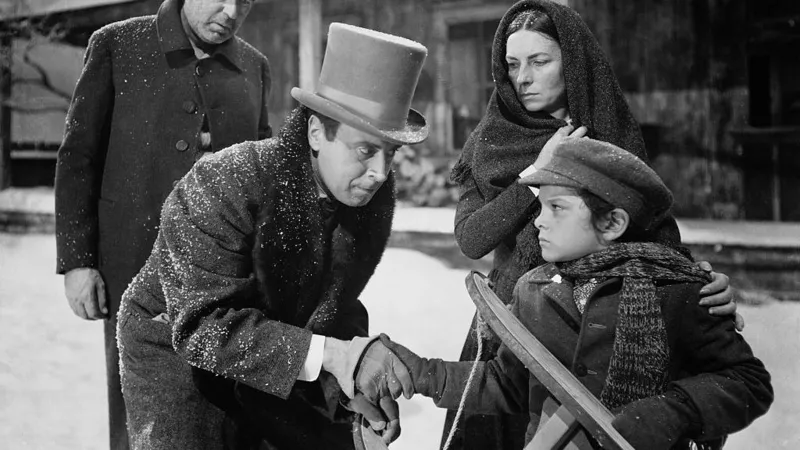
A prop from the movie Citizen Kane that was going to be thrown out sold for $15 million

From the BBC: “A prop central to the celebrated opening scene of Citizen Kane – widely regarded as one of the best films ever made – has sold at auction for $14.75m. The wooden Rosebud sled, one of at least three known to have survived, was long thought to have been lost until it was given to director Joe Dante in 1984, saving it from destruction. It is now the second most expensive piece of memorabilia to have ever been sold – a pair of ruby slippers used in The Wizard of Oz sold for $32m in December. The version sold on Thursday had not been seen for many years until it ended up in the hands of Dante. He told Heritage auctions how he was making the film Explorers in 1984 on the same studio that was formerly owned by RKO Radio Pictures, which produced Citizen Kane. Dante said crews were on site clearing out storage areas when one worker, who knew he liked vintage films, asked if he wanted it.”

Note: This is a version of my When The Going Gets Weird newsletter, which I send out via Ghost, the open-source publishing platform. You can see other issues and sign up here.

Continue reading “They built a balcony on the WTC and started a conspiracy theory”