At 23 years old she became the queen of a mountain kingdom

From Wikipedia: “In 1959, Hope Cooke was a freshman majoring in Asian Studies at Sarah Lawrence College. She went on a summer trip to India and met Palden Thondup Namgyal, Crown Prince of Sikkim. He was a 36 year-old recent widower with two sons and a daughter. Two years later, in 1961, their engagement was announced, but the wedding was put off for more than a year because astrologers in both Sikkim and India warned that 1962 was an inauspicious year for marriages. After the wedding she became the Queen Consort to the 12th and last King of Sikkim. In 1975 Namgyal was deposed and Sikkim merged into India as a result of internal turmoil, Indian military intervention and a referendum. Cooke returned to the US and began a career as a lecturer, book critic, and newspaper columnist for the Daily News.”

In the early 1900s a famous art historian wrote about how he was turning into a werewolf

From Public Domain Review: “Wholly oblivious to any and all of the festive sacred and secular celebrations of the day, or even to it being St. Michael’s Day, Hamburg-born art historian Aby Warburg sat at his desk in his brightly lit apartment in the Bellevue Sanatorium. Discouraged and frustrated by the previous seventeen-month succession of fruitless therapies, medical director Dr. Ludwig Binswanger had suggested to Warburg that the composition of an anamnesis — a biographical account of his illness — might help heal his troubled body and soul. On the morning after composing the anamnesis, before the onset of the very same daily psychotic attacks that he had been enduring for four years, he wrote to his wife Mary, lamenting that his situation had returned to that of the fall of 1918, as he writes about again reverting to being a werewolf.”

Note: This is a version of my When The Going Gets Weird newsletter, which I send out via Ghost, the open-source publishing platform. You can see other issues and sign up here.

Continue reading “At 23 years old she became the queen of a mountain kingdom”

The Trump administration is building a Panopticon

It seems quaint now, but not that long ago, one of the biggest reasons for concern about the surveillance of our behavior by massive internet platforms like Facebook, Google, and Amazon — or by companies buying click data and GPS location from our smartphones — was that they might use that information to flog advertising at us in a more personalized and irritating way. This was supplanted quickly by a fear that our data might be used by foreign agents like the Internet Research Agency, a “troll farm” linked to Russian dictator Vladimir Putin, or by those who wanted to target voters in order to get Trump elected. Those things are bad, obviously, but compared to what is happening now, they seem almost anodyne — like being concerned that you might get a bug bite while on a picnic in the woods, compared with seeing a massive grizzly bear advancing on your location, its teeth bared and its intentions obvious.

If you’ve been following The Torment Nexus for the last little while, you may recall a recent post titled “Be careful what you say on social media, part 2” — which was a followup to an earlier post. The first was triggered by the arrest of Mahmoud Khalil, a former student at Columbia who took part in peaceful pro-Palestine protests and was detained by agents of ICE — Immigration and Customs Enforcement, part of the Department of Homeland Security. They told Khalil that his visa was being revoked, and when they were told that he had a green card, the agents said that this was being revoked as well. He was taken to a detention facility, and has been there ever since. The second post in this series was sparked by the similar detention of several other students, including Turkish graduate student Rumeysa Öztürk, Columbia PhD student Ranjani Srinivasan, and Yunseo Chung, who came to the US when she was seven. Öztürk’s main offence seems to be that she wrote an op-ed about Israel in a student paper.

In that post, I described some of the tools that ICE and others are using to identify people they wish to detain and/or rendition to a for-profit prison in El Salvador (something which is unconstitutional in a number of different ways, but continues to occur, despite the Supreme Court’s attempts to get the government to stop). There are a variety of methods that government agencies can use to monitor social media with the aid of AI and then use those posts as evidence of potentially un-American conduct, as part of what Marco Rubio has called a “Catch and Revoke” plan. As 404 Media has reported, an ICE contractor known as ShadowDragon has the ability to monitor more than 200 social media and other sites, including Bluesky, OnlyFans, Instagram, etc. As I wrote:

Note: This is a version of my Torment Nexus newsletter, which I send out via Ghost, the open-source publishing platform. You can see other issues and sign up here.

Continue reading “The Trump administration is building a Panopticon”

She was forced to become a pirate and then lived in a cave

From Wikipedia: “Sarah Bishop was born around 1759 on Long Island, New York. She led a life of privilege as a member of an affluent and well-educated family. During the American Revolutionary War, her family’s house was burnt by a raiding party from a British privateer. She was captured by the raiding party and eventually became the wife of the captain. After the captain was killed, she went overboard and swam towards the shore at Stamford, Connecticut. She then travelled to Westchester County, New York, where she took up residence in a rocky cleft or cave. Described as mentally sound and deeply devoted to her faith, her few possessions included an old pewter basin and a gourd shell for cooking. She slept on a solid rock with scattered old rags, and when a reporter visited her in 1804, her cave had no signs of food or an active fire.”

He wrote a cryptic note to the judge and then jumped out the window and escaped

From Now I Know: “In the spring of 1976, Albert Spaggiari robbed the Société Générale bank in Nice. Bank employees returned to work from a long weekend, having just celebrated Bastille Day, but they couldn’t get into the vault. The door had been welded shut. Once inside, the bankers saw the damage: all the lockboxes had been opened and almost all the cash was gone. In total, the thieves got away with the equivalent of as much as $10 million — $55 million in today’s dollars. Spaggiari was ultimately arrested and he confessed to being the mastermind. In a private meeting with the judge, he said he was going to implicate others, including local political figures. The judge couldn’t make sense of Spaggiari’s handwriting, so he got up to explain to the judge what he had written, and then leaped out the window, landed on a parked car, then jumped onto a waiting motorcycle and fled. He was never caught, and lived out his life on the lam, surviving another decade before dying of cancer at the age of 56.”

Note: This is a version of my When The Going Gets Weird newsletter, which I send out via Ghost, the open-source publishing platform. You can see other issues and sign up here.

Continue reading “She was forced to become a pirate and then lived in a cave”

He let snakes bite him 200 times to create a better antivenom

From NPR: “In 2001, after working up to it for years, Tim Friede finally allowed himself to be bitten by a snake. Friede has been fascinated with snakes for as long as he can remember. He used to hunt garter snakes growing up in Wisconsin. As an adult, his obsession turned to venomous snakes — and the harm they cause people globally. He felt the most dramatic way to raise awareness of the issue was to allow himself to be bit, repeatedly. Right out of the gate, he says, “I was put in ICU after two cobra bites and I dropped in a coma for four days.” To date, he estimates he’s willingly been bit some 200 times by all manner of venomous snakes — black mambas, taipans, cobras, kraits and many others. Friede’s motivation evolved to see if he could develop immunity to this swirl of toxins — so that his body might provide a roadmap to making a broad kind of antivenom. Now, researchers say they’ve done just that, thanks in large part to the antibodies that Friede has developed over nearly a quarter century of self-envenomation.”

Victorian ladies who wanted to lose weight infected themselves with tapeworms

From Atlas Obscura: “The Victorian era, roughly the 1830s to 1900, is notorious for its bizarre beauty standards, and the even more bizarre secrets to meeting them. The ideal of the time was modeled after those afflicted by consumption—that is, tuberculosis. Pale skin, dilated eyes, rosy cheeks, crimson lips, and a meagre and fragile figure. From swallowing ammonia to bathing in arsenic—which they knew to be poisonous— to using figure-molding corsets in a quest for the “perfect” 16-inch waist, there was no limit to what fashionable Victorians would do. Most of these practices have, thankfully, gone out of style. There is one gruesome dietary idea, however, that has managed to survive—the tapeworm diet. The idea is simple: you take a pill containing a tapeworm egg. Once hatched, the parasite grows, ingesting part of whatever the host eats. In theory, this enables the dieter to lose weight and eat without worrying about calorie intake.”

Note: This is a version of my When The Going Gets Weird newsletter, which I send out via Ghost, the open-source publishing platform. You can see other issues and sign up here.

Continue reading “He let snakes bite him 200 times to create a better antivenom”

The Unabomber’s brother turned him in and then tried to win him back

From the New York Times: “It was May 1996, and David Kaczynski, a counselor for troubled youth in upstate New York, sat down to write a letter to his brother Ted. A month earlier, his brother had been shockingly unmasked as the shadowy Unabomber, responsible for a 17-year campaign of bombings that had killed and maimed people across the country. Ted Kaczynski, a brilliant but mentally troubled mathematician who had retreated years earlier to a remote hovel in Montana, had been arrested based on information from a tipster to the F.B.I.. He was now in custody and facing what would almost certainly be a lifetime behind bars, if not a death sentence. The tipster was David. Sitting in his home in Schenectady, N.Y., David began writing the letter. He used a pencil, knowing he might have to erase before he got it right. “I wanted to tell him in person that we morally felt an obligation to stop the violence,” he said.

Many people believe that the engraving on the Pope’s tomb is a travesty

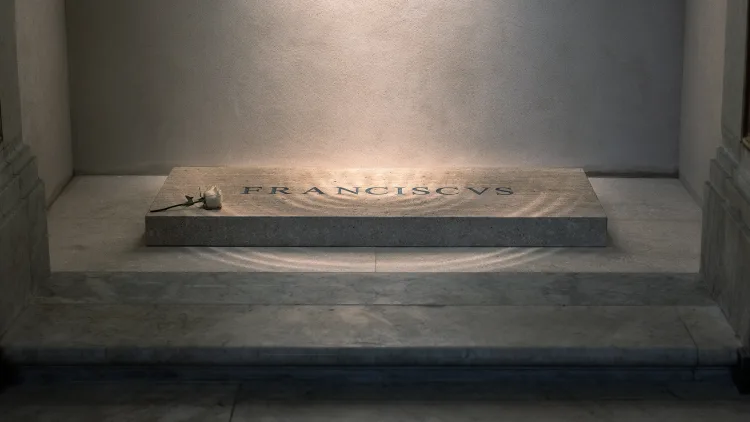
From Fast Company: “Pope Francis’s tomb is simple by design. Francis—a modest man who opted to live in humble quarters alongside his peers rather than in the Vatican’s official housing for the leader of the church—requested nothing more than his name and a cross to adorn regional marble (“the stone of Liguria, the land of his grandparents”). It really is quietly beautiful. But atop that marble is a tomb inscribed with the name “Franciscus.” Or what—due to terrible spacing between letters, known as kerning—reads something more like “F R   A NCIS VS.” Cheryl Jacobsen, a calligrapher and adjunct assistant professor at the Center for the Book at the University of Iowa, calls the engraving “horrifically bad,” noting that “there is no historical reason for spacing that bad.” Christopher Calderhead, editor and designer of Letter Arts Review, says it is “the most boneheaded rookie mistake you can imagine (pun intended).” Calderhead suspects the work was “farmed out to a run-of-the-mill tombstone company.”

Note: This is a version of my When The Going Gets Weird newsletter, which I send out via Ghost, the open-source publishing platform. You can see other issues and sign up here.

Continue reading “The Unabomber’s brother turned him in and then tried to win him back”

Treasure Island: The enduring enigma of Tucker’s Cross

From Mental Floss: “It was 1955, and Tucker, 30, was underwater in Bermuda. He was diving at the site of a shipwreck, which he would later learn to be the 16th-century Spanish ship the San Pedro. On the seventh day, Tucker was tugging on a piece of wood 30 feet below the surface when he made the discovery of a lifetime. The 22-karat cross, barely bigger than the palm of his hand, featured seven green emeralds unharmed by hundreds of years spent in the water. One dealer who got wind of the discovery offered Tucker $25,000 for it, the equivalent of $280,000 today. Another offer came from Clare Boothe Luce, the U.S. ambassador to Italy who held the cross’s Catholic symbolism in high esteem. She told Tucker she was prepared to pay $100,000 for it, or $1.1 million today. But Bermuda acquired Tucker’s cross, and they kept it on public display at the Bermuda Aquarium. In 1975, it was temporarily relocated for a special occasion: a visit from Queen Elizabeth II. Then it suddenly disappeared.”

Do cartoon rabbits eat carrots because Bugs Bunny imitated Clark Gable?

From Snack Stack: “We know that real rabbits aren’t huge fans of carrots. Is our association between animal and vegetable based not on nature but on a cartoon in which Bugs Bunny parodies Clark Gable in “It Happened One Night?” It’s true that wild rabbits aren’t going around digging up carrots just for a treat. They’re content with grass and clover and leaves and maybe the above-ground vegetables in the local gardens. I had to do some fact-checking. Is Bugs Bunny really imitating Clark Gable when he eats carrots? Yes, this checks out. This fact is discussed in the documentary “Bugs Bunny: Superstar,” released in 1975 and narrated by Orson Welles. And what about the idea that Bugs Bunny created the cultural belief that rabbits love carrots? It’s fairly easy to fact-check this. All we have to do is see if “bunnies eat carrots” was a common belief prior to 1940, the year that Bugs made his veggie-chomping debut in “A Wild Hare.”

Note: This is a version of my When The Going Gets Weird newsletter, which I send out via Ghost, the open-source publishing platform. You can see other issues and sign up here.

Continue reading “Treasure Island: The enduring enigma of Tucker’s Cross”

What should we do if an AI becomes conscious?

A recent New York Times piece arrived with a headline that asked “If AI systems become conscious, should they have rights?” If you were to judge the article by the response on social media like X and Bluesky (which is almost always a mistake, as many of you are no doubt already aware), you would think that writer Kevin Roose wrote some credulous claptrap about how all AIs are human and therefore we need to start thinking about their feelings. I’m not going to deny that some of the tweets and “skeets” (as some Bluesky users insist on calling their posts) in reaction to his piece are quite amusing, like the one from Daniel Kibblesmith which asked “Does my toaster miss me when I’m at work?” and “Are my washer and dryer married?” Another wrote: “Where does my reflection go when I walk away from the mirror?” which I quite liked, since a reflection of a person is very much what I think we are experiencing when we use artificial intelligence platforms like Anthropic’s Claude or OpenAI’s ChatGPT or Google’s Gemini.

Does my toaster miss me when I am at workAre my washer and dryer married

Daniel Kibblesmith (@kibblesmith.com) 2025-04-25T02:40:27.697Z

Gary Marcus, a psychologist and cognitive scientist who has gained a reputation as an AI skeptic, wrote that Roose’s piece was an example of “new adventures in AI hype,” and added that “I am not going to read Kevin’s column, and I don’t think you need to, either.” This seems to me like a somewhat classier version of the “I’m just reacting to the headline” response on X, which I’m not a big fan of. The skepticism was similar to the response Roose got to an article he wrote last year, about a conversation he had with Microsoft’s Bing AI. In the piece, Roose described how his discussion with the AI started out unremarkably, then quickly derailed. Roose said it seemed as though the Bing AI was bi-polar, with two distinctly different personalities — one a “cheerful but erratic reference librarian,” and the other… well, here is Roose’s description of it:

Note: This is a version of my Torment Nexus newsletter, which I send out via Ghost, the open-source publishing platform. You can see other issues and sign up here.

Continue reading “What should we do if an AI becomes conscious?”

People keep disappearing in Vermont’s ‘Bennington Triangle’

From Mental Floss: “Louis Knapp saw the girl in the red parka and decided to stop. It was roughly 3 p.m. on Sunday, December 1, 1946, and Knapp was driving along Route 67A in Bennington, Vermont. He asked the girl where she was going. To hike the Long Trail, she said, a reference to a path that climbed five miles up Glastenbury Mountain. She didn’t seem dressed for it, though. Knapp figured she was a student at Bennington College, which was right near where he had stopped. The two said little as Knapp neared his driveway on Route 9. Down the road roughly two miles was the entrance to the Long Trail. A few minutes later, Knapp’s daughter went outside, and there was no sign of the hitchhiker. The girl’s name was Paula Welden, and her fate would lend credence to the belief that the Long Trail seemed to harbor one story after another of people who simply vanished. So many, in fact, that it is called the Bennington Triangle.”

The mystery behind a Banksy painting that went missing from The Met is finally solved

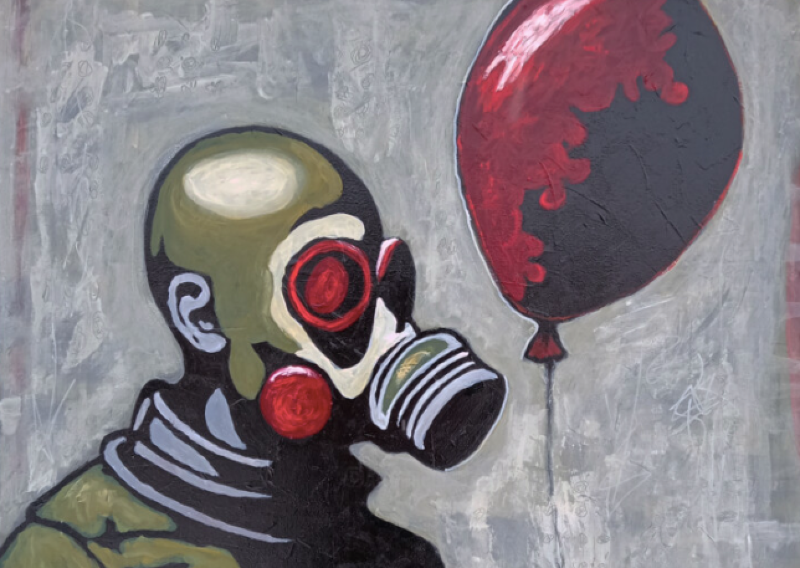
From the Art Newspaper: “Banksy has been making mischief for years, including hitting the US headlines in 2005 when he illicitly hung a work at the Metropolitan Museum of Art. John Barelli, the former head of the Met’s security department, said three accomplices helped the street artist to carry out the stunt. Two of them began arguing, distracting the guards, allowing the third, who wore a fake beard and a tweed hat, to covertly affix a painting to the wall. The intruder then placed a placard next to the painting: “Banksy, 1975. ‘Last breath.’ Oil on board. Donated by the artist.” Banksy apparently tried to reclaim his property. “About a month later, I got a call from our legal department, telling me that he wants it back,” Barelli said. “And I said, ‘Well, he can’t have it back. We threw it out.’” So where is the piece now? Barelli admits that when he retired, he took the work himself. “If I need some money, maybe I’ll do something with it.”

Note: This is a version of my When The Going Gets Weird newsletter, which I send out via Ghost, the open-source publishing platform. You can see other issues and sign up here.

Continue reading “People keep disappearing in Vermont’s ‘Bennington Triangle’”