More financial details re: Gigaom’s debt

There’s been a fair bit written about what helped to take Gigaom down a week and a half ago, and the role that debt played in the company’s failure (I wrote a personal take on the demise of the company). In a story about the shut-down, Peter Kafka at Re/code reported that sources told him the company borrowed $5 million in a debt round led by Western Technology Investments in 2011 and then borrowed even more debt after that. According to his story, by the end of last year, Gigaom was paying a total of $400,000 a month for rent and debt-service costs.

Thanks to Wong Joon Ian, an investigative reporter working for Coindesk who looked at securities filings from WTI, we have a few more details about the company’s debt load. According to SEC documents, the original loan from WTI was actually $4.7 million, but it came at the end of 2012 rather than in 2011 — and based on subsequent filings by WTI, Gigaom was paying more than $400,000 a quarter to service that single loan.

SEC records show that by the end of last year, Gigaom still had about $2.5 million remaining to pay on the loan, which was set to mature in February of next year. That means that in order to get current with its lender by the end of the loan period, the company would have had to boost its payments to $600,000 a quarter or find some other way of getting an injection of new funds. And it had at least $12 million more in debt outstanding apart from that WTI loan, according to Kafka’s story.

Joon Ian also notes that in an interview, the head of Western Technology Investment said that his firm likes to put borrowers who can’t pay their loans into what he called “friendly foreclosure,” so that they don’t have to file for bankruptcy, thus improving their chances of raising new funding or being acquired. Gigaom is reportedly talking with a number of media entities about acquiring some or all of its remaining assets, including the name and archive of published articles, as well as the company’s mailing list and possibly its events business.

Surveillance shouldn’t be the new normal

As the Globe and Mail has reported — based on classified documents obtained from an anonymous source — U.S. intelligence officials appear to be mapping the communications traffic of several large Canadian corporations, including Rogers Communications Inc., one of the country’s largest internet and telecom providers. Perhaps the most depressing aspects of this news is how completely unsurprising it is.

By now, we have all been subjected to a veritable tsunami of surveillance-related leaks, courtesy of documents obtained by former U.S. intelligence analyst Edward Snowden, a trove from which this latest piece of information is also drawn. These files suggest the National Security Agency uses every method at its disposal — both legal and otherwise — to track every speck of web and voice traffic, including tapping directly into the undersea cables that make up the backbone of the internet.

In that context, the idea that intelligence agencies are snooping on the networks of Canadian corporations like Rogers seems totally believable, despite the fact that a 66-year-old agreement between Canada and the U.S. supposedly prevents either country from spying on the residents of its partner. While the document in question doesn’t say that any snooping is occurring, it seems clear that the behaviour it describes is designed to create a map of those networks in order to facilitate future surveillance activity.

The U.S. has repeatedly argued that this kind of monitoring is necessary in order to detect the activities of potential threats to U.S. security. The problem with this approach, of course, is that no one knows where those threats will appear, or how they will manifest themselves — thanks to the diverse nature of modern international terrorism — and so the inevitable result is a kind of ubiquitous surveillance, in which every word and photo and voice-mail message is collected, just in case it might be important.

Photo by Carolina Georgatou

One of the risks inherent in the steady flow of leaks from Mr. Snowden and others is that the new reality they portray eventually becomes accepted, if not outright banal. Of course we are being surveilled all the time; of course our location is being tracked thanks to the GPS chips in our phones; of course the NSA is installing “back door” software on our internet devices before we even buy them. At this point, it’s hard to imagine a surveillance revelation that would actually surprise anyone, no matter how Orwellian it might be.

If nothing else, one of our duties in this kind of environment — a duty not just for journalists but for governments as well, and the Canadian government in particular — is to prevent this kind of behavior from becoming banal, to fight the overwhelming sense of “surveillance fatigue” that each new revelation triggers, by shouting our disapproval from the rooftops if necessary.

This is one reason why we should celebrate the existence of leakers and “whistle-blowers” like Mr. Snowden — and even entities like WikiLeaks, despite all the obvious flaws inherent in that organization and its founder Julian Assange — regardless of our partisan political leanings. The U.S. government and its allies may see both of these men as traitors, and their acts as treasonous, but how else are we to discover the innumerable ways in which we are being surveilled against our will?

If our government wants to maintain the trust of its citizens, it should mount its own campaign against these kinds of activities — which are taking place either with its explicit or tacit approval. Just because we are friends and trading partners with the U.S. doesn’t mean we have to submit to their vision of what the future needs to look like.

We don’t need to live in a world where the locks on our virtual doors have a secret pass-code so that government forces can enter at will if they believe we are a threat to national security, or where our every click is recorded and filed away in a secret location, and our cellphones and internet devices listen to our conversations waiting for us to utter certain red-flag trigger phrases. If our governments believe it is necessary to trade our freedom for what amounts to an illusion of security, we need to do everything in our power to convince them that it this is not a trade we wish to make.

This post originally appeared as an op-ed piece in the Globe and Mail

Gigaom is dead. Long live Gigaom

Last week, the place I’ve called my online home for over five years — a site that has been one of the leading tech blogs ever since my friend Om Malik started it in the Starbucks at the corner of Clay and Battery in San Francisco in 2006 — suddenly shut down. Gigaom was always more than just a job for me, and its death has hit me like the loss of a close friend. Like many of my former colleagues, I am still trying to process all of the feelings and thoughts its closure has triggered and understand why and how it happened. I consider this post just part of that process — I’m certainly not claiming to have any definitive answers.

Everyone wants to know why Gigaom failed, and what it says about the online media market. And I feel as though I should know, if only because I was one of the site’s media writers, and I have written so many times about the challenges other online outlets have faced. In fact, I’ve heard from more than one person who sees Gigaom’s death as some kind of karmic retribution for my past criticism of outlets like the New York Times — and perhaps it is. Frankly, it’s as good an explanation as any other.

For me, the business realities and technical aspects of Gigaom are all tied up with my feelings about the place, and about my friend Om Malik, who took a crazy gamble and left his job at Forbes to start a blog, and eventually built what I consider to be one of the best teams of writers and editors I’ve ever worked with. As I have said several times, I have absolutely zero regrets about agreeing to leave a comfy newspaper job and join him in that quest, despite the unfortunate way it ended so abruptly. Was it the best online media business ever? No. But it was a pleasure and a privilege to work there, and I am proud of what we accomplished.

paid_content_2745

If there’s one thing that bothers me about the site’s sudden closure, it’s that it might jeopardize the careers of or influence how people see my colleagues — excellent writers and editors like Stacey Higginbotham and Katie Fehrenbacher and Janko Roettgers and Laura Owen and Kevin Tofel and Derrick Harris and Kevin Fitchard and David Meyer and Jeff Roberts and Barb Darrow and Kif Leswing and Jonathan Vanian and Biz Carson and Signe Brewster and Carmel DeAmicis. If you haven’t already reached out to hire them, you should. They are rock stars, and they don’t deserve to have their work denigrated in this way, with bank trustees — or their corporate handmaidens — telling them to turn in their laptops and shut off the lights when they leave.

I’ve talked to several media outlets about Gigaom’s death — including Digiday and the Poynter Institute and the Columbia Journalism Review — and that has helped me think through some of the issues around it. Was Gigaom killed by its reliance on outside venture capital, as some have argued? In part, I think it was. As I mentioned in one interview, VC money is a Faustian bargain of the first order: it gives you the freedom to grow quickly, but it also puts pressure on a company to show meteoric growth, and there is a harsh penalty for not doing so — and the media industry isn’t exactly known for meteoric growth of the kind VCs like to see.

One aspect that many people are ignoring, however, is that Gigaom also took on debt, via a financing with several lenders including Silicon Valley Bank, in an attempt to juice its growth even further. In a different kind of market or at a different time, this might have worked — but ultimately the company failed to produce enough cash to service that debt, and that is part of what took it down (Peter Kafka at Re/code has more on that). Creditors are orders of magnitude less accommodating than shareholders or equity investors, and they tend to be a lot more nervous as well. When they want their money, all the happy stories about future growth that startups tell VCs mean less than nothing.

om-malik-christopher-michel-cc-by-2

Was Gigaom also killed by the merciless evolution of the online media market? I think to some extent that’s true as well — as I told CJR, when Gigaom started, and even up to a few years ago, having a staff of 50 and 6 million unique visitors a month would have seemed like a huge success. But in a world in which behemoths like BuzzFeed and Vice are the paragons of virtue, with thousands of staff and massive traffic, Gigaom must have looked like a pipsqueak, and that affects everything from advertising to funding.

The other aspect of the business that some media-focused sites aren’t including in their calculations is that Gigaom has never been just an editorial operation that lived and died on advertising. One of the most innovative aspects of the Gigaom model was that it had three legs: ad-funded editorial, events (conferences), and a subscription research arm where analysts wrote reports for corporate clients. I still believe that this model can work, despite what some might argue is overwhelming evidence to the contrary. It’s very similar to the model that a publisher like The Economist uses, for example. Ad-supported editorial helps build a relationship with readers, and events and subscription products eventually monetize that relationship, if everything works properly.

gigaom_1382541627_88

I don’t have — and never did have — access to the in-depth financial aspects of Gigaom’s business (and perhaps I should have, as my former colleague Celeste LeCompte argued in a recent Nieman Lab piece). But my understanding of what happened is that the editorial side of the business was not the problem. Was it hugely profitable? No. But was it doing any worse than plenty of other editorial outlets in terms of revenue or cash flow? No — in fact, quite a bit better than many, as far as I can tell. But ultimately the research arm seems to have failed to generate enough cash to justify the money that investors (and creditors) lent us to build it. Whose fault is that? I honestly have no idea. Was the model flawed, or just the execution of it? Again, I simply don’t know.

Some have argued that Gigaom was guilty of an excess of hubris, and that instead of trying to grow into something so quickly, it should have taken the slower approach of a niche site like Search Engine Land. There is certainly nothing wrong with that idea — sites like Danny Sullivan’s or Jessica Lessin’s The Information, or Mike Masnick’s TechDirt, or even Ben Thompson’s Stratechery are great examples of how small can be good. But that doesn’t mean creating such a site is the only way to go — others would like to reach for the stars, and that desire is a big part of what makes Silicon Valley what it is: an infuriating place filled with hubris and ego, but also a great example of what people can achieve when they push themselves.

Did Gigaom fail in its attempt to reach that goal? Yes. But that doesn’t mean the goal wasn’t worthwhile, or that what we built while striving to reach it was any less great. I would like to thank my friend Om for giving me the opportunity of a lifetime, and I would like to thank all of my colleagues for the pleasure of working with one of the best editorial teams on the planet. I am happy to call you my friends as well as my former co-workers. It was a great ride while it lasted. Onward!

Jason Calacanis on Gigaom

If you know things are bad, you need to cut hard and deep, trying to avoid the bone. However, like we’ve seen in The Walking Dead, it’s better to chop off your arm than to become a Walker!

Snapchat CEO meets with Saudi billionaire Prince Alwaleed

Could Snapchat, the red-hot messaging service that is reportedly working on a new funding round that will value the company at $19 billion or more, be getting some of that funding from billionaire tech investor Prince Alwaleed bin Talal? It sure looks that way: the Saudi prince’s investment company put out a statement on the weekend saying that bin Talal met with Snapchat CEO Evan Spiegel and the two talked about a “potential business co-operation” between their respective companies.

Prince Alwaleed — whose full name is Alwaleed bin Talal bin Abdulaziz al Saud — is a member of the extended Saudi royal family, and a veteran technology investor who has a stake in companies like Twitter, and a track record of investing early in companies like Apple. As a number of sources have also pointed out, the prince recently sold his stake in News Corp. and is said to be looking for a new-media entity to invest in.

Alwaleed’s interest may also be fuelled by the amount of usage that Snapchat gets in his home county. Many social-media apps like Twitter are popular in Saudi Arabia — in part because they give people a way to talk about the country’s current political regime and its various restrictions on free speech and other human-rights issues — but for Snapchat in particular Saudi Arabia is one of the largest non-U.S. markets in terms of usage.

150309093710-snapchat-execs-prince-alwaleed-780x439

Snapchat has been growing rapidly over the past year, and now has more than 100 million users. And while the service started as an “ephemeral messaging” app that automatically deleted messages after a certain amount of time, it has expanded its horizons beyond just that market by launching a number of new features — including a new service called Discover, which provides short video clips and other content from media partners like CNN and BuzzFeed.

Discover is still relatively new, but media-industry insiders say the number of unique visitors and engagement levels the service is driving are huge: Digiday quoted one as saying the traffic numbers were “f***ing incredible.”. And in a recent piece about how new apps like Snapchat and Vessel are trying to compete with YouTube to lure content creators, the WSJ said that the Food Network saw more than 10 million unique visitors to its platform in 12 days after it joined the Discover service.

The platform’s popular “Snapchat Stories” are also driving massive numbers of visitors, as my colleague Carmel DeAmicis recently reported. Numbers like that are making many media watchers sit up and pay attention, so it’s not surprising that they would have caught the eye of a prominent media-industry investor like Prince Alwaleed. Whether he eventually pulls the trigger and makes an investment in the company remains to be seen.

While others shut down comments, the NYT says it wants to expand them

If there was a ranking of popularity for online behavior, internet comments would probably wind up somewhere just below pop-up ads or auto-play videos. Seen by many as a haven for trolls and spam, a number of sites — including Popular Science and Bloomberg — have gotten rid of them. But there are still those who believe allowing readers to comment is a worthwhile endeavor, and the New York Times appears to belong to this group: instead of getting rid of them, the paper says it plans to expand comments and invest more resources in them.

Community editor Bassy Etim told public editor Margaret Sullivan that in contrast to some other organizations, the Times sees the readers who leave comments on its site as a “celebrity class” of users, and wants to give them more features and recognize their contributions. How exactly it plans to do that isn’t clear, but Etim also said that the number of Times stories that are open to comments will also increase — from an average of about 20 each day to more than twice that (opinion columns are almost always open to comments).

Unlike many of the other organizations that have chosen to kill off their comments — including Re/code, Reuters and The Week — the New York Times apparently doesn’t believe that social-media networks such as Twitter and Facebook can take the place of reader interaction directly on the Times site. As I’ve tried to argue before, the fact that those tools exist should be seen as an addition to traditional commenting, not a replacement for it. In addition to the Times, sites like Quartz, Medium and Gawker have been experimenting with ways of improving comments rather than killing them.

Those are real readers

One common argument made by sites that have chosen to kill their comments is that the people who post comments aren’t a publication’s “real” readers, and/or make up such a small proportion of the readership that they don’t really matter. Bloomberg’s online editor Joshua Topolsky, for example, said that the site would not have comments after a redesign because the number of people who would be served by them was so minuscule:

“You’re really talking about less than one percent of the overall audience that’s engaged in commenting, even if it looks like a very active community. In the grand scheme of the audience, it doesn’t represent the readership.”

This kind of comment ignores a number of things, however: One is that an active community of readers should never be ignored, even if some of them behave badly from time to time (and in fact that kind of behavior only increases if you ignore them). And the second is that even if the number of people who comment is low, the number of readers who pay attention to comments is arguably a lot higher — given the traditional social-media rule of thumb that says 90 percent of people read or lurk, with only one percent taking action.

2583886589_01ce541f8a_z

New York Times public editor Margaret Sullivan, who spent part of her column discussing the problems that readers have with the NYT’s comments — including having comments not show up, or not being able to post them because a story has already been closed to new comments — said she believes that comments are a key part of the newspaper’s relationship with its readers. While the Times system is not perfect, she said, “reader commenting is one of the best ways for The Times to stay close to its readers and what they care most about.”

Comments have value

The NYT isn’t the only major publication that believes comments have value: Aron Pilhofer, the head of digital for The Guardian in London — and the former head of the digital team at the New York Times — said at the recent News:Rewired conference that he believes media organizations who choose to shut down their comments are making a huge mistake:

“I feel very strongly that digital journalism needs to be a conversation with readers. This is one, if not the most important area of emphasis that traditional newsrooms are actually ignoring. You see site after site killing comments and moving away from community – that’s a monumental mistake… readers need and deserve a voice. They should be a core part of your journalism.”

The audience-development team at the Times is said to be working on a number of potential enhancements to the commenting function at the paper, changes that are expected to build on some earlier features and experiments with added functionality — such as the introduction of “verified commenter” status. Verified commenters are selected by the Times based on their previous behavior and can post comments without having them be moderated before they appear (the paper has a moderation team of about 13 people).

As I argued at the time, the verified-commenter feature could have been the first step in getting some devoted Times readers to “level up” or become more involved in a community of readers at the paper, a relationship that could then be monetized in a number of ways. The Times is also a partner — along with a number of other media organizations such as the Washington Post — in a project being run by the Mozilla Foundation, called The Coral Project, which is building an open-source platform for reader interaction, including comments.

While others shut down comments, the NYT wants to expand them

If there was a ranking of popularity for online behavior, internet comments would probably wind up somewhere just below pop-up ads or auto-play videos. Seen by many as a haven for trolls and spam, a number of sites — including Popular Science and Bloomberg — have gotten rid of them. But there are still those who believe allowing readers to comment is a worthwhile endeavor, and the New York Times appears to belong to this group: instead of getting rid of comments, the paper says it plans to expand its commenting features and invest more resources in them.

Community editor Bassey Etim told public editor Margaret Sullivan that in contrast to some other organizations, the Times sees the readers who leave comments on its site as a “celebrity class” of users, and wants to give them more features and recognize their contributions. How exactly it plans to do that isn’t clear, but Etim said the number of Times stories that are open to comments will increase — from an average of about 20 each day to more than twice that (opinion columns are almost always open).

Unlike many of the other organizations that have chosen to kill off their comments — including Re/code, Reuters and The Week — the New York Times apparently doesn’t believe that social-media networks such as Twitter and Facebook can take the place of reader interaction directly on the Times site. As I’ve tried to argue before, the fact that those tools exist should be seen as an addition to traditional commenting, not a replacement for it. In addition to the Times, sites like Quartz, Medium and Gawker have been experimenting with ways of improving comments rather than killing them.

Note: This was originally published at Gigaom, where I was a senior writer from 2010 to 2015. The site still exists, but the archive has been taken down.

Continue reading “While others shut down comments, the NYT wants to expand them”

The $19-billion question: Is Snapchat the new television?

Not that long ago, Snapchat turned down a massive $3-billion acquisition offer from Facebook, and almost everyone thought the company had lost its mind. Now, the startup is reportedly raising money in a financing round that will value it at a staggering $19 billion. Is there anything that could justify putting that kind of market value on a company that is only four years old and has almost no revenue?

Technology analyst Ben Thompson thinks there is — and it’s more than just the fact that Snapchat has a huge audience of millennials and younger users, although that’s clearly part of it. Thompson argues in a recent post at his Stratechery blog that one of Snapchat’s strengths is somewhat counter-intuitive: Namely, the fact that its model is a lot more like television than it is anything else.

“Mark Zuckerberg, earlier than just about anyone, clearly saw just how much money is going to be made on mobile. And, rumor has it, Snapchat’s investors completely agree: Bloomberg reports the company will soon be valued at $19 billion. To understand why you need to look not at other social networks, but rather TV.”

Ephemeral advertising

I confess that I found this idea jarring at first. How could a brand new mobile app that offers disappearing messages be anything like the massive market that is the conventional television business? But Thompson makes an interesting case, and one that supports the idea that Snapchat’s revenue from advertising — if it is handled properly, of course — could be substantially more than most are expecting.

admin-ajax (2)

This argument rests on the idea that television is being disrupted, but not just because younger viewers are cutting the cord and streaming more video through other means (something Thompson doesn’t believe is quite as widespread as many analysts assume, thanks to cable’s lock on things like sporting events, etc.). From a revenue perspective, the real disruption is that advertising is increasingly moving away from TV, and one of the places it is going in search of new viewers is mobile.

Old media ad model

So what makes Snapchat so appealing? One thing is that its media model — at least what we have seen so far, with the new feature Discover — is relatively old-fashioned: instead of just having a bunch of user-generated content and then some native advertising mixed in, the way Twitter and Facebook do, Snapchat offers a selection of content created by a handful of media partners like CNN and Vice.

It’s true that this content is made up of short video clips and in some cases deals with unusual topics, but one of the surprising things about Discover is just how traditional it is: A lot of it is news organizations talking about the weather or ISIS or whatever is in the news — and best of all, because of the way that Snapchat works, users have to hold their finger down the whole time they are watching it. This means advertisers know for a fact that someone actually sat through their entire ad.

“Here is what Snapchat offers: Nearly 200 million monthly active users, including greater than 50% penetration among users 18-24 (33% among users 18-34), and those numbers continue to grow rapidly. Very immersive ads that can only be viewed by holding your finger on the screen; brands can have a very high confidence their message is being viewed.”

The new couch potato

Thompson offers a quote from Slate TV critic Willa Paskin that puts it well: Snapchat channels, she says, “are a throwback to the couch potato mode of passive consumption,” with stories selected for you by Cosmo, CNN, etc. All of that is available on the web as well, but using Snapchat makes it even easier because it’s in one place: “You don’t have to search for anything, click on anything, seek out anything. It has already been picked out for you. Everywhere you and your phone are has become the proverbial couch.”

old-tvs-o

Obviously, Snapchat is not alone in this market. There are other video players who are a major force in mobile video, or getting there, including YouTube and things like Amazon Prime Video. And Facebook is not just going to sit around and watch Snapchat take over a market like that — which is why some are talking about (or perhaps hoping for) another WhatsApp-style $20-billion acquisition offer for Snapchat.

I’m also not as convinced as Thompson is that the lack of information on Snapchat’s viewers (apart from them being young) is going to work for a majority of big-brand advertisers. Thompson argues that this makes Snapchat more like TV, where figuring out who is actually watching your content is a game of smoke and mirrors — and that’s true. But in a world where Facebook can offer hyper-targeting of individual users based on a vast range of demographic and interest-based vectors, is a mass-media style offering of undifferentiated users really that appealing?

Thompson’s main point, however, seems unassailable: advertising is moving away from traditional television — in part because the audience is moving, but also because TV is becoming more about subscription-based models rather than advertising — and that money is going to have to go somewhere. And one of the places it is going is definitely mobile. Whether that means Snapchat is worth $19 billion or not remains a rather large question mark.

Medium gets a little more Twitter-like, and a little more blog-like

One of the interesting things about Medium — the combination platform and publishing company that former Twitter CEO Evan Williams launched in 2012 — has been watching it evolve in real time, as it tries out new features and changes existing ones. In its latest evolution, Medium has added several new tools that feel very similar to the two things that Williams is probably best known for: namely, Twitter and Blogger.

When it first emerged, and for most of the time since then, Medium has been seen as primarily a place for long-form posts or articles, in part because the site has a clean and flowing design that encourages large images. Most of the content that the site itself commissioned and paid for has also tended to be long-form, and Williams has often talked about his vision for the site as being similar to a magazine.

Short and long

On Tuesday, however, Medium announced a number of new additions to the service, including a very Twitter-like instant post-creation tool that appears on the front page of the site, with a simple box and the phrase “Write here,” and allows users to publish quickly. In a blog post, Williams said he wanted to make it easier “to start writing whenever you have an idea — and also to make it feel like less of a big deal to do so.”

medium-write-here

Another feature is more of a redesign of the individual author pages, profiles and tag pages — the latter being the new name for what used to be called topic “channels.” Now authors and editors can add tags to their posts and those posts show up in a feed that is arranged by tags such as Tech or Media or Photos, and then filtered by an algorithm based on how many users shared or recommended each post.

The redesign of tag and author pages turns them into more of a stream, Williams said — in fact, a very blog-like stream, with a mix of the shorter posts that the site is trying to encourage and longer posts that readers have to click through to view. Much like tweets, the shorter posts can be read within the stream in their entirety, and readers can click to recommend or share them without leaving the stream.

1-f-sufdc9v0a-m0uywtjxma2x

Although Williams didn’t say this, it seems fairly clear that Medium is trying to lower the barriers to creating content on the site — in much the same way that Twitter has been trying to decrease the friction between new users and the service, in order to increase engagement. Although Medium doesn’t really talk about numbers, it seems likely that it wants to broaden the reach of the site beyond just people who feel comfortable writing a 1,000-word blog post, choosing multiple images, etc.

A home for all kinds

In his blog post, the Medium founder suggests that the changes were made to counter the impression that Medium was just for long-form publishing, rather than a home for publishing content and ideas of all kinds, regardless of length:

“It was not our intention, however, to create a platform just for long-form content or where people feel intimidated to publish if they’re not a professional writer or a famous person (something we’ve heard many times). We know that length is not a measure of thoughtfulness.”

Given Williams’ experience with creating — or helping to create — both Twitter and Blogger, it shouldn’t be a surprise that he might want to take the best qualities of each of these platforms and build them into Medium somehow. But can a service be all things to all people? Can Medium support both long-form and short, Twitter-style content at the same time? Quartz editor Gideon Lichfield raised that question in a Medium post, entitled “Is Medium now >140 Twitter?” In a response, Williams says he believes it can do both:

“We go back and forth from the meaty to the light weight all day long on the web. Commentary and reporting. Snapshots and long-form posts. Our brains jump from one thing to another all day long, and we figure it out. Is it a challenge to do this under one system? It is?—?both from a design and brand standpoint. But we don’t think it’s impossible.”

The main differences between the new Medium and Twitter, Williams said, are that Medium isn’t intended to be for “status updates,” and it’s not really about social interaction (it does have comments, but they are called “notes” and they have to be approved by the author before they appear). And it’s also not real-time. The Medium founder said the changes were made because he believes “there’s a wide open middle-ground between what happens on social media and what happens in more formal publishing.” And that, Williams says, is where the site believes its home will be.

In the age of niche media, everyone still really wants to be mass

One of the best things about the web is that it has meant an explosion of choices when it comes to media, especially recently — with the rise of BuzzFeed, the launch of sites like Vox and Fusion, and blog networks like Gawker. And of course we still have all the old places too, like the New York Times and Washington Post and The Atlantic. If anything, we have too many places publishing great content for anyone to keep up.

And that brings up a related problem, which Purdue University doctoral student Frederik De Boer wrote about in a recent blog post. In a nutshell, De Boer said that his problem with many of the new-media sites that have popped up over the past year, such as Fusion — which was launched recently by the Fusion network, a cable channel co-owned by Disney/ABC and Univision that caters to millennials — is that they share a certain sameness of content.

”It just isn’t about anything in the way that the site’s founders and editorial people clearly want it to be. You can write a manifesto, and you can have some sort of goofy TV channel side-piece going on, and you’re still another site publishing people writing about news and politics and culture and sometimes sports. And in that, you’re joining every other website that publishes about news and politics and culture and sometimes sports.”

Note: This was originally published at Gigaom, where I was a senior writer from 2010 to 2015. The site still exists, but the archive has been taken down.

Continue reading “In the age of niche media, everyone still really wants to be mass”

In the age of niche media, everyone still really wants to be mass

One of the best things about the web is that it allows almost anyone to start up a website, and that has meant an explosion of choices when it comes to media, especially recently — with the rise of BuzzFeed, the launch of sites like Vox and Fusion, and blog networks like Gawker. And of course we still have all the old places too, like the New York Times and Washington Post and The Atlantic. If anything, we have too many places publishing great content for anyone to keep up.

And that brings up a related problem, which Purdue University doctoral student Frederik De Boer wrote about in a recent blog post. In a nutshell, De Boer said that his problem with many of the new-media sites that have popped up over the past year, such as Fusion — which was launched recently by the Fusion network, a cable channel co-owned by Disney/ABC and Univision that caters to millennials — is that they share a certain sameness of content. They all want to believe they are different, but they aren’t.

“It just isn’t about anything in the way that the site’s founders and editorial people clearly want it to be. You can write a manifesto, and you can have some sort of goofy TV channel side-piece going on, and you’re still another site publishing people writing about news and politics and culture and sometimes sports. And in that, you’re joining every other website that publishes about news and politics and culture and sometimes sports.”

A striking sameness

De Boer goes on to talk about other sites such as Slate and The Atlantic, the revamped New York Times magazine, the New Republic, Vox and several others, and his point (as I take it) is that each of these is producing something very similar to its competitors — the names may be different, and each site has something or someone that might stand out from time to time, but for the most part they are each covering the news in politics, culture and sometimes sports in a very similar way.

73979876

Some of De Boer’s criticisms of different sites feel a bit like a drive-by-shooting: the New Republic, for example, consists of “the same stuff, written by every non-white male [new editor] Gabriel Snyder could find to exorcise the vengeful presence of Marty Peretz,” while Vox has “a new-fangled invention called the card-stack — an innovative approach which allows webpages to link to other pages.” The Awl is described as “a lot of the same stuff, brought to you by the emotion sadness.”

Those sarcastic descriptions aside, however, I think De Boer makes a good point, which is summed up in the title of his post: “Unless your site is about one thing, it’s about everything.” I think his point is that if your site doesn’t have a unique focus, or a theme or defining vision when it comes to what you cover and when, then you are going to look like everyone else. And that’s not a good thing.

“I no longer know what a website means as an identity, unless that identity is a specific subject. I know what Guns and Ammo is. I know what Road and Track is. (I know what Redtube is.) I don’t know what Fusion is.”

That’s not to say everything is mass-oriented, of course. Sites like Search Engine Land and Skift are aimed at a niche market, and while they may not get as much publicity, they are arguably better businesses in many ways. Other sites such as The Information — which charges $400 a year — are clearly aimed at niche readers as well. But most of the attention in the media sphere seems to go towards the sites with the really big numbers, like BuzzFeed or Gawker.

A drive for revenue

It’s ironic in many ways, but there’s a tension within the online media industry right now: Even though the web theoretically allows individual writers or groups of writers to target very specific audiences and be successful doing so — as the tech blogger Ben Thompson has been able to do with his site Stratechery, for example — there is still a huge amount of pressure (both perceived and actual) for sites to be as broad and encompassing as the mass media they have replaced.

2583886589_01ce541f8a_z

Much of that pressure comes from an advertising-driven revenue model, which is driven by the need for large numbers, of pageviews or unique visitors, etc. My friend Josh Benton at the Nieman Journalism Lab is right that some of this comes from the fact that BuzzFeed and Vox are VC-funded and therefore need scale. But on top of that, there is internal pressure for a broad or large audience, because it makes those who are writing and publishing feel as though their work has more value. Says De Boer:

“These places run good writing. I’m not disputing that. I’m just saying that they are always launched with fanfare about what makes them different, but I’m not sure that you can ever maintain that kind of vision as an actually-existing publisher unless your site has a very specific, subject matter-based focus. When you’ve got to find enough writing to run, and you’ve received some great pitch that might not reflect your mission statement, what are you gonna choose? The abstraction of sensibility or the reality of good writing?”

The risk is that because you can write about anything, you feel like you should write about everything. But De Boer’s point is a good one. To the extent that your content feels as though it could have appeared at any one of a dozen different sites, that’s bad — it makes it dramatically less likely that anyone will a) remember your site or b) deliberately choose to go back there.

With more and more people finding content through social networks and sharing, there’s already a declining likelihood that they will remember where a specific piece of news or commentary came from. Do you really need to make it even harder by writing about all the same things every other site is? That leaves you chasing the drive-by, click-through audience, and that is the worst business in the world. Anything you can do to differentiate yourself is good. But too many are chasing the mass audience because that’s what advertisers want and that’s what investors want.

Two great examples of how journalism has changed for the better

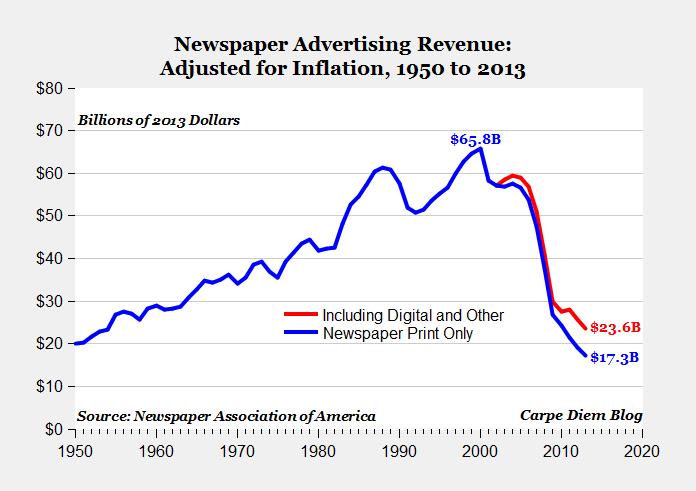
Are we living in a golden age for journalism, or is it the Dark Ages? There’s nothing that gets a group of media types going like that question, which is kind of an updated version of a perennial favorite: “Are bloggers journalists?” Obviously, the kind of upheaval that leads to mass layoffs at papers like the Chicago Sun-Times or the loss of $500 million in ad revenue for the New York Times is nothing to sneeze at.

But it’s important to take note of the good things that the web has brought as well — and the best is that journalism has been freed from its confines, and is available to anyone, anywhere, at any time. And that can be very, very powerful.

Everyone likes to point out when this state of affairs fails in some way: like when Reddit users identified the wrong man as the Boston bomber in 2013, for example, or when a network of media sites perpetuate obvious hoaxes and misinformation because they care more about clicks than the truth, something Craig Silverman described in detail in his recent report for the Tow Center for Digital Journalism at Columbia University.

Note: This was originally published at Gigaom, where I was a senior writer from 2010 to 2015. The site still exists, but the archive has been taken down.

Continue reading “Two great examples of how journalism has changed for the better”

Upworthy says native advertising is working better than expected

The conventional view of Upworthy is that it is just one of a number of sites that specialize in viral “click-bait,” but the site’s founders have always maintained that it is different because the content it chooses has a larger social purpose behind it, as opposed to just driving clicks. And that’s partly why its native advertising program is working better than expected, the company says — pulling in more than $10 million in revenue in the first nine months of last year.

Upworthy’s version of native advertising or sponsored content — something almost every media entity both new and traditional is experimenting with, including the New York Times — is called Upworthy Collaborations, and involves the site partnering with major brands to create content that looks and behaves exactly like the rest of the content Upworthy posts, most of which is designed to be uplifting or socially conscious in some way.

This makes the program a good fit for advertisers whose message is also designed to be uplifting or socially conscious: for example, one of the early participants was Unilever, which used the platform to promote its “Project Sunlight” initiative — a program aimed at helping feed needy children. Unilever executive Marc Mathieu said the partnership with Upworthy had far better results than the firm expected.

“In less than 8 months, we’ve sponsored and promoted dozens of pieces of content, and have reached over 175 million social impressions, and 6 million social interactions, from over 15 million viewers. We’ve also seen a 17% increase in brand perception among users engaging with the series recognizing Unilever as being committed to protecting the planet.”

Other advertisers who have participated in the program include Whirlpool, Gap, Holiday Inn, Virgin Mobile and Universal Pictures. Universal set up a native ad campaign around its feel-good film Unbroken, about an Olympic runner who is sent to a concentration camp during the Second World War. Marketing executive Doug Neil said the partnership resulted in a lot more engagement with potential viewers than other types of campaign.

“We created a strategic bundle of content — some that we provided, and some that Upworthy curated — that centered around perseverance of the human spirit in the face of adversity, which is the core of Louis’s story. We also asked people to tell their own stories as part of the #IAmUnbroken movement. The campaign exceeded expectations by generating over 60,000 social interactions in just a few short weeks leading up to the film’s release.”

Upworthy said that according to NewsWhip — which measures how content from a variety of media sites performs on social networks such as Twitter and Facebook — the site’s sponsored content performed 38 times better than the industry standard for social interactions involving content at the top 25 social publishers.

Two great examples of how journalism has changed for the better

Are we living in a golden age for journalism, or is it the Dark Ages? There’s nothing that gets a group of media types going like that question, which is kind of an updated version of a perennial favorite: “Are bloggers journalists?” Obviously, the kind of upheaval that leads to mass layoffs at papers like the Chicago Sun-Times or the loss of $500 million in ad revenue for the New York Times is nothing to sneeze at. But it’s important to take note of the good things as well — and the best is that journalism has been freed from its confines, and is available to anyone, anywhere, at any time.

Everyone likes to point out when this state of affairs fails in some way: like when Reddit users identified the wrong man as the Boston bomber in 2013, for example, or when a network of media sites perpetuate obvious hoaxes and misinformation because they care more about clicks than the truth, something Craig Silverman described in detail in his recent report for the Tow Center for Digital Journalism at Columbia.

But I think it’s also worth pointing out when “citizen journalism” — or networked journalism, or whatever we want to call it — really works, and a couple of great examples of that have come to light recently. One of them is related to a project that I’ve written about: namely, the Ukrainian Vehicle Sightings Database that British investigative blogger Eliot Higgins and his team have been putting together, which tracks the movements of Russian troops and machinery in and around Ukraine.

bellingcat-project

Eliot, as I’ve mentioned before, has no formal journalistic training and no background in media whatsoever. But starting from his flat in Leicester, England in 2011 — where he blogged under the nom de plume Brown Moses — he became an expert in Syrian weaponry and terrorist activity by studying YouTube videos and networking with other self-taught experts. His research was cited by New York Times writer C.J. Chivers, and helped confirm that the Syrian government was using banned weapons.

In a similar way, the open database of vehicle sightings in Ukraine that Eliot and his team at the Bellingcat site have been putting together — using photos and videos and eyewitness reports of vehicles, blast craters and burn marks that have been posted by residents — has produced some fairly strong evidence that Russia has been firing missiles and other weaponry into Ukraine from inside Russian territory, despite repeated Russian denials that it is doing any such thing.

The second example comes via a piece in the New York Times magazine, which will be published in print this weekend but is already available online. It tells the story of a group of residents who live in one of the worst slums in Rio de Janeiro — a group that calls itself “Papo Reto,” meaning “straight talk.” Armed with cellphones and nothing more, they have been documenting police and government violence in Rio favelas, at great personal cost, because the Brazilian media apparently isn’t interested.

Ribeiro predicted that at some point the police would turn on the crowd. They wanted to be on hand when it happened. “Tonight, this protest will be on the news, but I doubt any of the big television stations will show the police doing anything wrong,” Ribeiro said. That was what his camera was for.

In both of these cases, there is a key reason why amateur journalism is required: in Ukraine, it is difficult for media outlets to devote the kind of resources that would be required to document every sighting of every Russian vehicle, or spend weeks analyzing different types of missile, or the blast marks that they leave when they are fired from a truck. Crowdsourcing of the kind Bellingcat does isn’t just a nice addition to existing coverage, it adds a crucial missing element.

NYT magazine Rio feature

In the case of the Rio favela, the existing media doesn’t seem interested if a few people happen to die suspiciously, since that happens all the time — but it is of extreme interest to the residents of the Complexo do Alemão slum, and also to human-rights groups like Witness, which is trying to help more “citizen journalists” document that kind of behavior in similar situations around the world.

In a similar way, Twitter and other forms of social media have become crucial pathways for information in countries like Turkey, where most of the traditional media are either uninterested in the activities of the government or censor themselves because they don’t want to rock the boat. Twitter has become so important that Turkey has tried to ban it, and has pressured the company to block content — including the account of an alternative newspaper (to its credit, Twitter refused).

Are there flaws in citizen journalism? Of course there are. Is there a downside to giving everyone a video camera and a Twitter account and telling them to become reporters? Definitely. But there is also a massive upside to doing so, and examples like Bellingcat and Papo Reto in Rio de Janeiro make that point better than I ever could.

It’s not just about quizzes and listicles — it’s about experimentation

As NYU journalism professor Jay Rosen likes to say, you can tell a lot about people and their views on media based on what they say about BuzzFeed. And one of the things that critics often focus on is how much of the site is devoted to listicles or quizzes or other ephemeral content (as though newspapers don’t devote a lot of their space to similar pursuits, such as crossword puzzles or the comic section).

As a new report published by the Tow Center for Digital Journalism at Columbia University points out, however, there is a serious purpose to much of this game-playing by BuzzFeed that more media companies could learn from. It’s about more than just driving traffic, as some of the site’s critics seem to suggest — it’s about encouraging an atmosphere of experimentation, and then learning from what works.

Gamification of news

The report was written by Columbia PhD student Maxwell Foxman, and looks at what some like to call the “gamification” of the news, or the use of playful approaches to conveying information. As the author notes in his paper (the full PDF version of which is here), the engagement value of this kind of approach can be huge: the most-viewed piece of content the New York Times published in 2013 wasn’t an investigative news story, but a quiz based on the distribution of different American dialects. Says Foxman:

“Despite stigmas and fads surrounding play and the news, we can draw vital lessons from their complex relationship. Many of the tools that online newsmakers use are similar to those applied in games. Even the fervor with which we share information on social media can be considered playful. British broadcaster Charlie Brooker put Twitter at the top of his list of the twenty-five most significant video games.”

crossword-slide

As Foxman points out, the criticism of shallow features aimed at entertaining an audience didn’t start with BuzzFeed and its listicles or quizzes — when newspapers first started including crossword puzzles in the early 1900s, they became a public sensation, with Broadway songs written about them. But the New York Times (which now has one of the most popular puzzles in the world) called it a “sinful waste” and said those who filled them out got “nothing out of it except a primitive form of mental exercise.”

The Columbia student also describes how crossword puzzles evolved over time thanks to input from users, a test-and-response method that he encourages newspapers and other media companies to adopt for more things than just puzzles. This approach is also the subject of a book by game designer and academic Ian Bogost, called “Newsgames: Journalism at Play,” which was published in 2010. In one example of an early news-game, readers were encouraged to pretend that they were living in the Darfur refugee camp.

Run, test and repeat

Unfortunately, as Foxman notes, the trend of “gamification” on news sites that started several years ago quickly veered into a fascination with giving readers meaningless things like badges and other alleged “rewards” for participation on the site, as the Huffington Post did with a major initiative it rolled out in 2011. Since there was no real incentive for accumulating these rewards or engaging in the behavior they were meant to encourage, however, they had little effect.

dsc_5899

During his research, Foxman talked to a number of people at BuzzFeed, including Jack Shepherd, who was employee number eight and now runs the Buzz entertainment vertical, as well as members of the site’s gaming team. Shepherd points out that the site’s entire editorial approach is a kind of game-playing, saying the idea was not to “sit around [and] assign stories based on what we thought were the important stories of the day” but to see what people were actually sharing and build on that:

“We do the equivalent of play testing with our posts. We’ll try a bunch of different things and then the stuff that is doing well and getting shared is the stuff that we start showing people more, and the stuff that isn’t really working, we won’t show people as much.”

In the end, one of the most important aspects of BuzzFeed’s approach — as I tried to point out in a post about what it and other new-media companies like Quartz and Gawker are doing right — is that it is based on experimentation, and iteration. In that sense, it looks at the news or at content generally as a product or a service. Is it working? Why not? What do people respond to better? That’s not the way most traditional media companies look at what they do, but it probably should be.