
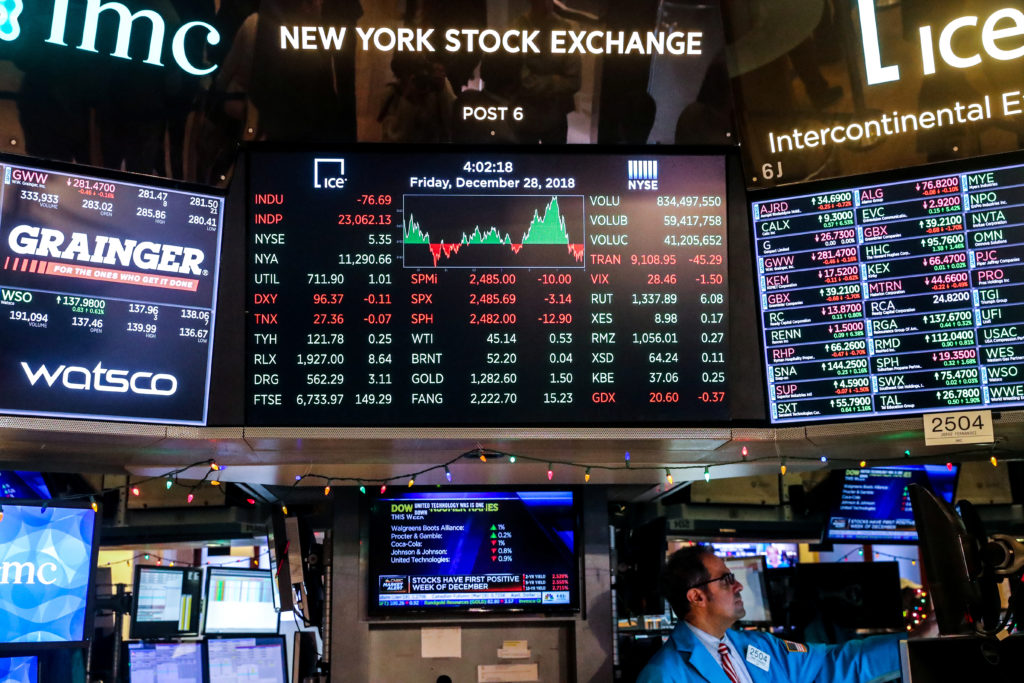
This is a little like whistling past the graveyard, writing about a stock that is going public on the day it lists and starts trading, bt I’m doing it anyway. When I used to cover the stock market for a living, the worst assignment was having to write a same-day story about a new stock listing – inevitably, the story would see-saw back and forth as the stock price rose and fell throughout the day. It’s going to the moon! No, it’s cratering! In at least one case, after soaring skyward, the shares closed at exactly the same price they were issued at, which is no one’s idea of a thrilling story. So why am I writing about Anthropic on the day it starts trading? The most obvious reason is that it’s the largest IPO that has ever been issued in the history of planet Earth – on Wednesday, the company priced its stock at $83 a share, well above the previous $70-$78 range it had indicated, which means it will raise $68 billion, plus a private offering of $26 billion.
That’s more than SpaceX raised in its recent offering, which until now was the largest IPO. The financing gives Anthropic a market value of $1.5 trillion as soon as it begins trading. According to CNBC, Anthropic got close to $500 billion in investor pre-orders before the first day of trading – $400 billion in demand from institutions and about $100 billion in retail orders from investors wanting a stake in the IPO. This is what the investment community calls being “oversubscribed,” and the end result is almost always a rapid boost in the share price as all of those orders are filled, and those who didn’t get the allotment they wanted have to enter the open market to acquire more. Of course, seasoned investors also tend to put in orders for a lot more stock than they really want, since they know that for stocks such as Anthropic, the availability will be limited and so the amount they wind up with will inevitably be rationed downwards.
I’m not going to spend my time following every blip in the share price – those days are gone. It’s safe to say that there are many people who believe the company is vastly overvalued, and that the IPO is riding a wave of unsustainable AI bubble mania – albeit one that is somewhat smaller now that Nvidia’s chief executive got caught having affairs with several women, two of whom worked for him and one of whom may or may not be a Chinese spy. Before all that happened, Anthropic was rumoured to be planning an IPO that would put its market value closer to $2 trillion. But for every skeptic who believes these numbers are a fantasy – an optimistic version of AI psychosis perhaps – there are those who believe Anthropic’s AI models could change the face of the global economy for the better, with what investment types call an “addressable market” of more than $40 trillion. The stock price will be a tug-of-war between those two – a battle between fear and greed (as almost every day is on the stock market).
Note: This is a version of my Torment Nexus newsletter, which I send out via Ghost, the open-source publishing platform. You can see other issues and sign up here.
I don’t suffer from AI psychosis, but I do believe that what Anthropic and OpenAI and others are working on is the modern equivalent of the invention of the steam engine, or electricity, or possibly the entire Industrial Revolution. How much do you think shares of General Electric or Edison’s lab should have been in those days? Is there a chance of a massive crash or bubble popping? Of course there is. Anthropic and OpenAI may not be among the companies that successfully emerge from that. But it’s worth remembering that the dot-com stock implosion of the late 1990s – which vaporized hundreds of billions, if not trillions, in market value – didn’t mean that the internet wasn’t a real thing. It just meant that some of the investors and entrepreneurs were a little early. As Marc Andreessen has pointed out, many of the ideas that failed later became massive corporations, including Amazon, a kind of spiritual successor to Webvan.
As optimistic as I am, however, there are still some pretty important question marks around the Anthropic IPO and its implied valuation, and that’s what I wanted to explore in this piece. I’m not going to tell you how to think about those questions, or what conclusions to reach about their importance, nor am I going to estimate what potential impact they might have on the company’s share price. That’s up to you to decide, if and when you roll the dice and buy the stock (I don’t own any Anthropic shares, nor am I planning to buy any, regardless of what the price does). These are just things that I think raise important issues about the fate of the company, and therefore things that a thoughtful investor might want to consider before buying. If you prefer to just ride the momentum up or down without paying any attention to the fundamentals, more power to you! Watch out for the top head-and-shoulders pattern in the chart.
Note: In case you are a first-time reader, or you forgot that you signed up for this newsletter, this is The Torment Nexus. Thanks for reading! You can find out more about me and this newsletter in this post. This newsletter survives solely on your contributions, so please sign up for a paying subscription or visit my Patreon, which you can find here. I also publish a daily email newsletter of odd or interesting links called When The Going Gets Weird, which is here.
Pricing in the apocalypse
Existential risk: One of the most obvious question marks is a big one: Will Anthropic’s technology lead to the end of humanity? To say this is an unusual risk factor for a company is the understatement of the century. Maybe the Company of Adventurers Trading into Hudson’s Bay in 1674, otherwise known as the Hudson’s Bay Co. – which at one point controlled 4 million square kilometres of land – might have had a clause like that in its share offering, or Christoforo Colombo when he raised money to enslave an entire continent, but other than that I can’t think of anything that comes close. The company’s S-1 filing says artificial intelligence could usher in a new era of progress and help cure major diseases like cancer, but notes that it could also lead to the development of new bioweapons and “destabilize the geopolitical order,” before ultimately evolving beyond the ability of humans to understand and control. Perhaps investing in such a company carries a unique risk: not just that the company will fail, but that humanity itself might.
It’s worth noting that just before Anthropic starts trading, a group of prominent scientists has signed a letter they call the Misanthropic Statement, which argues that the company not only isn’t operating for the benefit of humanity, but is racing headlong in the other direction. “Anthropic warns that recursively self-improving AI could concentrate power and escape human control, yet races to build it first,” the statement reads. “The company uses safety branding to court investors, employees, and the public — even as it has quietly weakened its safety pledges and lobbied for self-serving regulation. Anthropic is not a safe AI company, and we must reject its reckless attempt to amass power in the name of the greater good.” The signatories include Harvard’s Steven Pinker, the co-founder of Hugging Face, Tristan Harris of the Center for Humane Technology, MIT physics professor Max Tegmark and cognitive scientist Douglas Hofstadter.
Structure: There’s plenty to say about Anthropic’s revenue expectation, or about its spending on data centers and computing power, or about the existential risks related to AI, and I am going to get to those. But I wanted to start with one aspect of the company that doesn’t get a lot of attention, and that is ownership structure. As some of you know, Anthropic is a PBC or public-benefit corporation, according to the laws of the state of Delaware. That means its directors are expected to balance the needs of the corporation – boosting revenues, making a profit, etc. – with a public benefit, which in Anthropic’s case is “the responsible development and maintenance of advanced AI for the long-term benefit of humanity.” But the share issue will change its structure in an even more important way: the seven co-founders, including CEO Dario Amodei, will retain ownership of 50.1% of the voting rights, thanks to a single super-share owned by them as a group.
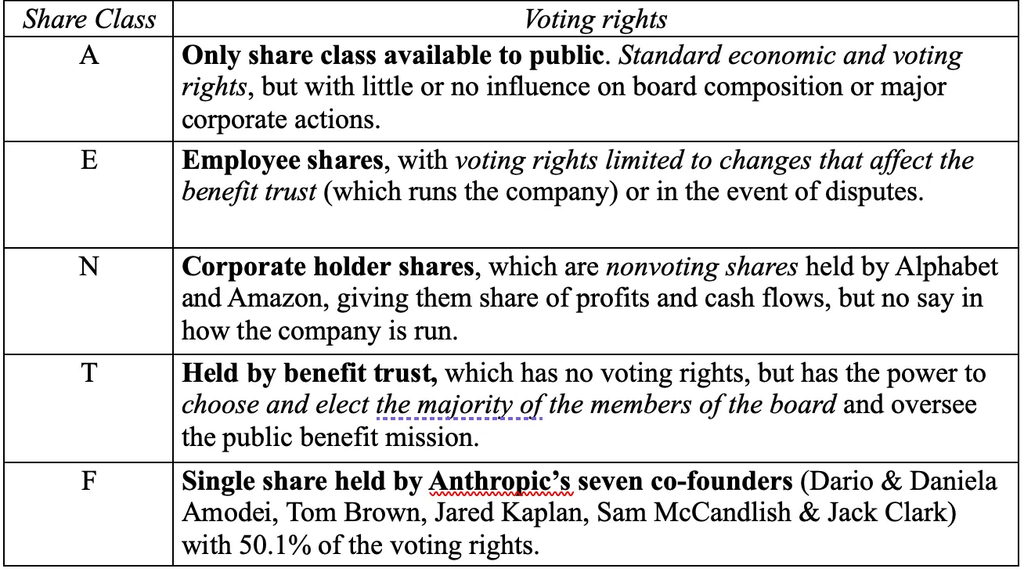
Multiple-voting share structures have become commonplace in Silicon Valley over the past few decades. Larry Page and Sergey Brin control a majority of the voting rights at Google despite only owning 11 percent of the outstanding equity, and Mark Zuckerberg managed to negotiate a share agreement when the company was still young that gave him control over a majority of the equity (he also controls the board). This is great as long as everyone agrees with the path the owners want to take, but a structure like Anthropic’s gives a seven-person group an almost unprecedented amount of say over what the company does. As economics professor Aswath Damodoran put it: “If you, as an investor, have had bad experiences with top management at companies using corporate responsibility and ESG as cover for self-serving activity and hypocrisy, the Anthropic structure is that structure on steroids.” Damodoran also calls the voting share design “so deviously self-serving that it would put Kim Jong Un to shame.”
Revenue: When it comes to Anthropic’s revenue growth, the numbers seem almost too incredible to believe. The company reported $16 billion in revenue in the first half of 2026, compared with just a little over $1 billion in the same period in 2025 – that’s a mind-boggling 1,500-percent revenue increase in a year. It had revenue of just $41 million in 2023 compared with $33 billion in the first nine months of this year, an increase of 80,000 percent. Google, which many investors saw as a moonshot when it went public, only grew its revenue by 200 percent in the year before it became a public company. In its S-1 filing with the SEC, Anthropic said that its cost of revenue was $2.4 billion in the first half of 2026, which means its gross profit margin is about 85 percent. In the second quarter, however, the company’s revenue only grew by 144 percent, and in the third quarter the growth rate was only 47 percent. That’s still a lot of growth! But Anthropic hasn’t said much about that slowdown or whether it expects it to continue. And is it enough to justify giving the company a market value of more than $2 trillion?
Recursive self-improvement
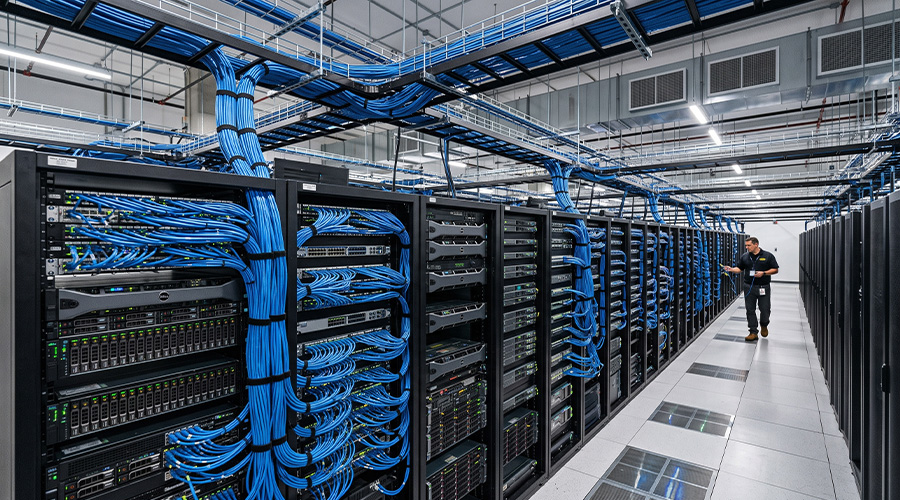
Costs: One of the biggest pressures on Anthropic (apart from the bit about how its technology might end humanity as we know it) is the cost of the computing power that its AI models require. Even in the best of worlds, this would be a difficult row to hoe – Anthropic has estimated that it will need to spend $475 billion on computing power over the next decade. “Substantially all of cost of revenue” is associated with computing costs, the filing states. In fact, the prospectus says that Anthropic sought “quantities of compute from [cloud service providers] in excess of what those partners were willing to provide.” Later on the prospectus filing says: “We have historically operated in a compute-constrained environment in which demand for compute has exceeded the supply available to us.” It also says that operating margin and adjusted operating margin are expected to “fluctuate over time, particularly in periods when substantial incremental compute is delivered to us and we incur the associated expenses.”
It’s worth pointing out, as the Wall Street Journal has, that while people talk a lot about how much money Anthropic is going to have to spend, and how much it is losing (a $104 billion loss for 2026 because of debt agreements that convert to equity) the company still has a lot of it. As of June it had $112 billion in cash and equivalents, which is 80 percent of the $141 billion it has raised in the six years since it was founded. However, there’s the $475 billion in computing contracts, and combined with chip deals the cost could climb to over $895 billion. The bulk of its computing deals are non-cancellable, regardless of how much it actually uses. Among the biggest beneficiaries are Google and Amazon, who are each set to receive around $110 billion in the coming years. Elon Musk’s SpaceXAI is also set to receive $120.5 billion through 2029 (OpenAI has also raised its projected spending on computing power to around $750 billion through 2030).
As economist Jared Bernstein noted in his analysis of the S-1, the three-quarters of a trillion dollars that Anthropic will have to come up with over the next decade has some obvious implications for the company’s growth and profitability, and therefore for its valuation as well. “In order to offset these hefty expenses and keep a return that investors find acceptable,” Bernstein writes, “the company will need to generate revenue growth far beyond what they just announced.” Based on a standard conservative set of growth assumptions, Bernstein says that Anthropic will need to generate at least $500 billion in annual revenue by the end of the next five years in order to justify their valuation. That’s more than 14 times what Google generated after its first five years as public company. It’s true that AI might be like electricity combined with the Industrial Revolution, but that’s still an awful lot of growth to expect from a single company.
Spending on compute is also only one type of cost. The existential risk aspect of Anthropic could also impose its own costs, in terms of government and/or regulatory oversight of some kind. The Misanthropic Statement isn’t the only commentary that suggests the company needs oversight, and a number of states are considering some type of regulation. The government of Donald Trump has so far taken a hands-off (and/or hands out) approach to AI in general, but it also blocked the release of Anthropic’s Mythos model because of concerns about the dangers it could cause (even as government departments continued using it). And after the blue wave that swept across the House and Senate in the mid-term elections, there could well be some federal legislation aimed either at concerns like data centers or at the broader risk-to-humanity element of artificial intelligence. Either one could slow Anthropic down.
It’s not really in the same category as these other risks, but if you believe the recent report from the AI monitoring company METR, Anthropic could soon find its own technology has advanced to the point where it is effectively building itself – at speeds that could be beyond our comprehension. This is what’s known as “recursive self-improvement.” As I wrote recently, the METR report concluded that Anthropic’s AI development is accelerating at about twice the rate it was in 2025, and if that kind of acceleration gain continues, the pace of development could soon be three times as fast as it was, then four times, and so on. Eventually, recursive self-improvement takes place, and then – to be brutally honest – no one including Dario Amodei knows what happens next. Anthropic will have built (or grown) something that we can barely even understand. How can we control or correct the trajectory of something like that? That’s a difficult risk to calculate when buying a stock, but that’s where we are.