
Is Substack good or bad? Yes

If you aren’t a writer or a journalist or someone else who cares deeply about platforms for writing and publishing, this week’s newsletter probably isn’t going to be that interesting for you. As I put it in a previous Torment Nexus newsletter about Substack a year or so ago, it would be nice to think that lots of people care about the nuances of how news and information gets published, and the challenges that the modern web and social media and technological monopolies pose to our information ecosystem, and yet a long career as a journalist writing about technology and publishing has convinced me that this is not the case! But as someone who fits all three of the descriptions I mentioned above, I’ve been fascinated with Substack ever since it launched in 2017 in a wave of optimism about online publishing, and I’ve watched it evolve over the years into a thing that some people love and some people hate.

The reason for the love is relatively easy to describe: writing online is hard – not just the writing part, but the rest of it as well, including finding and monetizing an audience, etc. The main benefit of Substack is that it automates a lot of that, for writers who don’t want to have to think about the mechanics, or having to get down in the machinery and fiddle with the levers and pulleys that make online publishing work. You just click “publish” and Substack does the rest. As co-founder Chris Best put it in a recent post: “The deal most of the internet offers creators goes something like this: We’ll give you reach if you give us your audience. Perform for the algorithm. Hope for a minority share of a platform’s own revenue, or figure out the money part yourself. Build your following on our platform, under our rules, subject to our priorities—and if any of that changes, good luck. Substack is built on a different theory: Give publishers a direct connection to the people who believe in them. Let people pay for the work they value.”

The numbers make it clear that lots of people see the benefits of this model. According to Substack, more than 100,000 publishers make money on Substack using the subscription model, and the top ten collectively make more than $100 million a year. I am one of those people, as some of you may know: I publish this newsletter as well as my daily When The Going Gets Weird collection of interesting links using Substack – although I also publish them both on the open-source Ghost platform, as well as on my personal blog at mathewingram.com (which is offline at the moment, illustrating the benefits of using a service that isn’t hosted on an old PC in your daughter’s living room and maintained by an English major). I make a few hundred dollars a year from Substack at most, probably because I haven’t put much effort into building my audience there, but I decided when I launched my newsletters that publishing in multiple places was something I wanted to commit to, and I am comfortable relying on the donation or patronage model of publishing (although my accountant is not happy about it).

Note: This is a version of my Torment Nexus newsletter, which I send out via Ghost, the open-source publishing platform. You can see other issues and sign up here.

Continue reading “Is Substack good or bad? Yes”

The heat wave that got the US to legalize wearing shorts

Before the summer of 1936, people were used to dressing in a lot of layers. And while the materials in summer were lighter, they were still hot. That arrangement was tolerated most summers. Temperatures would climb, and everyone would grimace and bear it, sweating underneath coats and petticoats, vests and corsets, hats and gloves. But the summer of 1936 was too much. It was a summer when people perished because of their choice of clothing. In Yonkers, on June 21, two reporters from the New York Daily News — hoping to test the city’s anti-shorts law — were arrested for wearing shorts. They were given the choice to leave the city or put on more appropriate clothing. They refused and were eventually brought forth before city judge Charles W. Boote. The judge was probably sweating underneath his robe when he made his decision on July 10, when the high was 102. Boote was sympathetic to the journalists, fining them $10 (adjusted for inflation about $240) but suspending the fines. (via National Geographic)

How a homeless woman became friends with Renee Zellweger and Zach Galifianakis

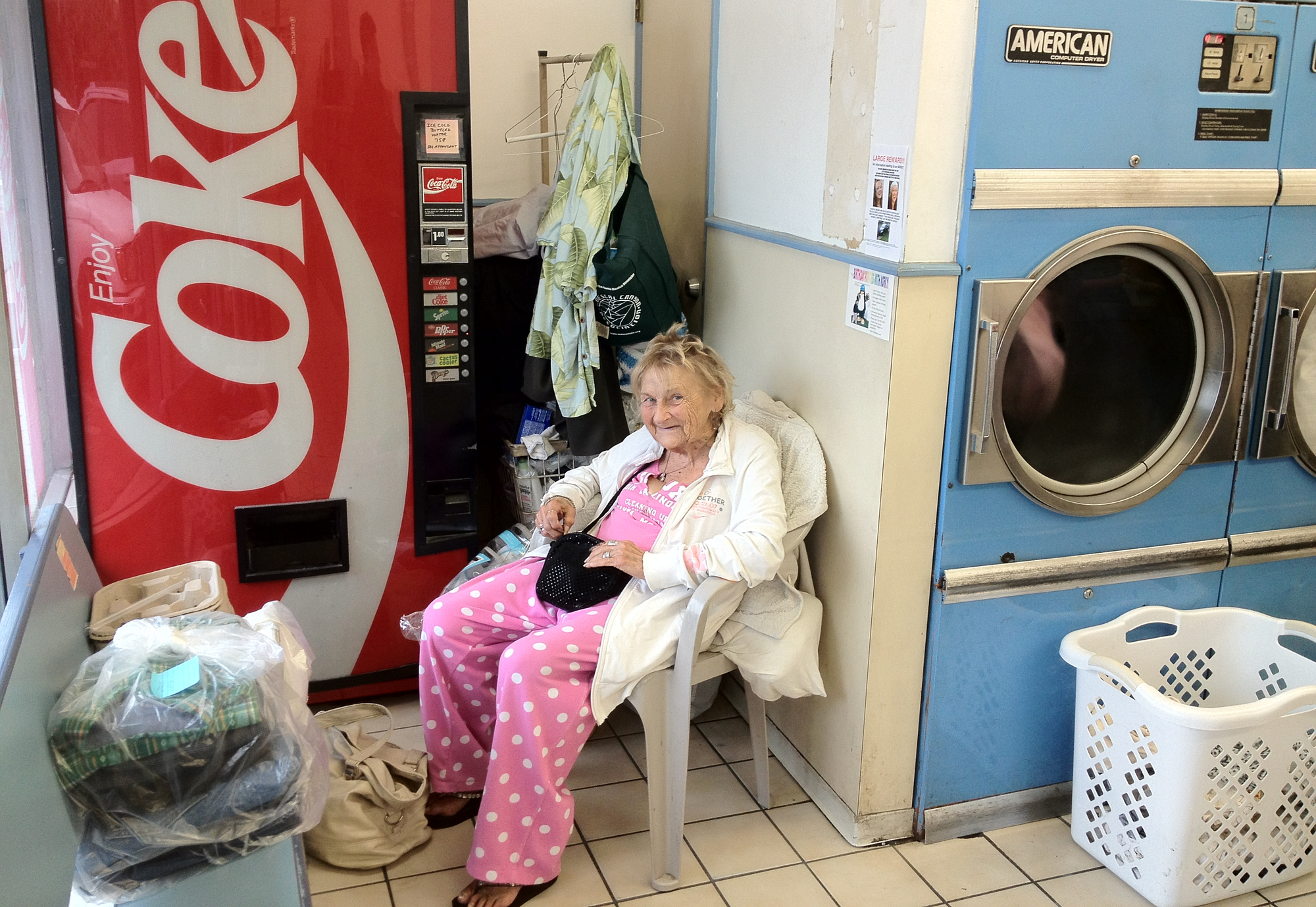
The last 25 years of Marie “Mimi” Haist’s life sounds almost too unbelievable to be true: Divorced, jobless, and without a home, she sought shelter in a laundromat for nearly 20 years in an upscale Santa Monica neighborhood. She slept between the first row of washers and dryers and earned money by helping fellow customers wash their clothes. It wasn’t much, but enough to at least buy a little something to eat. Then—because life is odd, random, and totally unexpected—Mimi met a couple of movie stars who ended up becoming her friends. In the late ’90s, Zach Galifianakis was still years away from superstardom when he met Mimi at the laundromat. “I taught him how to wash his clothes,” remembers Mimi. “I later met Renée [Zellweger] through Zach.” Although Mimi didn’t know who Zach was at the time, things were a bit different when she was introduced to Zellweger. “Of course, I recognized her right away from the movies!” (via Glamour)

Note: This is a version of my When The Going Gets Weird newsletter, which I send out via Ghost, the open-source publishing platform. You can see other issues and sign up here.
Continue reading “The heat wave that got the US to legalize wearing shorts”

First he erased his own identity and then he walked into the sea

On June 12, 2009, a man checked into a hotel in Sligo, Ireland under the name Peter Bergmann and a nonexistent Austrian address. He paid cash every night. Over the next three days, cameras around town filmed him leaving the hotel with a purple plastic bag of belongings and coming back without it, using the blind spots between cameras to dispose of whatever was inside. He bought eight 82-cent stamps and airmail stickers at the post office, and asked a taxi driver where to find a quiet beach for swimming. On June 15, he checked out, ate a toasted ham and cheese sandwich at the bus station while reading scraps of paper from his pocket, tore them up, dropped them in a bin, and took the 2:20 bus to Rosses Point. Sixteen people saw him walking on the beach, greeting passersby. His body was found the next morning. Every clothing label had been cut out, and he carried no wallet, money, or identification. The pathologist found no signs of foul play, but did find advanced prostate cancer and bone tumors. (via Boing Boing)

The reason a JetBlue flight suddenly went into free fall seemed almost too bizarre to believe

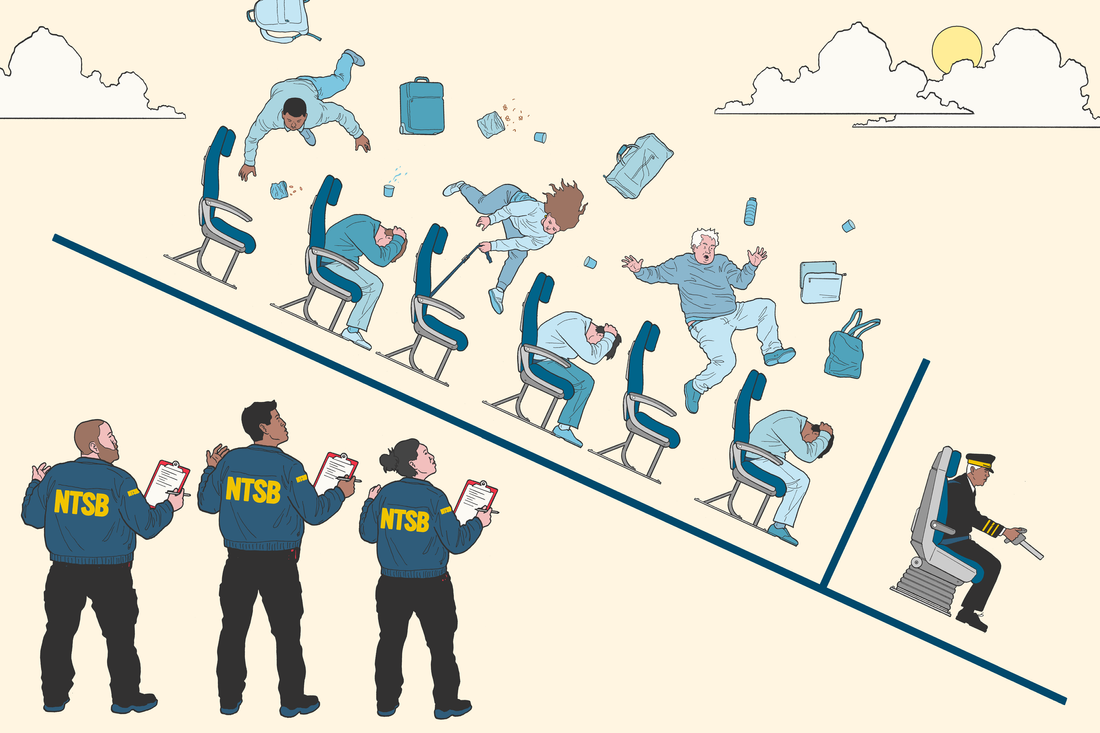
The JetBlue airliner that suddenly went into a dive over the Gulf of Mexico last October 30 did not crash. Despite how long the ordeal felt to passengers like Turner, the plunge lasted only about five seconds before the autopilot returned the aircraft to level flight. The flight crew, spooked, turned the plane toward the coast of Florida and brought it in for an emergency landing in Tampa. Twenty-two people were treated for their injuries. But because no one died, the flight didn’t receive widespread coverage. A dedicated team of investigators went to work. But in the days and weeks that followed, they became increasingly flummoxed. It wasn’t what had happened that puzzled them but why. As they examined the obvious potential causes, nothing matched up.Working their way down the list of possibilities, they found themselves in increasingly arcane and implausible-sounding territory. And the final option left to them — the only thing that could be true so had to be true — was so extraordinarily implausible that a normal reaction would be to dismiss it out of hand. (via NY Mag)

Note: This is a version of my When The Going Gets Weird newsletter, which I send out via Ghost, the open-source publishing platform. You can see other issues and sign up here.

Continue reading “First he erased his own identity and then he walked into the sea”

If you’re looking for mathewingram.com I have some bad news

(NOTE: I’ve restored my site thanks to Linux and some Updraft backups, but I am keeping this here for posterity)

It’s likely that not many people care about this, but I am writing this on my localhost/ blog — which I normally use as a backup to my blog at mathewingram.com/work — because the machine hosting that blog (and my photo server and my Plex instance and a bunch of other things) got hacked by ransomware a few days ago. I am currently in the process of either trying to restore it or wiping it and starting again, and at this point I have to say that the latter seems more likely.

I got hacked by someone using a form of ransomware known as Lockbit, which gets root access and encrypts all of your files and then renames them with a .lockbit extension. In my case it also got access to my Google Drive — I assume by cloning an authentication token to get around two-factor — and uploaded a bunch of encrypted files and backups. It seems that either I interrupted the process or they weren’t very good, because they didn’t get all of the files and they didn’t upload that many before I changed my passwords and locked them out.

That said, however, they screwed things up badly enough that it’s going to take some time and effort to put them back together, and it may not be possible. Ironically it would be easier if they had finished the job, because the last phase is to upload a ransom note and leave it as a screen saver, and that note often contains a unique ID that can be entered into an Interpol database that has decryption keys for some kinds of ransomware. If I can’t find a note or unique ID then I can’t search for the decryption key.

My working theory is that the hackers got in by brute-forcing the Windows Remote Desktop protocol, which I used to access my machine, since it is located somewhere other than my house. I had recently switched from RealVNC to RDP because RealVNC was charging a lot of money (relatively speaking) and RDP is free. I tried to set up Zerotier, a VPN, to get in through but it didn’t work for some reason I’ve been unable to figure out, so I opened a port to redirect RDP through — not the usual RDP port but a different one. A little while later there were a lot of blocked login attempts, but I didn’t think anything of it because open ports are often scanned and I thought I was protected enough, but clearly that wasn’t the case!

Anyway, even if I wipe the machine nothing priceless or irretrievable will be lost, because after many disk failures and other similar incidents in the past I have learned to have multiple redundant backups of almost everything, so I am all good on that front. But it will take some time to put things back where they belong — and maybe I will either go with Linux this time, or spend a bit more time trying to get a VPN working properly!