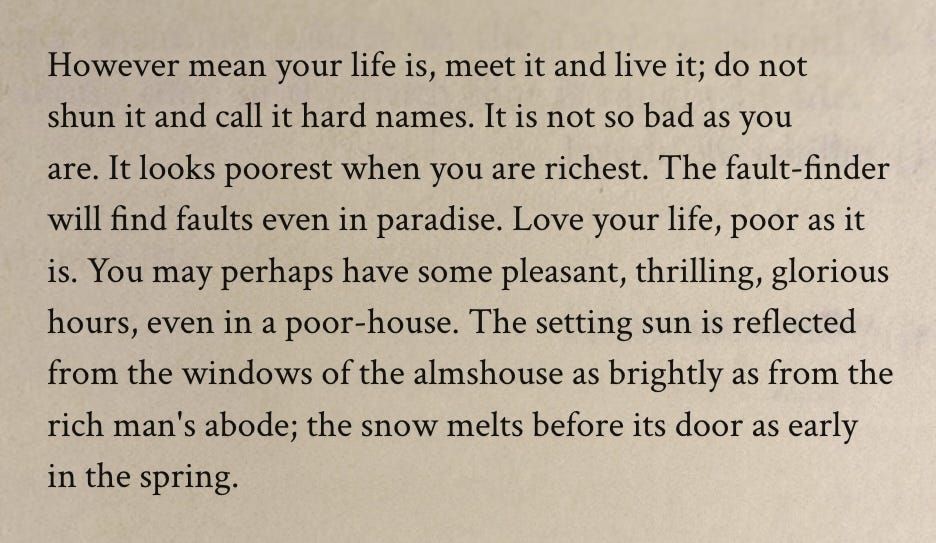
Thoreau on enjoying life

Links that interest me and maybe you
In the late 1990s, when most people just about had an email address and the smartphone with even one G, never mind five of them, was just a twinkle in a mad inventor’s eye, the internet was still regarded by many as the preserve of the nerd. Most of the record industry either treated it as an irrelevance or, with the advent of Napster and other streaming services a few years later, a threat. But Jagger was an early adopter, or at least he was someone who spotted the internet’s potential while others retained suspicion. Jagger is also a cricket nut. So when he discovered that nobody was planning to broadcast the Akai-Singer Champions Trophy — a relatively minor one-day tournament in December 1997, featuring England, Pakistan, India and West Indies — these two interests converged. So he formed a company and broadcast it himself. (via the NYT)
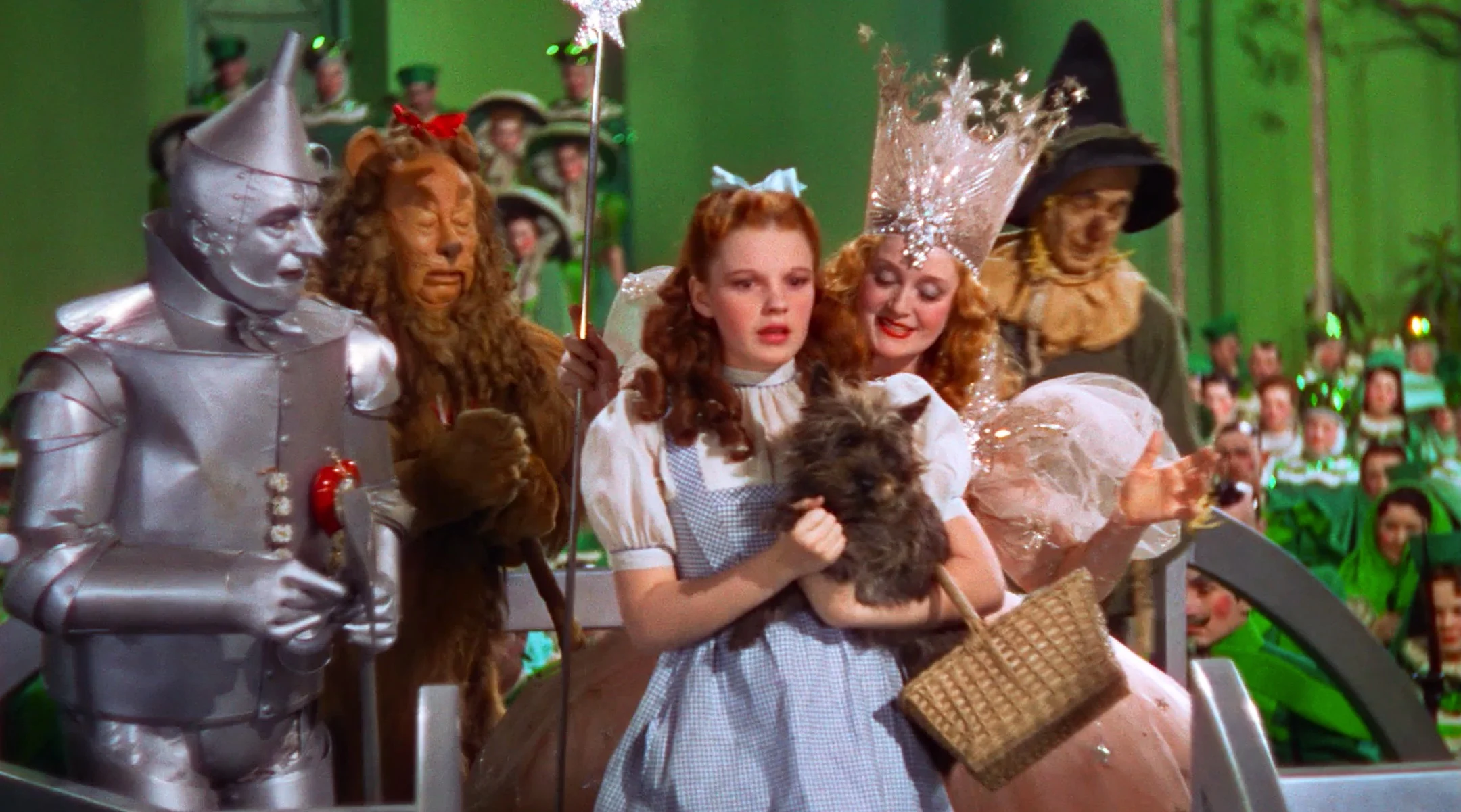
In a 1964 article, educator and historian Henry Littlefield outlined an allegory in the book of the late-19th-century debate regarding monetary policy. According to this view, for instance, the Yellow Brick Road represents the gold standard, and the Silver Shoes (Ruby slippers in the 1939 film version) represent the Silverites’ wish to maintain convertibility under a sixteen to one ratio. Hugh Rockoff suggested in 1990 that the novel was an allegory about the demonetization of silver in 1873, and that the City of Oz earns its name from the abbreviation of ounces “Oz” in which gold and silver are measured. The cyclone that carried Dorothy to the Land of Oz represents the economic and political upheaval, the yellow brick road stands for the gold standard, and the silver shoes Dorothy inherits from the Wicked Witch of the East represents the pro-silver movement. When Dorothy is taken to the Emerald Palace before her audience with the Wizard she is led through seven passages and up three flights of stairs, a subtle reference to the Coinage Act of 1873. (via Wikipedia)
Note: This is a version of my When The Going Gets Weird newsletter, which I send out via Ghost, the open-source publishing platform. You can see other issues and sign up here.
Continue reading “Mick Jagger was a pioneer in streaming video on the internet”The Pacific Northwest is known for five things: lumber, aircraft, tech, coffee, and crime. What might account for the abrupt rise and equally abrupt fall, between the nineteen-sixties and the turn of the century, of the “golden age” of serial killing? And why were so many of these brutes cradled in a crescent of psychopathy around Seattle’s Puget Sound? Fraser thinks the master key is to be found in the fact that the area south and southwest of Seattle was home to massive ore-processing facilities, and her subjects were reared in their murky shadows. “Spare some string for the smelters and smoke plumes,” she writes of her crazy wall, “those insidious killers, shades of Hades.” The smelters caused a profusion of heavy metals in the air and water, and toxins such as lead and arsenic were found in staggering concentrations in the blood of Tacoma’s children. Some were merely dulled, or delinquent; a few became tabloid monsters. (via the New Yorker)

Spotify’s first iteration of its shuffle feature was dictated by a decades-old algorithm that generated unbiased randomness from a finite sequence of elements. Breathtakingly efficient, the Fisher-Yates shuffle was employed by Spotify to dismantle user playlists and reassemble them into new, unpredictable orders. From the developers’ perspective, the task of creating this feature was masterfully accomplished with just a few lines of code. From early users’ perspective, shuffle was a travesty. This discrepancy was bewildering for both parties, but mainly for developers, who had delivered a mathematically perfect version of randomness. Perfection turned out to be the problem. The algorithm captured a Platonic ideal of randomness instead of one compatible with the human mind. We presume that randomness must always be chaotic. However, as randomness is unpredictable, it will at times give the impression of order. (via the FT)
Note: This is a version of my When The Going Gets Weird newsletter, which I send out via Ghost, the open-source publishing platform. You can see other issues and sign up here.
Continue reading “Lead poisoning may have led to a generation of serial killers”If you didn’t see the image at the top of this post, it appeared on the photo wires and in many newspapers and other media outlets following the brazen robbery of the Louvre in Paris, where a group of thieves stole jewellery and other artifacts worth about $100 million (some of the thieves have since been caught). But the theft itself isn’t my favourite part of this story — not even the part where the password the Louvre allegedly used for their video surveillance system was the word “password.” The photo instantly went viral because of the extremely dapper individual in the fedora and vest with the umbrella — “please let this be the French detective assigned to the case,” said one post.
The best part was when the dapper chap’s real identity was revealed a few days later: his name is Pedro Elias Garzon Delvaux, and he is a 15-year-old who lives with his parents and grandfather in Rambouillet, 30km from Paris. He is a fan of Sherlock Holmes and Hercule Poirot, and just likes dressing up in that kind of outfit, especially when he is going out to visit places like the Louvre. He just happened to be walking by the police cordon when a photographer snapped that shot. It’s just so perfect, so serendipitous. And he sounds like a terrific young man — he says “I like to be chic — I go to school like this.” But not with the fedora, that’s reserved for weekends, holidays and museum visits.

In 2015, David Hole was prospecting in Maryborough Regional Park near Melbourne, Australia. Armed with a metal detector, he discovered something out of the ordinary – a very heavy, reddish rock resting in some yellow clay. He took it home and tried everything to open it, sure that there was a gold nugget inside the rock – after all, Maryborough is in the Goldfields region, where the Australian gold rush peaked in the 19th century. Hole tried a rock saw, an angle grinder, a drill, and even doused the thing in acid. Unable to open the rock, Hole took the nugget to the Melbourne Museum for identification. A scientist there said that after 37 years of working at the museum and examining thousands of rocks, only two of the offerings had ever turned out to be real meteorites, and Hole’s rock was one of those two. He published a scientific paper describing the 4.6 billion-year-old meteorite, which he called Maryborough. (via ScienceAlert)

A mellified man, also known as a human mummy confection, was a legendary medicinal substance created by steeping a human cadaver in honey. The concoction is detailed in Chinese medical sources of the 16th century, which reports that some elderly men in Arabia, nearing the end of their lives, would submit themselves to a process of mummification in honey to create a healing confection. The mellification process would ideally start before death. The donor would stop eating any food other than honey, going as far as to bathe in the substance. Shortly, the donor’s feces and even sweat would consist of honey. When this diet finally proved fatal, the donor’s body would be placed in a stone coffin filled with honey. After a century or so, the contents would have turned into a sort of confection reputedly capable of healing broken limbs, which would then be sold in street markets at a hefty price. (via Wikipedia)
Note: This is a version of my When The Going Gets Weird newsletter, which I send out via Ghost, the open-source publishing platform. You can see other issues and sign up here.
Continue reading “He thought he found gold but it was a 5 billion-year-old meteor”