A video clip posted on social media sites on Monday showed Julian Assange, the founder of WikiLeaks, climbing the stairs to a private airplane that was parked on the tarmac at London’s Stansted airport. A fairly mundane image in many ways, were it not for the fact that Assange has been in prison in the UK for the past five years, and for most of that period has been fighting the US government’s attempts to extradite him to the US to face Espionage Act charges for publishing classified information (I wrote about the filing of the initial indictment). The plane that Assange boarded at Stansted flew to Bangkok and then to Saipan, the island capital of the Northern Marianas, which have been a US commonwealth since World War II.
Assange flew to Saipan to attend a hearing on Wednesday as part of a deal reached with the US government under which he agreed to plead guilty to a single count of illegally obtaining and disclosing national security material. In exchange, he was released from prison, since the five years he spent there was more or less equivalent to what he would have received as a sentence for such a charge, and returned to his home country of Australia. The Northern Mariana Islands were chosen as the location for the court hearing because Assange didn’t want to set foot in the continental US, and because the islands are close to Australia, making it easier for him to travel there.
After news of the plea arrangement was published, Julian Assange’s mother told TheGuardian that she was grateful her son’s “ordeal is finally coming to an end” and that the deal shows the importance and power of “quiet diplomacy”; John Shipton, Assange’s father, also expressed his joy at his son’s release from prison. Videos and photos posted on social media on Wednesday showed Assange’s wife, Stella, who married him in 2022 while he was in prison, embracing her husband (the two have been in a relationship since 2015 and have two sons, born in 2017 and 2019). A post from Stella Assange on X had a photo of the two hugging and said simply “Home.”
Note: This was originally published as the daily newsletter for the Columbia Journalism Review, where I am the chief digital writer
From JSTOR Daily: “Behind a plate-glass window, framed by grand Doric columns, repose three bodies. Except for their leather loincloths, they are naked. From a pipe above each bed, a trickle of cold water runs down their faces. Their eyes are closed. They bear the marks of their deaths: one is swollen by drowning, one gashed by an industrial accident, another stabbed. A crowd of people gathers outside the window, staring at the bodies. This is the Paris Morgue, circa 1850. Theoretically, the purpose of the display was to enlist public help in identifying unnamed corpses. But around the turn of the century, the morgue developed a reputation as a gruesome public spectacle, drawing huge crowds daily. The morgue was even listed in tourist guidebooks as one of the city’s attractions: Le Musée de la Mort. The crowds that attended the morgue attracted snack peddlers and street performers, creating an almost festival atmosphere.”
The Beastie Boys paid for a punk legend to have sex reassignment surgery
From AntiMatter: “Donna Parsons said that it wasn’t until January of 2002 that she first heard the word transgender. As soon as she read about it, Donna saw herself—perhaps for the first time—and began transitioning almost immediately. Tragically, not long afterwards, Donna was diagnosed with colon cancer. She had an operation to remove the cancer that year, followed by six months of chemotherapy, but the cancer came back. “My understanding was that she was pretty much dying, and that she wanted to live out the rest of the little time she had left in the body of her choosing,” recalls Beastie Boys’ Adam Horovitz in Beastie Boys Book. “So Adam Yauch took care of it. He organized it so we gave her the money for the operation, but it was under the guise of reimbursement and unpaid back royalties for the Polly Wog Stew record from 1982. Donna got the operation, and then within a year passed away.”
Note: This is a version of my personal newsletter, which I send out via Ghost, the open-source publishing platform. You can see other issues and sign up here.
From How Stuff Works: “Politicians are under a lot of scrutiny in the 21st century: a public servant can’t even accept millions of dollars in bribes without getting trouble. But let’s reflect back on a time in American history when a new governor could show up to his inauguration proudly sporting shoes made from a hanged felon whose corpse he skinned himself. Back in 1881, an outlaw named George Parrott, known by the nickname “Big Nose George,” was hanged in Rawlins, Wyoming. After Parrott’s 1881 death, nobody showed up to claim the body, so the doctor who pronounced him dead took his body home for “medical study.” He extracted Parrott’s brain and gave it to his friend, the surgeon Thomas Maghee, who wanted to study Parrott’s “criminal brain.” Osborne also sawed off the top portion of Big Nose George’s skull and gave it to Lillian Heath, a 15-year-old girl who went on to become Wyoming’s first female physician (she reportedly kept it her entire life, using it as an ashtray and a door stop).”
The Nobel Prize winner who bet against himself and lost
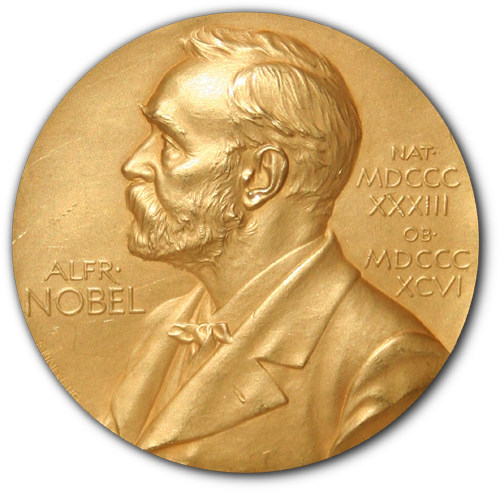
From Now I Know: “Robert Lucas, Jr. graduated from the University of Chicago with a Ph.D. in Economics and returned to the school as a professor in 1975. Over his career, he developed a macroeconomic theory called “rational expectations,” which, according to the Chicago Tribune, “holds that people aren’t surprised when the government attempts to stimulate the economy, so they adapt their behaviors accordingly during such times and thus alter the expected results of government policies.” It was somewhat controversial at first, but ultimately, the world of macroecon experts adopted Lucas’s view. And on October 10, 1995, Lucas was awarded a Nobel Prize in Economics for his work. The Nobel came with a $1,000,000 cash prize. But he only got half of it — because his ex-wife believed in him more than he believed in himself. A clause in his divorce agreement stated that if he won a Nobel, his wife would get half.”
Note: This is a version of my personal newsletter, which I send out via Ghost, the open-source publishing platform. You can see other issues and sign up here.
From All That’s Interesting: “The great-grandson of John D. Rockefeller, aspiring explorer and ethnographer Michael Rockefeller had no interest in managing his family’s empire upon graduating from Harvard in 1960. Instead, he set out for the remote wilds of Dutch New Guinea to collect art made by the largely uncontacted Asmat people. But Rockefeller’s boat capsized off New Guinea’s southern coast and that was the last anyone ever heard from him. Despite a search effort and a media firestorm, hr was never found and the authorities eventually declared him dead due to drowning in 1964. But in the decades since, various independent investigators claim to have uncovered evidence that the authorities actually buried the truth about Michael Rockefeller’s death because it was simply too horrific to reveal.”
North Korea’s lucrative trade in human hair is helping it skirt the impact of sanctions
From The Guardian: “They almost certainly don’t know it, but western owners of shiny new wigs and false eyelashes could owe their look to North Korean slave labour. In recent years, a booming trade in human hair has helped to sustain North Korea’s isolated economy, softening the impact of international sanctions and providing Pyongyang with vital revenue to pursue its nuclear ambitions. Last year, exports to China included 1,680 tonnes – or about 135 double decker buses worth – of false eyelashes, beards and wigs worth around $167m, according to Chinese customs data. Millions of dollars in sales of human hair helped drive a recovery in the secretive state’s exports in 2023, with wigs and other hair products making up almost 60% of declared goods sent to China, by far its biggest trading partner.”
Note: This is a version of my personal newsletter, which I send out via Ghost, the open-source publishing platform. You can see other issues and sign up here.
From the Wall Street Journal: “The young Argentine couple in the pastel-colored house lived a seemingly ordinary suburban life, driving around this sleepy European capital in a white Kia Ceed sedan, always paying their taxes on time and never so much as getting a parking ticket. Maria Rosa Mayer Muños ran an online art gallery, telling acquaintances she’d left Argentina after being robbed in Buenos Aires by an armed gang at a red light. Her husband, Ludwig Gisch, ran an IT startup. Described by neighbors in their middle-class district of Črnuče as “normal” and “quiet,” the husband and wife appeared to be global citizens: switching from English and German with friends to accentless Spanish with their son and daughter, who attended the British International School. Yet almost everything about the family from number 35 Primožičeva street was a carefully constructed lie, according to intelligence officials.”
She was pronounced dead then they found her gasping for air in a body bag
From Popular Mechanics: “About two hours after the body of 74-year-old Constance Glanz arrived at the funeral home outside of Lincoln, Nebraska, earlier this month, an employee there noticed something strange. Glanz, who had been pronounced dead at a nearby nursing home, was breathing. After she was transported to a local hospital, Glanz survived for a few more hours. She was later declared dead for a second time. In 2023, a 76-year-old Ecuadorian woman was declared dead after a suspected stroke. Five hours later, she was found alive after her coffin was opened to change her clothing. Months earlier, an Iowa woman was taken to a funeral home where workers found her gasping for air in a body bag. In 2018, a South African woman who was initially declared dead was discovered alive in a mortuary refrigerator.”
Note: This is a version of my personal newsletter, which I send out via Ghost, the open-source publishing platform. You can see other issues and sign up here.
From Rolling Stone: “Sharonda had struggled with substance abuse when Danielle was a teenager, and had not been present for much of her life; they had only started speaking again in 2015, around the time Danielle had her first child. As part of an effort to reconnect with her daughter, Sharonda had set off on her own spiritual journey. She would eventually call herself a psychic, appointing Danielle as her guide. On April 8, Sharonda received a phone call from the Los Angeles County Medical Examiner’s office: Danielle, 34, had driven her car into a tree at high speed and did not survive the impact. Danielle’s partner, Jaelen Chaney, 29, had been found in their apartment stabbed to death. Her two children appeared to have been pushed out of a moving car, and, while the nine-year-old only had a few cuts, the eight-month-old died.”
The man who sat by the pool at the Beverly Hills Hotel every day for forty years
From The New Yorker: “For forty-two years, from the time he discovered the hotel, in 1950, until it closed, last December 30th, Irving’s days had been as well ordered and as predictable as the Sun King’s. At seven o’clock every morning, wearing one of the many perfectly fitted tropical-weight suits that have been a special affection of his since a memorable day in the nineteen-thirties, he would stroll over from his house, in the lower reaches of Beverly Hills; enter the hotel under the long, sloping green-and-white striped awning that extended all the way from the driveway, above Sunset Boulevard, to the main entrance; turn right in the lobby; and arrive at the Polo Lounge. Occasionally, when the weather was particularly fine, he would take his breakfast outside, under the great Brazilian peppertree on the curving flagstone Polo Lounge patio.”
Note: This is a version of my personal newsletter, which I send out via Ghost, the open-source publishing platform. You can see other issues and sign up here.
From Atlas Obscura: “Jerusalem’s Church of the Holy Sepulchre is one of the holiest places in Christianity and has been the site of pilgrimages since the 4th century. Care over the church is shared by no less than six denominations. The whole edifice is carefully parceled into sections, some being commonly shared while others belonging strictly to a particular sect. A set of complicated rules governs the transit rights of the other groups through each particular section on any given day, especially during the holidays. Sometime in the first half of the 18th century, someone placed a ladder up against the wall of the church. No one is sure to which sect he belonged. The ladder remains there to this date. No one dares touch it, lest they disturb the status quo, and provoke the wrath of others. The exact date when the ladder was placed is not known but the first evidence of it comes from a 1728 engraving by Elzearius Horn. It hasn’t moved since.”
Charles de Gaulle’s favorite daughter Anne had Down syndrome
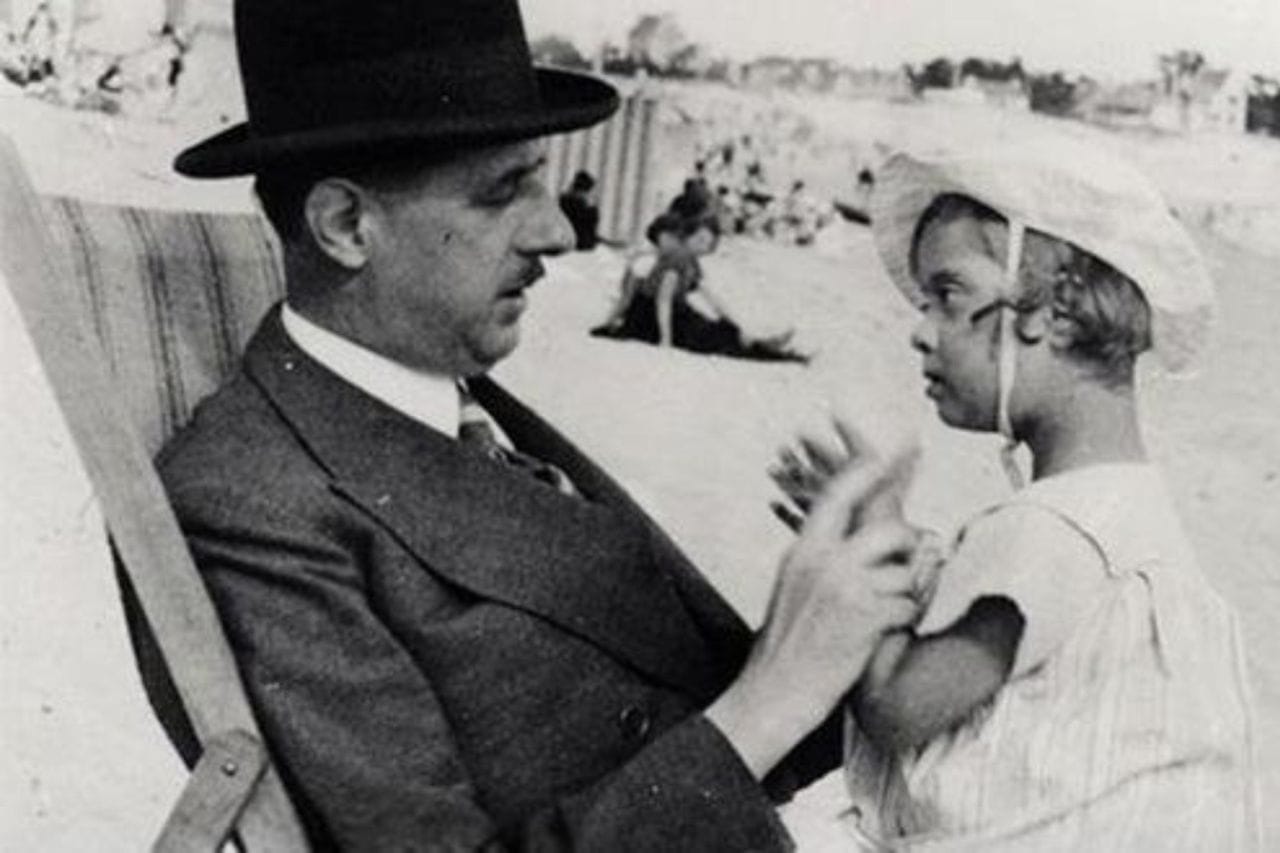
From The Independent: “When Anne was born, in 1928, there would have been a huge stigma attached to having a child with Down syndrome. It was often thought to be a result of parental alcoholism, venereal disease, or overall degeneracy. Eugenics was also coming into vogue at the time. In those days the norm would have been to put a child like Anne into an institution. (Indeed, nearly four decades later, when playwright Arthur Miller fathered a son with Down syndrome, he not only put him in an institution, he pretended he never existed.) De Gaulle is generally thought of as a bit of a pig, but with Anne he was different. Apparently he delighted in telling her stories and singing her songs, doing little dances for her and putting on pantomimes. And in many ways, she was de Gaulle’s secret weapon: “She helped me overcome the failures in all men,” he said, “and to look beyond them.”
Note: This is a version of my personal newsletter, which I send out via Ghost, the open-source publishing platform. You can see other issues and sign up here.
From New York: “One weekday in the summer of 2021, Christopher Pence entered his home office in Cedar City, Utah, and plugged a USB stick into his computer. He booted up Tails, an operating system designed to optimize privacy, and used it to access the dark web — a marketplace teeming with illicit goods and services like child pornography, weapons, and drugs. Christopher, who was 41 and worked for Microsoft as a systems engineer, wanted to hire a hit man to kill a young couple he had met on only a handful of occasions. Christopher was an unlikely client in the murder-for-hire trade. He was not violent and had no criminal record. When he wasn’t logging ten-to-12-hour days working, often while listening to one of his favorite Christian rock bands, he was helping his wife, Michelle, raise their 11 biological and five adopted children. The entire family, along with Christopher’s retired parents, lived in a 5,800-square-foot home on the northern edge of the Mojave Desert, surrounded by wind-raked brushland and snow-capped mountains in all directions. They were building greenhouses on the property and had plans to buy cows.”
If you really love Excel spreadsheets, this Las Vegas competition is for you
From The Verge: “It’s happy hour in Las Vegas, and the MGM Grand casino is crawling with people. The National Finals Rodeo is in town, the NBA’s inaugural in-season tournament is underway, the Raiders play on Sunday, and the U2 residency is going strong at the giant Sphere, so it seems everyone in every bar and at every slot machine is looking forward to something. (And wearing a cowboy hat.) Even for a town built on nonstop buzz, this qualifies as a uniquely eventful weekend. But I’d wager that if you wanted to see the most exciting drama happening at the MGM on this Friday night, you’d have to walk through the casino and look for the small sign advertising something called The Active Cell. This is the site of the play-in round for the Excel World Championship, and it starts in five minutes. There are 27 people here to take part in this event (28 registered, but one evidently chickened out before we started), which will send its top eight finishers to tomorrow night’s finals. There, one person will be crowned the Excel World Champion.”
Note: This is a version of my personal newsletter, which I send out via Ghost, the open-source publishing platform. You can see other issues and sign up here.
From Atlas Obscura: “Vending machines have a fascinating history — the first one was actually created to prevent holy water theft back in the 1st century. That machine came about thanks to the handiwork of Heron of Alexandria. Now, Heron invented plenty of things that helped set the stage for our modern society. Steam engine? He was all over it. A wind-powered machine? That was him. But many of these things pale in comparison to the machine he created that efficiently ensured that people weren’t taking too much holy water at the temples where they went to worship. Heron came up with a solution that was immensely clever. People would drop tokens inside of the holy water dispenser, and the weight of the token would push against a lever that opened a small door. While the door was open, the holy water would fall out. Eventually, the coin would fall and the door would close—ensuring that people never took more than their fair share.”
Letters sent by people who took rocks from the Petrified Forest and then felt bad
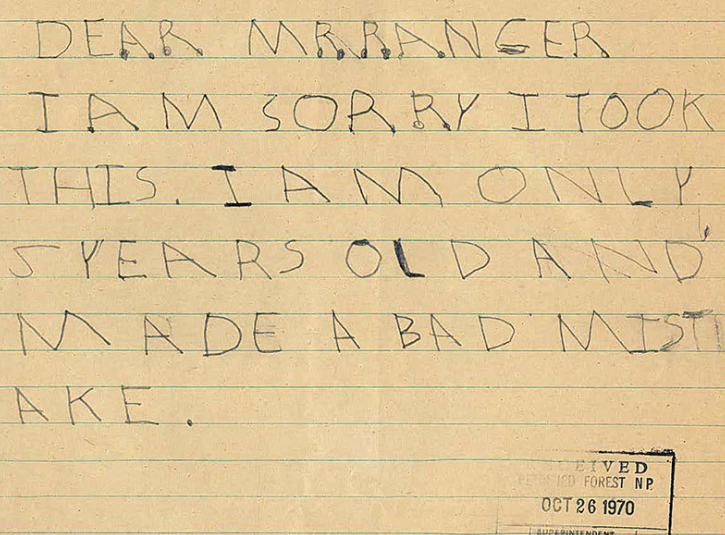
From Letters of Note: “Each year, countless visitors to Arizona’s Petrified Forest National Park ignore the stark warnings at its boundaries, spiriting away roughly 12 tons of its ancient, fossilised wood and stones—invaluable fragments of prehistory that rarely reappear. But some are returned, accompanied, more often than not, by a written apology that is soon archived in the park’s museum alongside hundreds of other “conscience letters.” Tales of remorse, guilt, and superstition can be found in these notes, with many confessing to a series of misfortunes and inexplicable bad luck since taking the petrified wood. Some speak of ruined relationships, financial disasters, and persistent health issues, attributing their woes to the stolen relics. These heartfelt pleas for forgiveness have become an unexpected and poignant part of the park’s history.”
Note: This is a version of my personal newsletter, which I send out via Ghost, the open-source publishing platform. You can see other issues and sign up here.
From The Cut: “For 40 excruciating minutes, Melanie Wilking, a trained dancer-slash-influencer with more than 3 million TikTok followers, sat in front of a camera, flanked by her weeping parents. It was a dramatic departure from her usual smiling choreographed videos, which for years she’d performed with her older sister, Miranda. Now Melanie claimed that Miranda had been pulled into what she described as a “cult.” “Miranda is a part of a religious group and she’s not allowed to speak to us,” she said, wiping tears from her eyes. Her sister and the other group members are “not in control of their lives,” she continued. “Someone else is controlling their lives, and they’re all victims of this.” Both Miranda and Melanie had moved to Los Angeles to dance a few years ago, but their paths began to diverge last year when Miranda was signed to 7M Films, a talent-management agency founded by a doctor-turned-preacher with a roster of a dozen young dancers making stylish, high-production dance videos.”
Why did baggage handler Beebo Russell steal a plane from the Seattle-Tacoma airport?
From Rolling Stone: “The stolen airplane began rolling forward under its own power, with no one in the cockpit. The twin engines of the Horizon Air Bombardier Dash 8 Q400 aircraft had been set to idle. But without anyone riding the brakes, the 13-foot propellers began pushing the plane slowly toward the runways of Seattle-Tacoma International Airport. The thief, Richard “Beebo” Russell, had just disconnected the tow bar of a tug vehicle he’d used to pivot the plane out of its parking spot. In a frantic, seven-second dash, the husky 28-year-old abandoned the truck and sprinted to the lowered passenger-entry door. He scrambled into the fuselage and hoisted up the hatch before flinging himself into the captain’s seat. This account pieces together public air-traffic-control recordings; disclosures from the FBI; testimony before the Washington State Legislature; and an unpublished after-incident report commissioned by the Port of Seattle.”
Note: This is a version of my personal newsletter, which I send out via Ghost, the open-source publishing platform. You can see other issues and sign up here.
From the New York Times: “As you watch the U.S. Artistic Swimming team practice for the Olympics — their bodies upside down, their legs scissoring in the air in perfect time, like frenzied offshore wind turbines — you will notice two things. First, the sport is much harder, and possibly even more insane, than you thought. Second, in a discipline whose enthusiasm for homogeneity is reflected in its pre-2017 name, synchronized swimming, one of the athletes in the pool is very much not like the others. His name is Bill May, and he is the only man on the team. A rule change in 2022 cleared the way for men to compete in the sport at this summer’s Paris Games. That means that this is May’s first and, realistically, last chance ever to fulfill his lifelong dream. He is 45 years old.”
Dick Van Dyke is almost a hundred years old but planning a cross-country tour
From Deadline: “As the star of cultural touchstones from The Dick Van Dyke Show to Mary Poppins to Chitty Chitty Bang Bang to Diagnosis Murder, Van Dyke has been on screen for as long as almost everybody can remember. His received his first lifetime achievement award 30 years ago. The legend label is not new. Perhaps he struggles to accept it because it implies a finality, that your work is complete and you’re now a part of the past, not the present. Van Dyke does not consider himself done. “I’d still like to do a one man-show,” he says. He certainly wouldn’t be short of material. Van Dyke has been working for more than 70 years now, across film, theater and TV. The biggest screen moments of his career were celebrated in the recent CBS special Dick Van Dyke 98 Years of Magic, a very sweet variety show involving heartfelt tributes and a parade of performers giving their takes on Van Dyke’s most famous musical numbers.”
Note: This is a version of my personal newsletter, which I send out via Ghost, the open-source publishing platform. You can see other issues and sign up here.
From Defector: “On the morning of Aug. 5, 1936, Helen Stephens was supposed to be on top of the world. The day before, she had won the Olympic gold medal in the 100-meter dash. She’d defeated her longtime rival, a Polish sprinter named Stella Walsh. Then, it all fell apart. That morning, a Polish newspaper, the Warsaw-based Kurier Poranny, published a curious accusation: Stephens, the paper alleged, was not really a woman at all. “It is scandalous that the Americans entered a man in the women’s competition,” the paper plainly stated. The accusation should have been dismissed outright, the ravings of a sportswriter frustrated by the defeat of one of his country’s stars. But at the Nazi-run Berlin Olympics, the story had juice. At a press conference, a European journalist asked: “Are you really a woman? Are you a man running in women’s races?”
For Jock Sutherland, being hailed as the world’s best surfer was just one phase in an unlikely life
From the New Yorker: “Jock Sutherland surfs unusually well for a man of seventy-five. Surfing well at his age is unusual, full stop. But he has spent his whole life, nearly, in this wave-rich corner of Oahu. We paddled out through a gantlet of blue-gray lava rocks. I tried to mimic Sutherland’s every move—he had been navigating this tiny, swirling channel since the nineteen-fifties. There were a dozen people out, and every one of them greeted Jock as he paddled past: little shakas and fist bumps with old regulars. This spot, where the waves range greatly in quality and intensity, is known as Jocko’s. In the mid-sixties, he made his move on surfing’s main stage, riding enormous waves with rare, almost playful aplomb. He rode the Banzai Pipeline, the world’s most famous, most photogenic, and, at that time, most dangerous wave. He rose swiftly through the Surfer poll, and in 1969 was No. 1—the consensus best surfer in the world.”
Off to war in a plywood box: The glidermen of World War II
From Warfare History: “One of the problems was how to get the maximum number of troops on the ground before the defenders could adequately react, and, second, how to provide them with heavy weapons such as artillery, antiaircraft weapons, transport, and engineer equipment once they got to, or close to, their landing zone. The answer to both problems was the glider, not only for resupply of weapons, equipment, and ammunition, but as a means to get a lot of people on the ground quickly and together, fully equipped and ready to fight. Once loose from the tug, you could land a glider in a pasture, a field of wheat, even a marsh. There was no landing gear to worry about; you could jettison the tricycle undercarriage at need and land the glider on its belly, some rudimentary skids taking up some of the shock. You could build them as big as a tug could tow them.”
(Editor’s note: If you like this newsletter, please share it with someone else. And if you really like it, perhaps you could subscribe, or contribute something via my Patreon. Thanks for being a reader!)
A lifetime of love for the charismatic narwhal, the unicorn of the sea
From Knowable: “Martin Nweeia is a modern Renaissance man. He has a degree in English and biology, a working dental practice, and a side interest in zoology and anthropology; he has composed for documentary films and has become an expert on narwhals — the mysterious, one-toothed “unicorns of the sea.” The male narwhal typically hosts a roughly eight-foot-long, single exterior tusk, whose function has been a mystery for centuries. Nweeia has obtained many grants to investigate the narwhal and, in more than 20 trips to the Arctic, he has compiled ambitious logs of Indigenous knowledge about the tusk, conducted in-depth studies on the material it is composed of, and attached heart and brain monitors to narwhals to try to determine what they can sense through the protrusion. Nweeia lectures at Harvard’s School of Dental Medicine and holds a global fellow position at the Polar Institute at the Wilson Center.”
How did the first humans on the Canary Islands survive a thousand years of isolation?
From Science.org: “More than 1000 years ago, a young man stood on the northern shore of the island now known as El Hierro. Across the wave-swept Atlantic Ocean, he could see the silhouettes of other islands, but for him, those islands were as unreachable as the Moon. His ancestors here had farmed wheat, but he and his contemporaries grew only barley and raised livestock such as goats. His genes held evidence that his parents were closely related, like many of the roughly 1000 people on the island, who had not mingled with outsiders for centuries. Yet the first Canarians, who arrived from North Africa roughly 1800 years ago, survived and even thrived on this arid, windswept archipelago for more than a thousand years. They numbered in the tens of thousands when Europeans first started arriving at the start of the 14th century.”
A family discovered a rare Tyrannasaurus Rex fossil in North Dakota
From the New York Times: “In the summer of 2022, two boys hiking with their father and a 9-year-old cousin in the North Dakota badlands came across some large bones poking out of a rock. They had no idea what to make of them. The father took some photos and sent them to a paleontologist friend. Later, the relatives learned they’d made a staggering discovery: They’d stumbled upon a rare juvenile skeleton of a Tyrannosaurus rex. Part of the fossil, which measures about 32 inches, is believed to be the tibia, or shin bone, of a 10-foot-tall, 3,500-pound dinosaur that scientists are calling Teen Rex. Only a few such fossils have been discovered worldwide, according to the Denver Museum of Nature & Science. The specimen is also the most complete T. rex the museum has ever collected, it said. The paleontologist who identified the fossil said the boys had made an “incredible dinosaur discovery that advances science.”
Acknowledgements: I find a lot of these links myself, but I also get some from other newsletters that I rely on as “serendipity engines,” such as The Morning News from Rosecrans Baldwin and Andrew Womack, Jodi Ettenberg’s Curious About Everything, Dan Lewis’s Now I Know, Robert Cottrell and Caroline Crampton’s The Browser, Clive Thompson’s Linkfest, Noah Brier and Colin Nagy’s Why Is This Interesting, Maria Popova’s The Marginalian, Sheehan Quirke AKA The Cultural Tutor, the Smithsonian magazine, and JSTOR Daily. If you come across something interesting that you think should be included here, please feel free to email me at mathew @ mathewingram dot com
From the NYT: “It has been an article of faith for nearly a century, as if chiseled onto a tablet by Abner Doubleday himself: The leading hitter in major league history is, and always will be, Tyrus Raymond Cobb. But history evolves. We know that Doubleday did not, in fact, invent baseball. And as of Wednesday, Josh Gibson will replace Cobb as the leading hitter in the official records of the game. At .372, Gibson’s career batting average eclipses Cobb’s by six points. Major League Baseball announced the results of a newly integrated statistical database covering records from Negro Leagues that operated from 1920 to 1948. The formal acceptance of the data comes three-and-a-half years after MLB officially recognized the Negro Leagues in December 2020.”
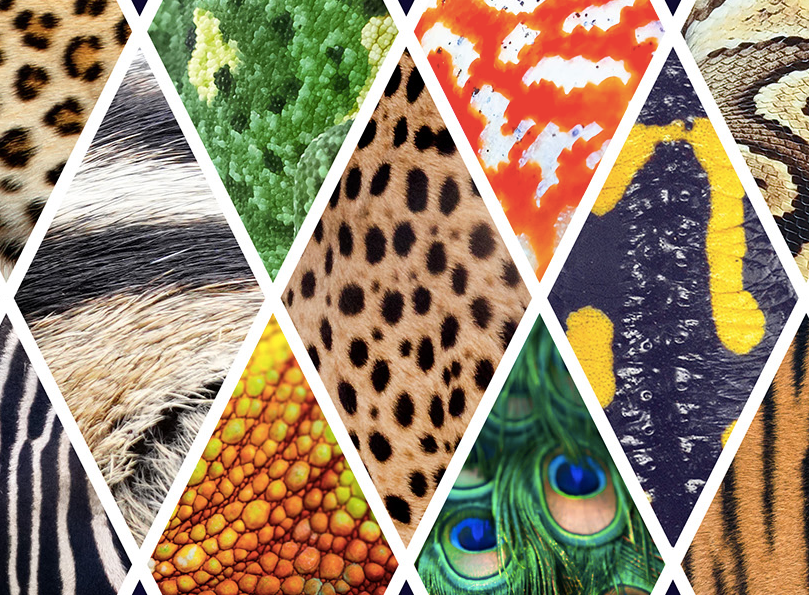
From Knowable: “There’s a reason fashion designers look to animal prints for inspiration. Creatures have evolved a dizzying array of patterns: stripes, spots, diamonds, chevrons, hexagons and even mazelike designs. Some, like peacocks, want to be seen, to attract a mate or scare off a rival or predator. Others, like tigers or female ducks, need to blend in, either to sneak up on prey or to avoid becoming lunch themselves. Some patterns arise simply or randomly, but others develop via complex, precise interactions of pattern-generating systems. More than 70 years ago, mathematician Alan Turing proposed a mechanism that explained how patterns could emerge from bland uniformity. Scientists are still using his model to gain a deeper understanding of animal markings.”
Note: This is a version of my personal newsletter, which I send out via Ghost, the open-source publishing platform. You can see other issues and sign up here.
From Mental Floss: “During the American Revolution, George Washington approved a plan to kidnap a 17-year-old midshipman. Such kidnappings were not unusual. Throughout the war, Continental and British army leadership attempted—and sometimes succeeded—in kidnapping colonial governors and high-ranking military officers to gain leverage in stalled negotiations. The British unsuccessfully tried to abduct Washington himself in 1780. The teenaged midshipman was Prince William Henry, a son of King George III and third in line to the throne. William Henry arrived in New York City’s harbor on September 26, 1781, aboard the HMS Prince George; he was the first member of the British royal family to set foot in the American colonies.”
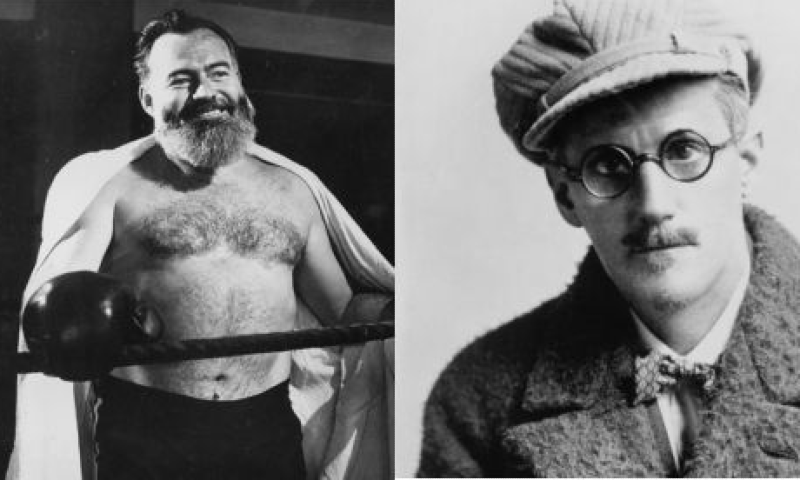
James Joyce used to pick drunken fights and then hide behind Ernest Hemingway
From Open Culture: “Hemingway characterized Joyce as a thin, wispy and unmuscled man with defective eyesight, and also noted that the two writers did a certain amount of drinking together in Paris. The author of Ulysses and other books would routinely pick drunken fights, then duck behind his burly friend and say, “Deal with him, Hemingway.” Hemingway, who was convinced he had the makings of a real pugilist, was likely happy to oblige. Hemingway’s biographer wrote that Joyce was an admirer of Hemingway’s lifestyle and worried aloud that his books were too “suburban” next to those of his friend. Joyce said “there is much more behind Hemingway’s form than people know.”
Note: This is a version of my personal newsletter, which I send out via Ghost, the open-source publishing platform. You can see other issues and sign up here.
From the BBC: “In 2020, Danish antiquities dealer Dr Ittai Gradel began to suspect an eBay seller he had been buying from was a thief who was stealing from the British Museum. More than two years later, the museum would announce that thousands of objects were missing, stolen or damaged from its collection. Why had it taken so long for it to do so? Dr Gradel collects ancient gemstones carved with intricate figures or motifs – the circle of dealers is small, so the internet has become a vital trading tool. On 7 August 2016, a grey and white piece of a cameo gemstone featuring Priapus – the Greek god of fertility – was posted for just £40. Dr Gradel knew he had seen the Priapus cameo before. He was sure it featured in an old gems catalogue he owned from one of the world’s most famous institutions, the British Museum.”
Remote tribe gets the Internet and now they are hooked on porn and social media
From the New York Times: “As the speeches dragged on, eyes drifted to screens. Teenagers scrolled Instagram. One man texted his girlfriend. And men crowded around a phone streaming a soccer match while the group’s first female leader spoke. Just about anywhere, a scene like this would be mundane. But this was happening in a remote Indigenous village in one of the most isolated stretches of the planet. The Marubo people have long lived in communal huts scattered hundreds of miles along the Ituí River deep in the Amazon rainforest. They speak their own language, take ayahuasca to connect with forest spirits and trap spider monkeys to make soup or keep as pets. But since September, the Marubo have had high-speed internet thanks to Elon Musk.”
Note: This is a version of my personal newsletter, which I send out via Ghost, the open-source publishing platform. You can see other issues and sign up here.