
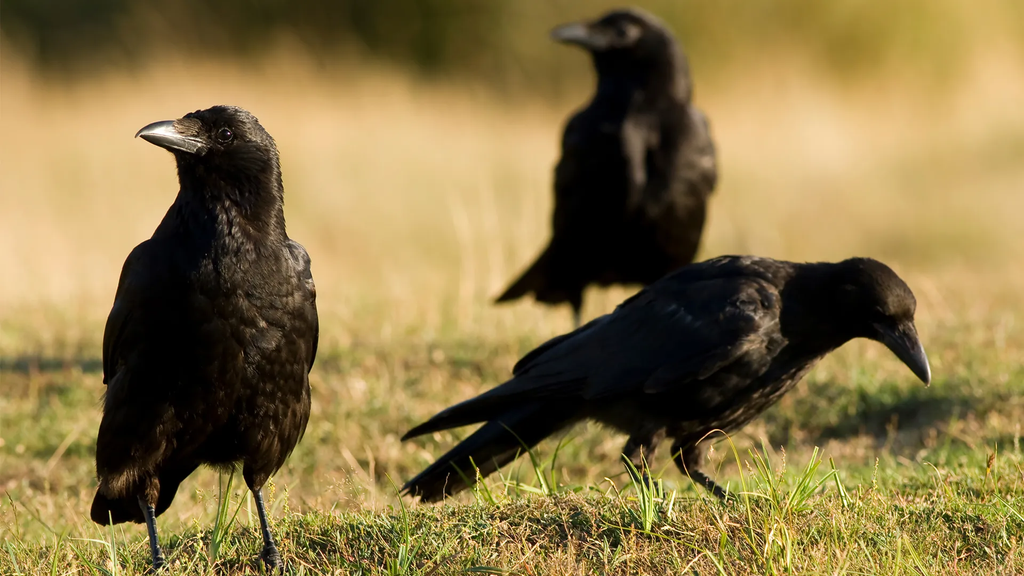
Many people who receive attention from crows feel that the birds have more complex motives. “It seemed like they would just come by to hang out,” my sister tells me — like, well, friends. What is a friend, anyway? For a scholarly perspective, I spoke to Thom van Dooren, a field philosopher at the University of Sydney. He believes crows relate to people in ways that meet several conditions for friendship. Criterion one: You must know a friend from a stranger. “In order to strike up a friendship, you have to be the kinds of organisms who can firstly recognize one another as individuals,” he says. Here, the avians have an advantage. While people struggle to tell crows apart, crows are startlingly good at identifying us. In experiments, urban crows held long grudges against people who mistreated them, cawing harshly and forming mobs upon seeing the face of their persecutor—even years later. My sister’s crow companions knew her when she had a different haircut or wore a hat or sunglasses. (via Audobon)
A food scientist says he would love to taste the rotting fish sauce from an abandoned factory
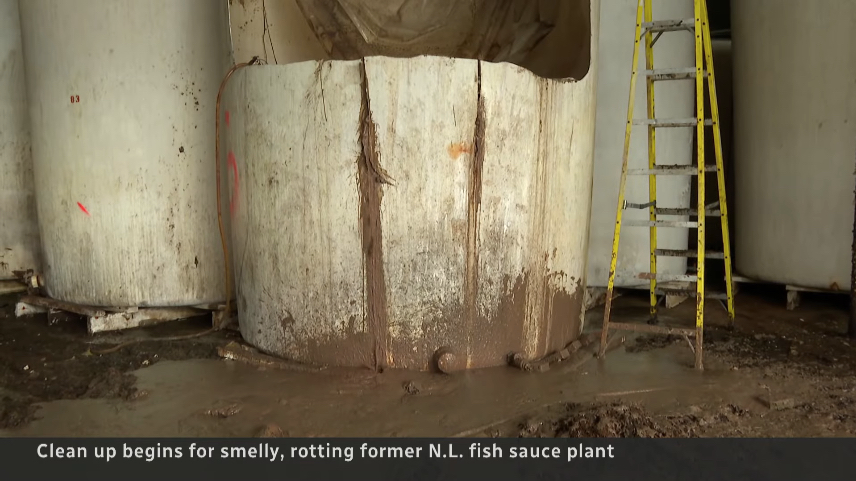
Take capelin, a small silvery fish in the smelt family. Now add salt. Then throw those two ingredients in 110 vats, each of them about 10 feet tall, and let them sit in a defunct factory for over two decades. The resulting stench might haunt an entire community, as it has the people of St. Mary’s, a coastal town of about 300 people in the Canadian province of Newfoundland and Labrador. In 2019, one resident described the ritual of abandoning her home every summer, boarding up the windows and doors so the smell doesn’t permeate her belongings. The people of St. Mary’s have long fought for the fish sludge to be cleaned up; after an aborted attempt in 2016, that work finally began in earnest this week. There are 900,000 liters of fish sauce to remove — some of it just liquid, some of it with fish solids. I spoke with food scientist Bryan Quoc Le earlier this week. Given his background in chemistry and Vietnamese cuisine, he was the ideal expert to unpack this horrifying and possibly delicious situation. (via Defector)
Note: This is a version of my When The Going Gets Weird newsletter, which I send out via Ghost, the open-source publishing platform. You can see other issues and sign up here.
The real mummy’s curse is the health risks of trading in mummified remains
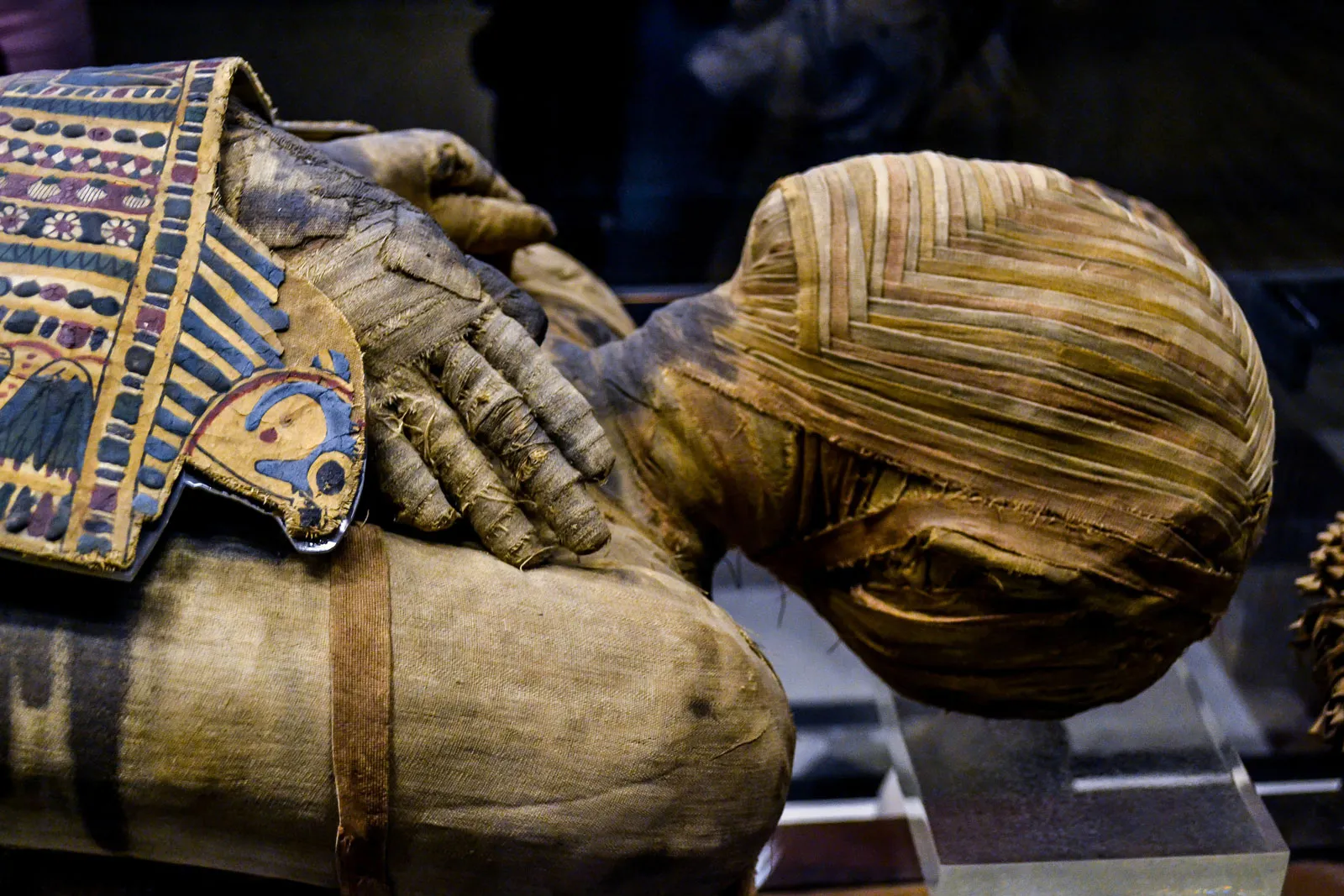
The rise of the internet, especially social media, has amplified international trafficking and driven demand for unique cultural heritage, including mummified humans and animals. However, these preserved remains pose health and biosecurity risks due to the toxicity of embalming methods and/or suboptimal storage that can promote microbial growth. This article investigates these risks by analyzing 128 online posts from Meta platforms, e-commerce sites, webstores, and auction houses. We reveal that mummified remains sold online exhibit signs of biodeterioration, yet sellers provide no safety guidance, suggesting limited awareness or deliberate disregard of hazards. Throughout history a range of toxic materials and substances have been employed to preserve tissues, including heavy metals such as arsenic, mercury, and lead, as well as organic compounds with antimicrobial properties and pigmentation qualities. (via Cambridge.org)
Hi everyone! Mathew Ingram here. I am able to continue writing this newsletter in part because of your financial help and support, which you can do either through my Patreon or by upgrading your subscription to a monthly contribution. I enjoy gathering all of these links and sharing them with you, but it does take time, and your support makes it possible for me to do that. I also write a weekly newsletter of technology analysis called The Torment Nexus.
Wrestler Mr. Perfect once saved MLB legend Wade Boggs’ life while they were deer hunting
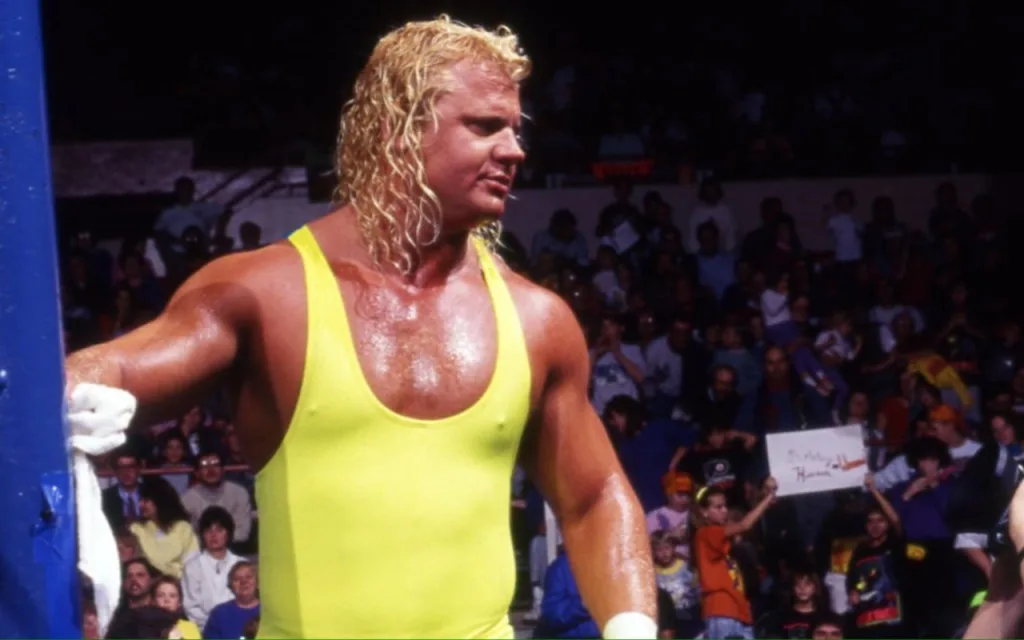
Former MLB third baseman Wade Boggs was a long-time friend of the late WWE Hall of Famer Curt Hennig, AKA Mr. Perfect. He recently confirmed a story about how Hennig saved his life while they were deer hunting. A Twitter/X user tagged Wade Boggs in a post asking the MLB legend to confirm the story’s authenticity. It stated that Boggs and Curt Hennig went deer hunting in Iowa back in the day. When the MLB legend got tangled in some barbed wire. Boggs was split open from his knee to ankle and was losing a lot of blood, and Curt Hennig reportedly got him out, picked him up, and carried him on his shoulder for about three miles to the pickup truck and got him to the hospital. The story also claimed that Boggs had called Hennig his guardian angel after he saved his life. Responding to the tweet, Wade Boggs confirmed the story was true by simply posting a thumbs-up and folded hands emojis. (via Yahoo)
Nebraska awards people the title of Navy Admiral despite being miles from any ocean
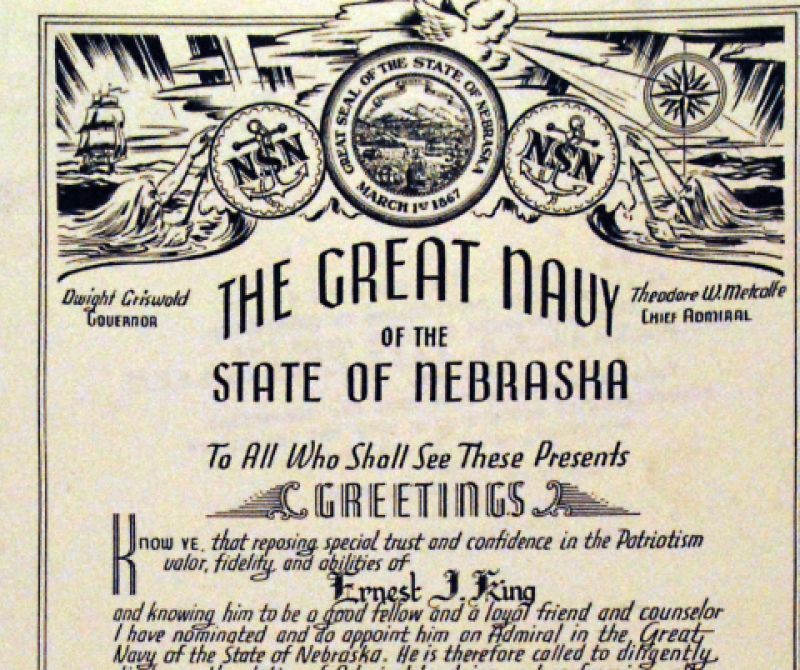
Nebraska Admiral (formally, Admiral in the Great Navy of the State of Nebraska) is the state of Nebraska’s highest civic honor, and an honorary title bestowed upon individuals by approval of the Governor of Nebraska. It is not a military rank, requires no specific duties, and carries with it no pay or any other compensation. Admirals have the option of joining the Nebraska Admirals Association, a non-profit organization that promotes “The Good Life” of Nebraska. The award certificate describes the honor in a deliberately tongue-in-cheek fashion: “And I [the Governor of Nebraska] do strictly charge and require all officers, seamen, tadpoles and goldfish under your command to be obedient to your orders as Admiral—and you are to observe and follow, from time to time, such directions you shall receive, according to the rules and discipline of the Great Navy of the State of Nebraska. The use of the title of admiral, instead of some other high-ranking military title, is a humorous reference to the fact that Nebraska has no navy and is the only triple land-locked state. (via Wikipedia)
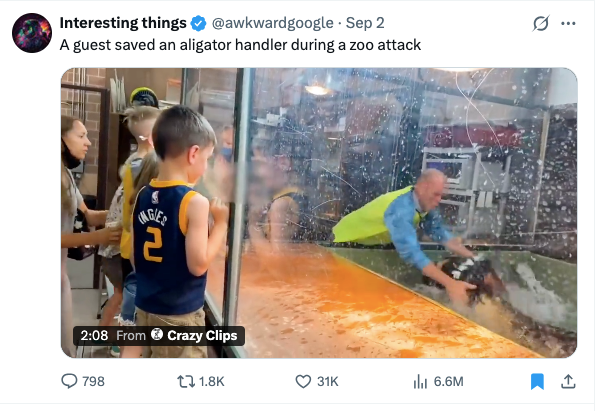
Guest saves an alligator handler who gets pulled into the tank by a gator
Acknowledgements: I find a lot of these links myself, but I also get some from other places that I rely on as “serendipity engines,” such as The Morning News from Rosecrans Baldwin and Andrew Womack, Jodi Ettenberg’s Curious About Everything, Dan Lewis’s Now I Know, Robert Cottrell and Caroline Crampton’s The Browser, Clive Thompson’s Linkfest and Why Is This Interesting by Noah Brier and Colin Nagy. If you come across something you think should be included here, feel free to email me at mathew @ mathewingram dot com