
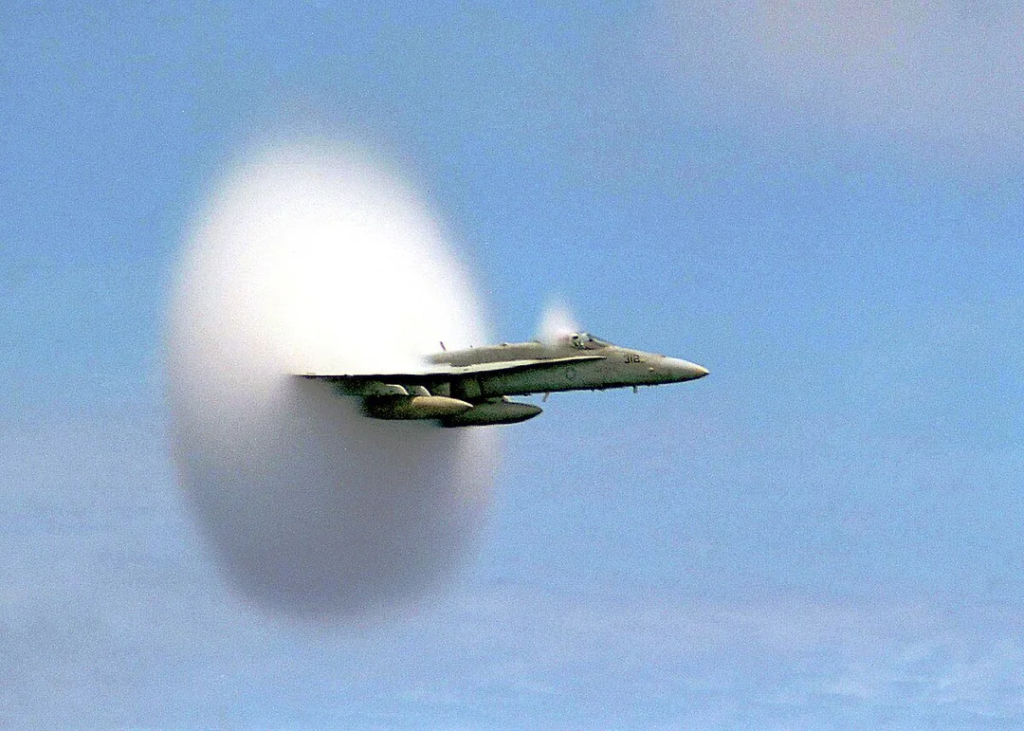
The screeching of peeling tape is a familiar albeit annoying sound. However, despite decades of study, its source has remained elusive. The peeling of adhesive tape from a solid surface is known to progress with a stick-slip mechanism. Indeed, numerous studies investigated the chaotic trajectory of these motions and the associated pulling forces, which is important for disparate phenomena, such as fracture mechanics, triboluminescence, and earthquake dynamics. However, the early studies missed a crucial aspect of the slip mechanism, which relies on a sequence of transverse cracks which can travel supersonically, relative to the air, across the width of the adhesive under the tape as it detaches from the solid substrate. This sound is produced by a discrete train of weak shocks emanating from the fine fractures which travel supersonically with respect to the surrounding air, in the transverse direction. (via Physical Review)
He discovered the jet stream but no one noticed because he published it in Esperanto

Had Japanese meteorologist Wasaburo Ooishi not been an Esperantist, U.S. scientists during World War II might have been more aware of a national vulnerability. Between 1923 and 1925, Ooishi completed almost 1,300 observations of fierce high-altitude winds, later named the jetstream. The somewhat eccentric Ooishi was not only the director of Japan’s Tateno atmospheric observatory but also the head of the Japan Esperanto Society, proponents of the artificially constructed language. Ooishi announced his discovery in the Tateno observatory’s annual reports, which he published in Esperanto. Not surprisingly, his research was ignored, and the U.S. military was caught off guard by two consequences of the invisible jetstream. The first surprise came in 1944 when B-29 pilots flying toward targets in Japan discovered at their cruising altitudes winds as high as 230 mph. The winds caused bombs to miss targets and, as headwinds, required bombers to use far more fuel than expected. (via the Smithsonian)
Super Glue was invented accidentally and forgotten then rediscovered

The incredibly stable adhesive known as Super Glue was invented by accident in 1942 by Dr. Harry Coover while he was working for Eastman-Kodak’s chemical division in Rochester, New York. During World War II, Coover was part of a team conducting research with chemicals known as cyanoacrylates in an effort to find a way to make a clear plastic that could be used for precision gunsights for soldiers. While working with the chemicals, the researchers discovered that they were extremely sticky, and this property made them very difficult to work with. Moisture causes the chemicals to polymerize, and since virtually all objects have a thin layer of moisture on them, bonding would occur in virtually every testing instance. They rejected cyanoacrylates as a feasible option and moved on with their research. Six years later, in 1951, Coover was transferred to Kodak’s chemical plant in Kingsport, Tennessee. That’s when he re-discovered the cyanoacrylates and recognized new potential in them. (via MIT)
Hi everyone! Mathew Ingram here. I am able to continue writing this newsletter in part because of your financial help and support, which you can do either through my Patreon or by upgrading your subscription to a monthly contribution. I enjoy gathering all of these links and sharing them with you, but it does take time, and your support makes it possible for me to do that. I also write a weekly newsletter of technology analysis called The Torment Nexus.
Scientists think they’ve found the mysterious “sunstone” that the Vikings used to navigate

To avoid getting lost on their voyages across the North Atlantic 1000 years ago, Vikings relied on the sun to determine their heading. (This was long before magnetic compasses were available in Europe.) But cloudy days could have sent their ships dangerously off course, especially during the all-day summer sun at those far-north latitudes. The Norse sagas mention a mysterious “sunstone” used for navigation. The trick for locating the position of the hidden sun is to detect polarization, the orientation of light waves along their path. Even on a cloudy day, the sky still forms a pattern of concentric rings of polarized light with the sun at its center. If you have a crystal that depolarizes light, you can determine the location of the rings around the hidden sun. Calcite is such a crystal. It has a property called birefringence: Light passing through calcite is split along two paths, forming a double image on the far side. (via Science.org)
Wagner designed a wooden horn that was to be used during his opera Tristan und Isolde

About 4 1/2 hours after the first notes of Wagner’s “Tristan und Isolde,” a startling sound emerges from the wings, one many in the audience likely have never heard before. A nearly 4-foot wooden horn known as a holztrompete, specially constructed to the composer’s somewhat ambiguous specifications, signals the arrival of the ship carrying Isolde and King Marke to Brittany, inspiring a mortally wounded Tristan to hang on to life for a few more moments. A new production of the opera features a specially constructed horn that measures a minimum 46.5 inches and lengthens slightly if the tuning slide is turned. While the Wagner Tuba was invented in the 1850s by the composer for his Ring Cycle to bridge the sounds of horn and trombones, the holztrompete’s details are more nebulous. Wagner said it should have “the effect of a very powerful natural instrument, such as the alphorn” and that he wanted it to be “at least three feet long, made of wood, almost trumpet-like, slightly curved downwards.” (via AP)
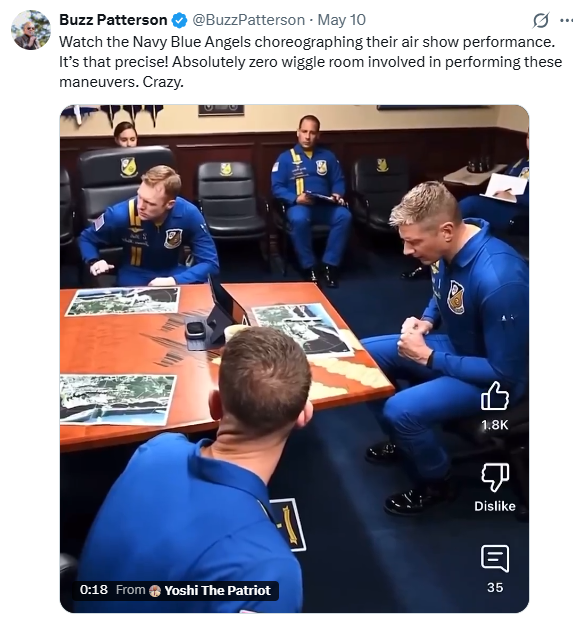
Blue Angel aerobatic pilots choreograph their performance by picturing every move
Acknowledgements: I find a lot of these links myself, but I also get some from other places that I rely on as “serendipity engines,” such as The Morning News from Rosecrans Baldwin and Andrew Womack, Jodi Ettenberg’s Curious About Everything, Dan Lewis’s Now I Know, Robert Cottrell and Caroline Crampton’s The Browser, Clive Thompson’s Linkfest and Why Is This Interesting by Noah Brier and Colin Nagy. If you come across something you think should be included here, feel free to email me at mathew @ mathewingram dot com