
When excavators explored (and emptied) King Tuntankhamun’s tomb in the 1920s, they found a lot of magnificent artifacts. The 5,398 officially noted burial objects included ceremonial figurines, chariots, pieces of jewelry and artwork, and even piles of food. Excavators also found King Tut’s underwear — more than 140 pairs of it. No one knows why King Tut was sent off to the afterlife with so many loincloths, let alone why he packed precisely this many for his journey. A closer look at Tut’s garments suggested his measurements were 31”, 29”, 43”—rather hippy for a young man. Indeed, a “virtual autopsy” scan of King Tut done some years ago suggested he had a slim torso and fatty deposits around his hips. For a time, there was speculation that King Tut may have inherited a congenital disorder that impacted his body shape. Akhenaten, who may have been the boy-king’s father, was depicted in artwork as having wide hips and a protruding belly, which stood out from portraits of other Egyptian royalty. But genetic research has shown it’s unlikely the family had congenitally big butts; it’s more likely that Akhenaten had unusual taste in art. (via Popular Science)
A double-amputee Army veteran has climbed the highest peak on seven continents
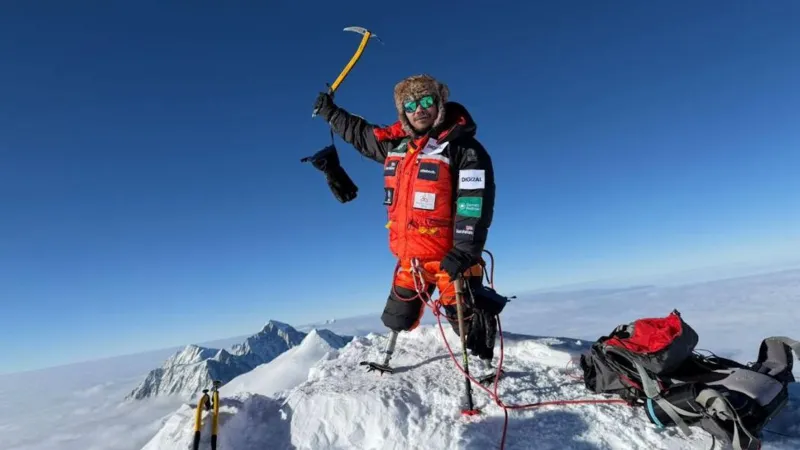
A former Gurkha has become the first double above-the-knee amputee to climb the highest peak on each of the seven continents. Hari Budha Magar, from Canterbury in Kent, completed his long-running challenge with a gruelling three-day ascent of Antarctica’s 16,059ft (4,892m) Mount Vinson, the summit of which he reached on Tuesday. The veteran, who lost both legs in 2010 while serving with the British Army in Afghanistan, had spent years training in order to prepare for the record-breaking attempt. Following the loss of his legs to an Improvised Explosive Device (IED), Magar said he struggled to recover, both mental and physically, describing “dark” times and “a loss of self-worth”. However, he eventually discovered a new purpose, sparked by his boyhood dream of becoming a mountaineer. His seven peaks challenge began with the 15,780 ft ascent of Mount Blanc in the Alps in August 2019, followed by Kilimanjaro in Tanzania in 2020 and Everest in the Himalayas in May 2023. (via the BBC)
Note: This is a version of my When The Going Gets Weird newsletter, which I send out via Ghost, the open-source publishing platform. You can see other issues and sign up here.
Continue reading “King Tut was buried with 140 pairs of immense underwear”