He was a star NFL agent and then came the crossbow murder

He drove his red Mercedes along Pershing Avenue with the top down, his wavy brown hair just long enough to flap in the wind. With his monogrammed shirts and pleated pants, Michael Blatt exuded a specific 1980s California cool rooted in the certainty that, no matter what, he would never, ever lose. An Army brat, Blatt said he moved 18 times before coming to the University of the Pacific to play soccer in the mid-1960s. His ambition took root. By 21, he wanted to make a million dollars. By 24, he wanted $10 million.After graduating from UOP in 1968, he worked in finance, but Blatt would never settle for managing other people’s money. One day, legend goes, he walked into a bank and asked for a million-dollar loan. The chairman, wearing a cowboy shirt and an oversized belt buckle, said, “You’re either crazy, full of bullsh—, or you gotta be right.”Blatt got the loan. Within six years, he had built 4,000 apartment units. Within a decade, his company tallied $120 million worth of construction. Later, he built a subdivision he called Blatt Estates with streets named after his children. (via The Athletic)

During World War I the White House called a herd of sheep into service to mow the lawn

In the spring of 1918, the United States was a year into World War I, and any man holding a job that could be done by someone — or something — else was a man who could be sent to France instead. That posed a problem for President Woodrow Wilson: the White House needed its grass cut and its groundskeepers freed up, and those two needs were pulling in opposite directions. The idea came from Dr. Cary T. Grayson, Wilson’s personal physician, who happened to have useful friends in horse racing. Grayson contacted his horse racing acquaintance William Woodward, who owned Belair Farm. Woodward sent along a small flock, 18 sheep in all, by wagon to the nation’s capital. The idea was simple: the sheep needed to eat anyway, and grazing on the lawn of the President’s house would mean the grass would always be well tended to. The idea worked at first, and had a nice side benefit. Sheep grow wool, and wool grown on the President’s lawn was kind of cool. But there were problems with the sheep-as-mowers scheme. (via Now I Know)

Note: This is a version of my When The Going Gets Weird newsletter, which I send out via Ghost, the open-source publishing platform. You can see other issues and sign up here.

Continue reading “He was a star NFL agent and then came the crossbow murder”

If you’re looking for mathewingram.com I have some bad news

(NOTE: I’ve restored my site thanks to Linux and some Updraft backups, but I am keeping this here for posterity)

It’s likely that not many people care about this, but I am writing this on my localhost/ blog — which I normally use as a backup to my blog at mathewingram.com/work — because the machine hosting that blog (and my photo server and my Plex instance and a bunch of other things) got hacked by ransomware a few days ago. I am currently in the process of either trying to restore it or wiping it and starting again, and at this point I have to say that the latter seems more likely.

I got hacked by someone using a form of ransomware known as Lockbit, which gets root access and encrypts all of your files and then renames them with a .lockbit extension. In my case it also got access to my Google Drive — I assume by cloning an authentication token to get around two-factor — and uploaded a bunch of encrypted files and backups. It seems that either I interrupted the process or they weren’t very good, because they didn’t get all of the files and they didn’t upload that many before I changed my passwords and locked them out.

That said, however, they screwed things up badly enough that it’s going to take some time and effort to put them back together, and it may not be possible. Ironically it would be easier if they had finished the job, because the last phase is to upload a ransom note and leave it as a screen saver, and that note often contains a unique ID that can be entered into an Interpol database that has decryption keys for some kinds of ransomware. If I can’t find a note or unique ID then I can’t search for the decryption key.

My working theory is that the hackers got in by brute-forcing the Windows Remote Desktop protocol, which I used to access my machine, since it is located somewhere other than my house. I had recently switched from RealVNC to RDP because RealVNC was charging a lot of money (relatively speaking) and RDP is free. I tried to set up Zerotier, a VPN, to get in through but it didn’t work for some reason I’ve been unable to figure out, so I opened a port to redirect RDP through — not the usual RDP port but a different one. A little while later there were a lot of blocked login attempts, but I didn’t think anything of it because open ports are often scanned and I thought I was protected enough, but clearly that wasn’t the case!

Anyway, even if I wipe the machine nothing priceless or irretrievable will be lost, because after many disk failures and other similar incidents in the past I have learned to have multiple redundant backups of almost everything, so I am all good on that front. But it will take some time to put things back where they belong — and maybe I will either go with Linux this time, or spend a bit more time trying to get a VPN working properly!

It’s the end of reading as we know it! It’s the new Dark Ages!

If you read The Atlantic, or you follow a lot of writers on Substack — or virtually any other writing-focused website or form of social media — you will already know what this post is about: The Atlantic published a piece recently entitled The End of Reading, the subtitle of which stated that “the age of reading might be a short anomaly in human history.” The piece begins with a lyrical description of the famous Library of Alexandria, which King Ptolemy the First intended to be the repository of all human knowledge at the time. The king reportedly paid scholars to live and work in the library, we are told, and the collection was available to anyone “eager to study, an encouragement for the entire city to gain wisdom,” according to a visiting Greek writer. Eratosthenes allegedly calculated the circumference of the Earth there, and Zenodotus edited the earliest manuscripts of Homer’s epic poems. The library eventually disappeared, The Atlantic tells us — in part because Julius Caesar set it on fire, and then the temple housing some of the manuscripts was sacked in the 4th century, but also for other reasons:

Contemporary historians tend to dismiss the importance of these dramatic incidents in favor of a more mundane cause of death: negligence. Maintaining the collection was an enormous expense. Humidity, mice, and insects slowly ate away at the papyrus scrolls. Scribes had to continually copy old texts before they deteriorated and became illegible. Eventually, the challenges of maintaining the library became greater than the will to preserve it. “It is not that the disappearance of a library led to a dark age, nor that its survival would have improved those ages,” the classics scholar Roger Bagnall has written. The fact that the library was allowed to die showed that the dark age had already arrived. Some 2,000 years later, under very different circumstances, the darkness is gathering again.

“The darkness is gathering again.” In other words, welcome to the new Dark Ages! If this seems a little over-the-top to you, you aren’t the only one. And what kind of evidence does The Atlantic produce to justify this apocalyptic pronouncement? Americans (who are “once members of a proudly literate society,” according to the magazine, although that could definitely be debated) read much less than they used to, we are told. In a study by the National Endowment for the Arts, fewer than half of all adults reported having read a book of any kind in 2022, and a study analyzing 236,000 responses to the American Time Use Survey found the  proportion of Americans who read for pleasure on any given day fell from 28 percent in 2004 to 16 percent in 2023. The decline “cuts across age groups, gender, and education levels,” The Atlantic says, and even the demographics that traditionally read the most — retirees, women, and college graduates — have seen “a collapse” in their reading habits over the same period.

Note: This is a version of my Torment Nexus newsletter, which I send out via Ghost, the open-source publishing platform. You can see other issues and sign up here.
Continue reading “It’s the end of reading as we know it! It’s the new Dark Ages!”

Kids need to explore the world and that includes social media

I’ve written a number of times about what has become conventional wisdom – spread primarily by academics like Jonathan Haidt – that phones and/or social media are evil, and that they cause teenagers in particular to develop anxiety, depression, etc. and therefore should be regulated. Haidt’s book The Anxious Generation has either directly or indirectly led to laws against teen use of social media in Australia, the UK and Canada, and many other countries are reportedly considering similar legislation. As I’ve tried to point out in previous newsletters, all of this has come about despite the fact that there is virtually no concrete evidence in the psychological literature of any causal link between phones or social media and teen rates of depression, anxiety, or suicide – in fact, in some cases the exact opposite. Candace Odgers, a leading researcher in this area, has said in a review of Haidt’s book that his views are “not supported by the science,” and a meta-analysis of the research found the correlation between teen use of social media and rates of depression to be “indistinguishable from zero.”

Odgers is one of the most prominent researchers to take issue with Haidt’s interpretation of the science in this area, but she is far from the only one. A recent piece in The Atlantic looked at the views of another prominent psychologist – someone who at one point was a close colleague of Jonathan Haidt’s, but has since diverged from him to the point where he said he now believes Haidt’s views are diametrically opposed to the truth. The psychologist in question is Peter Gray, who is perhaps best known for exposing the Stanford prison experiment as a fake. He also wrote a book entitled Free To Learn that was published in 2013, and argued that one of the biggest contributors to anxiety, depression, and other mental challenges among young people is their more regimented upbringing compared to previous generations, and in particular, a lack of free-form play time. Here’s how his thesis is described in the Atlantic piece:

Gray’s academic work defines play as a self-directed activity done only for its own sake. This, he came to believe, enables kids to figure out how to solve their own problems, nurture their own relationships, make their own rules, and manage their own disappointments. But he says that our society has spent the past 70 years or so interfering with that process. We’ve made it harder and harder for kids to do anything: They’re kept indoors for greater portions of the day and given less unstructured time; they play organized sports supervised by adults; they don’t go anywhere alone. Gray grew certain that this loss of independence has been harmful to their mental health.

Note: This is a version of my Torment Nexus newsletter, which I send out via Ghost, the open-source publishing platform. You can see other issues and sign up here.

Continue reading “Kids need to explore the world and that includes social media”

Data center criticism is based on bad science and scare quotes

If you are following the growing artificial intelligence industry at all, you’ve probably come across some facts and figures about how AI is going to use up all of the country’s water, while also using up all the power and causing prices to spike for regular non-AI using humans, and also that the giant data centers required for this industry are taking over all the usable land, and will cause pollution to soar, and/or lead to a wide range of other negative societal effects. I don’t think of myself as an apologist for AI — although I have written about how it can be useful for important things like medical research, and how using it as a tool for writing isn’t always a terrible thing — and it’s possible that anti-data-center arguments have some merit purely as an anti-billionaire measure, but at the same time, many of the arguments I’ve noted above simply aren’t rational. They may contain numbers that sound terrible — billions of gallons of water, megawatts of power, etc. — but when looked at rationally they tend to collapse.

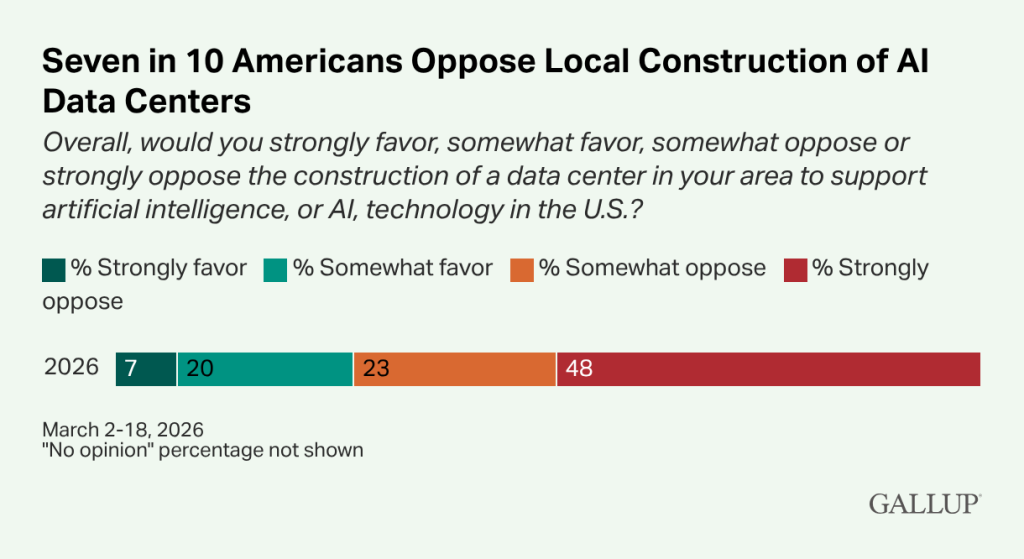
According to a recent Gallup poll, seven out of 10 Americans are opposed to the construction of data centers for artificial intelligence in their local area, and almost half of those surveyed were strongly opposed. In the same March survey, 53% of Americans say they oppose building a nuclear energy plant in their area, far less than the 71% opposed to data center construction. Since Gallup first asked the nuclear power plant question in 2001, the high point in opposition has been 63%. Half of opponents mention data centers’ excessive use of resources, including almost 20% mentioning either their use of water or energy. Sixteen percent mention a related environmental concern of pollution, including noise pollution and air and water pollution. Most of the remaining opposition stems from general or specific concerns about artificial intelligence.

If you want to keep up with the revolt against data centers, there’s a dedicated website called Data Center Watch, which says it is run by a “boutique research firm tracking the growing opposition to data center development.” According to the site, local residents blocked or delayed about 20 projects around the US in the second quarter of last year, representing nearly $100 billion in proposed investment. Residents across the US are attacking and/or trying to block data center projects, according to a report from the Wall Street Journal:

Note: This is a version of my Torment Nexus newsletter, which I send out via Ghost, the open-source publishing platform. You can see other issues and sign up here.

Continue reading “Data center criticism is based on bad science and scare quotes”

Anthropic discovers that Claude has a “secret thinking area”

As longtime Torment Nexus readers probably know, I have a minor obsession with the topic of artificial intelligence engines and consciousness — in part because such discussions inevitably reveal how little we know about human consciousness, let alone the machine kind. What is consciousness? Where does it reside? How does it emerge? How do we know that Atlantic writer Ted Chiang is conscious, let alone anyone else? And so on. If this isn’t your jam, I completely understand, and if you stop reading and move on, I will not be offended at all (but come back later!) I know that some people feel AI consciousness is a dead end, and that large-language models like Claude and Gemini and ChatGPT are just “stochastic parrots” or souped-up autocomplete tools that stole all their intelligence from others, and that talking about them being conscious or becoming conscious is like wondering if your toaster misses you when you are at work — and that those who discuss it, like Richard Dawkins did, have lost their minds or are the victims of “AI derangement syndrome.” I get that. I am not one of those people.

I’m not saying I believe that AI engines like Claude or ChatGPT are conscious or even that I think they will become conscious! But at the same time, I’m not saying they aren’t or won’t. David Chalmers, a professor of philosophy and neural science at New York University and a prominent researcher in the field of AI consciousness,  told New York magazine recently that the odds have gotten significantly higher that an AI could be conscious — in 2023 he said the probability was around 10 per cent. “I don’t know if I’d say that these systems are conscious yet,” Chalmers said, but “people who are confident that they’re not conscious maybe shouldn’t be. We just don’t understand consciousness well enough, and we don’t understand these systems well enough.” Chalmers and Yoshua Bengio — who worked with Geoffrey Hinton and Yann LeCun on the development of neural networks — have written a paper that concludes that based on various criteria current AI engines are not conscious but future ones could be.

In the world of consciousness research, as I understand it, there are a (large) number of different models of how consciousness might work in human beings — or anywhere else, for that matter — and how we might find evidence of it working, or at least see the signs of it in operation. One of the most popular is called Global Workspace Theory or GWT, and it was developed by cognitive neuroscientist Bernard Baars in the 1980s. In a nutshell (and I am paraphrasing and condensing significantly here) this theory of consciousness suggests that the human brain operates a little like a theater where a play is being performed. Backstage, in the dark, there is a huge amount of unconscious work happening — things like regulating your breathing, recognizing visual input, retrieving memories, and so on. The stage is a kind of global workspace, where if a piece of data is important enough, it is shoved into the spotlight so that the rest of the brain can have access to it, and this is the foundation of consciousness.

Note: This is a version of my Torment Nexus newsletter, which I send out via Ghost, the open-source publishing platform. You can see other issues and sign up here.

Continue reading “Anthropic discovers that Claude has a “secret thinking area””

Is there a new quantum processor or is Microsoft lying?

I’ve been writing a lot about artificial intelligence lately, and I wanted to break that cycle by writing about something that’s been bugging me for a little while now: namely, the controversy over Microsoft’s claim that it has developed a new and improved version of a quantum microprocessor based on the theoretical “Majorana” particle. What is said particle, you ask? I am not a quantum physicist by any means (I don’t even play one on TV) but I believe it is technically known as a fermion — a class of sub-atomic particles that obey certain rules. Protons and electrons are types of fermion, and so are quarks and weirder things like leptons (but not bosons). The main feature of a Majorana particle is that it acts as its own anti-particle. In regular physics, every particle has an anti-particle with the same mass but the opposite charge (except for photons, which are their own anti-particle because their magnetic charge is zero and the opposite of zero is still zero). When a particle and its anti-particle meet, they annihilate each other.

In case you were wondering (as I was), the Majorana particle is named after a brilliant Italian physicist named Ettore Majorana, who was born in 1906 and did ground-breaking work on theoretical physics; Enrico Fermi compared him to Isaac Newton. He correctly predicted the existence of the neutron, which won its discoverer the Nobel Prize, but in 1938, he disappeared mysteriously. Majorana was a public supporter of Italian fascism and a member of the National Fascist Party, but at the time he disappeared the Italian government had started requiring all university professors to swear an oath of loyalty to the Fascist regime in order to keep their jobs. It’s possible he didn’t want to do this and went into hiding but there is no record of anything written by him after his disappearance, and some colleagues suspect he committed suicide.

How does any of this relate to Microsoft’s quantum processor? Great question. When it comes to the nitty-gritty of the particle’s behavior I am completely out of my depth, so I’m going to defer to Wikipedia’s description of how Majorana particles could emerge, and also how they can (theoretically) be used in quantum computing:

In superconducting materials, a quasiparticle can emerge as a Majorana fermion, more commonly referred to as a Bogoliubov quasiparticle in condensed matter physics. Its existence becomes possible because a quasiparticle in a superconductor is its own antiparticle. Majorana fermions can be bound to a defect at zero energy, and then the combined objects are called Majorana bound states. This name is more appropriate than Majorana fermion because the statistics of these objects is no longer fermionic. Instead, they are an example of non-abelian anyons: interchanging them changes the state of the system in a way that depends only on the order in which the exchange was performed. The non-abelian statistics that they possess allows them to be used as a building block for a topological quantum computer.

Note: This is a version of my Torment Nexus newsletter, which I send out via Ghost, the open-source publishing platform. You can see other issues and sign up here.

Continue reading “Is there a new quantum processor or is Microsoft lying?”

Om Malik 1966-2026

I first met Om Malik in 2006, when we invited him to be a panelist at the web conference that some friends and I had just started in Toronto called Mesh (despite having literally no clue what we were doing). The idea was to bring smart folks together to talk about the wonderful future that blogs and live chat software and other magical Web 2.0 creations were surely going to bring about (LOL). And Om was one of those smart people we wanted to have on stage — I had been reading his blog and his writing at Business 2.0 about broadband and other new technologies, and I wanted him to talk about how the social web was going to change the media (I worked at a newspaper then, and I really wanted something to change the media). And he was everything I expected when we met: funny, smart, shot straight from the hip. I liked him right away.

As we sat around chatting at the MaRS Centre in Toronto, I mentioned to Om that I thought he should turn his blog into a business — just put up a website and sell ads and so on. As I recall, he stayed up late the night before he had to leave for San Francisco, drinking wine and smoking cigars (both of which he gave up after having a heart attack the next year) and he missed his flight. When he got into the office, he got chewed out by an editor and not long after that he quit and turned his blog into Gigaom, hiring writers and working out of his apartment (using a Pringles can or some other gizmo to leech off the free Wi-Fi from the Starbucks across the street, if I remember correctly). Om told a story about how he told his mother he wanted to call the site MegaOm, and she reportedly said “You are getting so big, it should be called GigaOm!” I don’t know if this is true 🙂

If this is your photo of Om please let me know
Continue reading “Om Malik 1966-2026”