
Johnny Cash on love

Links that interest me and maybe you

I first met Om Malik in 2006, when we invited him to be a panelist at the web conference that some friends and I had just started in Toronto called Mesh (despite having literally no clue what we were doing). The idea was to bring smart folks together to talk about the wonderful future that blogs and live chat software and other magical Web 2.0 creations were surely going to bring about (LOL). And Om was one of those smart people we wanted to have on stage — I had been reading his blog and his writing at Business 2.0 about broadband and other new technologies, and I wanted him to talk about how the social web was going to change the media (I worked at a newspaper then, and I really wanted something to change the media). And he was everything I expected when we met: funny, smart, shot straight from the hip. I liked him right away.
As we sat around chatting at the MaRS Centre in Toronto, I mentioned to Om that I thought he should turn his blog into a business — just put up a website and sell ads and so on. As I recall, he stayed up late the night before he had to leave for San Francisco, drinking wine and smoking cigars (both of which he gave up after having a heart attack the next year) and he missed his flight. When he got into the office, he got chewed out by an editor and not long after that he quit and turned his blog into Gigaom, hiring writers and working out of his apartment (using a Pringles can or some other gizmo to leech off the free Wi-Fi from the Starbucks across the street, if I remember correctly). Om told a story about how he told his mother he wanted to call the site MegaOm, and she reportedly said “You are getting so big, it should be called GigaOm!” I don’t know if this is true 🙂


The UK recently passed a new law that effectively bans children under the age of 16 from using most social-media platforms, a move that the UK government notes was based explicitly on Australia’s similar law, which was passed in 2024 (Britain’s law comes into effect next year). The law covers platforms like Instagram, YouTube, TikTok, Snapchat, Facebook and X but it excludes messaging services like WhatsApp and Signal. Some social app features – such as livestreaming and the ability to be contacted by strangers – will be blocked from users under the age of 18, and those features will also be blocked in related services like online gaming apps. According to the UK’s description, all of these new rules will be backed up by stronger requirements for age checks. In the preamble to the British version of the law, the government tries to answer the question “Why are these changes being made?” and this is the explanation it gives:
The government ran a national consultation from March to May 2026, one of the largest engagement exercises undertaken by this government. The results showed overwhelming public demand for action, with 9 in 10 parents backing a social media ban for under‑16s, and two-thirds of young people agreeing under-16s should not be allowed to use at least some social media platforms. These changes reset the rules so that children are protected from the platforms and online features that create the most harm.
One thing you might notice about this explanation is a complete lack of any evidence that such a law a) is necessary and b) works. All we have is a statement that suggests that most parents and young people – or at least most of those who chose to respond to a request for input – wanted this law to be passed. Or if not this law specifically, then they at least wanted “action,” whatever that means. I’ll get to the part about whether such laws are necessary, but the lack of data on whether such legislation will work or not is interesting, since the British law is based on an Australian law that has been in effect for almost two years now. Surely by now there would be some evidence that it is working? If there is, the British government doesn’t supply any, which isn’t that surprising because as far as I’ve been able to determine that kind of evidence doesn’t exist.
Note: This is a version of my Torment Nexus newsletter, which I send out via Ghost, the open-source publishing platform. You can see other issues and sign up here.
Continue reading “Banning teens from social media is bad and also doesn’t work”In a previous edition of this newsletter, I wrote about the launch of Anthropic’s newest AI model, code-named Mythos, and how the company said that it was too powerful to be trusted — mostly because of its ability to detect and potentially exploit software vulnerabilities — and therefore would only be available to a select few companies for testing as part of something called Project Glasswing. At the time, I and others drew an analogy between Anthropic’s repeated claims about the dangers posed by its AI models and the classic fable about “The Boy Who Cried Wolf” (coincidentally, the latest update to Mythos is code-named Fable), because its claims are seen by some as primarily marketing. Well, regardless of the truth of those claims, based on recent events it appears that the townsfolk have created a Wolf Detection Department, and the full might of the Wolf Protection Force is being brought to bear on the boy and his company.
In his Understanding AI newsletter, Tim Lee put together a good overview of what happened over the past few days. Anthropic, he says, “stunned the AI world by announcing it was revoking access to Claude Fable 5 and Mythos 5, the powerful new models it released just three days earlier. The government, Anthropic said, had issued an export control directive to suspend all access to Fable 5 and Mythos 5 by any foreign national, whether inside or outside the United States. Because Anthropic doesn’t have a way to limit access to Americans, this amounted to a de facto ban.” According to multiple news reports, researchers working for Amazon found it was possible to bypass Fable’s guardrails and gain access to its cybersecurity capabilities. Anthropic CEO Dario Amodei, however, argued in a blog post that the type of bypass that occurred does not pose the same risk as a broader jailbreak, and therefore a ban is unwarranted.
Whether it is warranted or not, however, is unfortunately (or fortunately, depending on your point of view) up to the government to decide, not Anthropic. The company may believe that it is the only one capable of managing or harnessing a tool like AI — and it may even be right — but that is not going to stop the government of Donald J. Trump from doing whatever the hell it wants, even if it doesn’t really know what it is doing or why. On top of that, as AI researcher and former White House advisor Dean Ball noted in a recent newsletter post entitled “Leviathan Waking,” there is a very real sense that Anthropic is either being naive or foolhardy in the way it went about releasing Mythos, since that release came so soon after the company was declared a supply-chain risk for not playing ball by allowing the Department of War to use its AI to target weapons (which I wrote about here). Ball described it in this way:
In D.C., Anthropic’s rapid release of Mythos after the supply-chain risk controversy with the Department of War was not just seen as another step in the development of AI, even if that is what it was. It was seen by many as a move against the United States Government—a private company, developing a weapon, as a move against the government. What else, really, could one have expected? The stark reality is that making superintelligence is a profoundly political act even in the healthiest of societies, to say nothing of the filthily political world we Americans currently inhabit.
Note: This is a version of my Torment Nexus newsletter, which I send out via Ghost, the open-source publishing platform. You can see other issues and sign up here.
Continue reading “The Anthropic AI danger chickens come home to roost”


Hamza Doost is 6-foot-3, with a chubby, bearded face, black hair, and an ankle monitor. For the past year, the 21-year-old has been confined to his father’s home in Hayward, an East Bay suburb. He’s allowed a computer, but the government tracks every keystroke. Curiously — given the circumstances — he’s allowed one cryptocurrency account. Not long ago, he sat for a photo wearing a cheerful Hawaiian print shirt, surrounded by gleeful friends aboard a luxurious private jet. According to federal prosecutors, Doost was a key figure in a sophisticated crime ring known as “SE Enterprise,” responsible for what was the largest single private theft of cryptocurrency in U.S. history: a $246 million heist pulled off not with guns or elaborate technical exploits but with phone calls and psychological pressure directed at one early bitcoin investor in Washington, D.C., who made the mistake of trusting the group. (via the SF Standard)
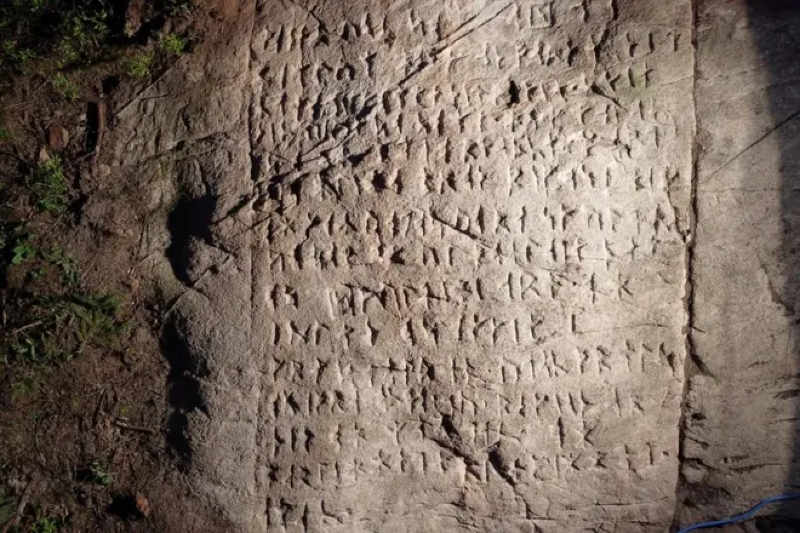
In 2017, a windthrown tree on a property near Wawa, Ontario, uprooted and exposed a section of bedrock. Avelino Pablo Cruz, an agricultural crew supervisor working nearby, took a break and noticed strange markings carved into the newly exposed rock. He reported them to the landowner. It would be years before anyone understood what he had found. The markings turned out to be 255 runic characters arranged in 15 lines — the longest runic inscription yet documented in North America and the only known runic inscription in the world reproducing the Lord’s Prayer. A second panel nearby depicts what appears to be a Scandinavian-style longship carrying 16 figures. The Wawa inscription may sound at first like evidence of a Norse visit to Ontario but it is rather a Modern Swedish version of the Lord’s Prayer, written in futhark characters, a runic script used in northern Europe and Scandinavia. (via Discover)
Note: This is a version of my When The Going Gets Weird newsletter, which I send out via Ghost, the open-source publishing platform. You can see other issues and sign up here.
Continue reading “A California teen helped run a $250-million crypto scam”
As regular readers will know, I’ve written a lot about the topic of AI and consciousness (too much for some perhaps!) because I find it fascinating, in much the same way that I find the issue of whether AI is dangerous or not fascinating – something I’ve also written about a number of times. And the main reason both of these topics are so interesting is that even the so-called experts, the people who built the fundamental underpinnings of these technologies, can’t seem to agree. On the subject of AI danger, for example, Geoffrey Hinton – the University of Toronto professor who was one of the main architects of neural networks – says that we are in deep trouble. His former colleague Yoshua Bengio agrees. But Yann LeCun – the former head of AI at Meta, who also worked on these technologies – says that this is ridiculous, and that current AIs are no more intelligent than the average cat. Timnit Gebru, a pioneering AI scientist formerly with Google (as Hinton was at one time) says they are just “stochastic parrots.“
On the consciousness question, discussions are inevitably filled with categorical statements. Those who think AI couldn’t possibly be conscious are convinced that the people who think it can be (or possibly already is) are idiots who are subject to “chatbot psychosis” or “AI derangement syndrome.” Others are convinced that there’s plenty of evidence that AIs are conscious – as Nobel Prize-winning biologist Richard Dawkins declared in a recent essay. It’s difficult to say when this debate began, but I think a good starting point is the essay from former Google ethicist Blake Lemoine in 2022, who argued that Google’s AI was either conscious or so close that it didn’t matter (he was ridiculed and then fired). To be fair, the anti-AI-consciousness side seems a lot more categorical than the pro – Anthropic cofounders Dario Amodei and Jack Clark haven’t said whether they think Claude is conscious, but they have left the door open to it (which seems to infuriate the anti-consciousness side as much as if they said it was).
Among the many categorical statements about AI consciousness, one of the most recent and most noteworthy – at least in terms of the amount of coverage it got – is the recent piece in The Atlantic from science-fiction author Ted Chiang (he wrote a story that became the movie Arrival). Chiang’s point is obvious from the title: “No, Artificial Intelligence Is Not Conscious.” Pretty definitive, Ted! To even discuss the question of AI consciousness is “absurd,” he says. And what is this based on? Is it his background in machine intelligence or the philosophy of consciousness, or perhaps his training in biological systems? It is not. From what I can tell, his conclusions seem to be based on what the kids like to call “vibes.” Should we seriously consider the possibility that Claude, or any large language model, might be conscious and capable of receiving moral instruction, Chiang asks? “No. Absolutely not,” he replies. He continues:
If we give an LLM a prompt that reads “The following is a conversation between Julius Caesar and Genghis Khan,” it will generate a coherent dialogue between the two historical figures. But no matter how detailed the responses are, no matter how vividly they recount their respective historical accomplishments, we would never conclude that the LLM has conjured up digital re-creations of Julius Caesar and Genghis Khan, nor would we suggest that the historical figures are conscious despite being disembodied and are happily conversing in a language that neither actually spoke. In reality, they are just characters in a piece of speculative fiction.
Note: This is a version of my Torment Nexus newsletter, which I send out via Ghost, the open-source publishing platform. You can see other issues and sign up here.
Continue reading “Is Atlantic writer Ted Chiang conscious? How do we know?”
Back in 1984, when Erin was 13, her life seemed perfect. Her father, John H. McCann III, was successful, charming, and funny. Erin and her younger sister, Meredith, who was ten, lived in a Tudor-style mansion in a wealthy suburb of Pittsburgh. There was a swimming pool in their backyard, along with a zip line, a tree house, and a playhouse from FAO Schwarz that looked like a log cabin. Then, one September morning, the doorbell rang. When Meredith opened the front door, two men in suits asked if her parents were home. Leah came downstairs and told the men that she would be right back to speak with them after dropping Meredith at school. By the time Erin and Meredith got home that afternoon, their mother had left town. Leah told her daughters that they wouldn’t be going back to Fox Chapel—not after the weekend, not ever. They would all disappear and start a new life elsewhere, under new names. (via The Atavist)

A court in the northern Brazilian state of Pará has ruled that both federal and local officials must act to restore and preserve Fordlandia, a city established nearly a century ago by U.S. industrialist Henry Ford deep in the Amazon rainforest. Fordlandia, now a ghost town and a district of the city of Aveiro, was built in 1927 in Pará by the Ford Motor Co. as a rubber-tapping metropolis intended to secure a steady supply of natural rubber for tires. Designed to resemble an idyllic American suburb, it was once the third-largest settlement in the Amazon region. However, disease ravaged the rubber tree plantations, leading to the city’s abandonment. In 1945, the Brazilian government acquired the site. In 2015, Brazil’s federal prosecutors’ office in Pará sued the country’s Iphan architectural heritage agency and the city of Aveiro for failing to preserve Fordlandia. They also demanded that authorities grant the city protected status. (via AP News)
Note: This is a version of my When The Going Gets Weird newsletter, which I send out via Ghost, the open-source publishing platform. You can see other issues and sign up here.
Continue reading “What it’s like growing up with a dad who smuggles cocaine”
Loren Krytzer walked into the California auction room broke and unemployed. Seventy-seven seconds later, he walked out a millionaire — all thanks to a blanket. His life changed forever when he discovered that a forgotten old family heirloom, a Navajo blanket from the 1800s that had been sitting in his closet for seven years, was actually worth $1.5 million. And just in time, too. He had been scraping by, living in a shack on the edge of California’s Liona Valley, and had lost a leg after a near-fatal car accident. He inherited the blanket initially because no one in his family realized its value, either. When his grandmother died, he had gone to her house to collect the books she had promised him. The last bag in the house held two blankets passed down from his great-grandmother: a softer Hudson’s Bay blanket and the Navajo blanket his grandmother once laid out on the porch when her cat was having kittens. (via CNBC)

The U.S. military has likely been quietly broadcasting codes for its global encryption network using public GPS for nearly 20 years, turning each satellite into a hidden “numbers station,” according to Steven Murdoch, an information security expert, who detailed his findings in a new published article in a security journal. That means every device that uses GPS has been receiving hidden government information for years, and nobody outside the military knew it until now. Murdoch, a professor of security engineering and head of the Information Security Research Group at University College London, presented evidence that a 176-bit GPS sequence labelled “Subframe 4, Page 17” is encrypted material from the Pentagon’s Over-the-Air Distribution (OTAD) network, which delivers cryptographic keys to military personnel. (via 404 Media)
Note: This is a version of my When The Going Gets Weird newsletter, which I send out via Ghost, the open-source publishing platform. You can see other issues and sign up here.
Continue reading “Broke and unemployed man got $1.5 million for a family heirloom”