The misshapen pieces of Google’s disinformation magazine


Note: This is something I originally wrote for the daily newsletter at the Columbia Journalism Review, where I’m the chief digital writer

Jigsaw, a unit of Google previously known as Google Ideas, recently launched a digital magazine called The Current, which aims to “explore today’s digital threats and solutions.” There isn’t much exploring to be found in the inaugural edition, however. It’s mostly a cursory overview of the problem of disinformation, alongside brief descriptions of some tools that Google has used to combat the problem, gussied up with a coat of digital paint, along with two contemporary art pieces that seem only loosely relevant, and an interactive map. It’s a magazine best not read too closely. But I did anyway.

It’s unclear why Jigsaw decided to publish The Current now, but it’s probably not a coincidence that Google—and its parent company, Alphabet—is under pressure from legislators in the US and Europe to take action against misinformation. Founded in 2010 and run by Jared Cohen, a former adviser to Hillary Clinton, Jigsaw says its mandate is to “forecast and confront emerging threats, creating future-defining research and technology to keep our world safer.” The reality is not as bright. Last summer, Vice described Jigsaw as “a toxic mess”; a dozen current and former staffers complained of an environment of mismanagement and poor leadership in an organization that, “despite the breathless headlines it has garnered, has done little to actually make the internet any better.” In one case in 2018, Jigsaw set up a fake political activism site—putting political misinformation out into the world—and then hired a Russian troll factory to attack it.

The Current looks nice, at least. With a toned-down, almost monochromatic color scheme, it looks like a high-end-furniture catalog. It’s also interactive: when a user hovers over text, the mouse arrow turns into a Magic Marker icon and a pop-up window encourages readers to send in comments. But if you click on “send a message,” you see a small box with three choices: “Agree,” “Disagree,” and “Want to know more.” Your ability to weigh in, it turns out, is limited to one of three pre-programmed responses. The text of The Current’s “articles” is organized into snippets not much longer than Netflix promotional descriptions, with links inviting you to “Dive Deeper.” Click a first link, and you go to a page titled “The Problem,” which explains, for instance, that disinformation campaigns are “professional and coordinated—not unlike marketing campaigns.”

Continue reading “The misshapen pieces of Google’s disinformation magazine”

The woman who jumped from the Empire State building and lived

On December 2 in 1979, Elvita Adams decided to end her life. After losing her job, the 29-year-old Bronx woman was reportedly living off $100 welfare checks. Unable to pay the rent, her landlord was threatening to evict her and her 10-year old son. So in a deep depression and not knowing what to do, she found herself on top of the Empire State Building. She said later that she had wandered over from the Bronx to see the lights. “They were so pretty, I wanted to reach out and touch them,” she was quoted as saying afterwards.

Adams Esb

Adams climbed over the fence that surrounded the observation platform on the 86th floor and leapt to what she no doubt thought would be her death. But instead, something miraculous happened: a powerful wind — between 23 and 38 miles per hour, according to historical reports — was blowing towards the building, and it blew her back in to the 85th floor, where she landed on a small ledge. A security guard pulled her to safety through a window after he heard her moaning. She was taken to hospital, where she was diagnosed with a broken hip, and put under psychiatric watch, but later discharged (via All Things Interesting).

Dangerous roads: The medieval Broomway in Essex

If you’re into dangerous roads, the Broomway is right up your alley. It is an ancient medieval road that leads straight into the sea near Essex. At high tide it is impossible to traverse, and even at low tide it can be dangerous, not just because it is mostly mud but because of unexploded munitions from the war. Known locally as The Black Grounds, the path makes its way northeast, running parallel to the coast for a few miles before curving back to land at the delightfully-named Foulness Island. Before modern roads it was the only way to access the island. The pathway used to be defined by bundles of broomsticks tied to poles which would guide those intrepid enough to wander out into the mist—this is where the name comes from, though it’s also been dubbed “Doomway.”

The Broomway is exceptionally dangerous. The tide comes in quicker than you expect, and drowning rates are high here—the Foulness burial register records 66 dead bodies recovered from the sands since 1600, and that’s only a fraction of those who have lost their lives to the tide. Even when the surface is walkable, at low tide, it’s not to be completely trusted, riddled with patches of sticky mud and quicksand and surrounded by old mines that may explode if touched. With sand in all directions, it can be hard to stay on track in the misty weather, but even in perfect conditions it’s not hard to become disorientated and lose the path.

Source: The Broomway – Essex, England – Atlas Obscura

Riding a personal rail-car to your island home via the Lorenbahn

Off the northwest coast of Germany, in the Wadden Sea, there are 10 unusual tiny islands called “halligs,” which make up the German portion of the North Frisian Islands. They are so low-lying that they are continually flooding, and some have disappeared completely beneath the waves. One of the islands, known as Nordstrandischmoor, is home to only about 20 people. Until 1934, residents were almost completely cut off from the rest of the world, but then a long, stone dam was built up between the island and the mainland — complete with one of the strangest railways in Germany.

What the locals call the “Lorenbahn” is a private, narrow-gauge railway that extends about two miles out into the sea, connecting the island to mainland Germany. Many households have their own private wagon (known as a “lore”) that they use to transport themselves and all sorts of wares to and fro, provided they are over 15 years old and have a moped license. The railcars are diesel-fueled now, but they used to have sails and rely solely on wind power. /via
https://www.atlasobscura.com/places/the-lorenbahn-nordstrand-germany

Britain to give regulator power over social media

Note: This is something I originally wrote for the daily newsletter at the Columbia Journalism Review, where I’m the chief digital writer

Convincing digital platforms like Facebook and YouTube to remove offensive content is a tricky business in the US, thanks to laws like Section 230 of the Communications Decency Act and the First Amendment. In Britain, however, there are a lot fewer restrictions on what the government can and can’t do when it comes to regulating the behavior of the digital giants. On Wednesday, the government said it plans to put forward legislation that would give Ofcom, the broadcast regulator, control over social-media platforms. The proposed law comes in response to a federal inquiry that produced last year’s Online Harms white paper, and it would allow Ofcom to fine—and even in some cases imprison—any executives that refuse to remove illegal content in a timely manner, or even content that isn’t actually illegal but could be seen as “damaging to children or other vulnerable users,” as the Online Harms white paper described it.

A lot of lobbying still has to take place before the proposed legislation becomes law, but conceptually at least, it is similar to Germany’s so-called NetzDG law, which came into effect in 2018 (the law’s formal name is the Gesetz zur Verbesserung der Rechtsdurchsetzung in sozialen Netzwerken). That law gives German authorities the ability to levy fines of up to $60 million per infraction against digital networks—or in fact any online service with more than 2 million users—if they fail to remove illegal or offensive content within 24 hours of being notified about it (Facebook, which has been fined, has complained that the law “lacks clarity”). So far, the British authorities haven’t said anything about implementing specific fines or time periods in relation to removing content, but they have said in extreme cases they may block access to a digital service entirely.

Requiring the removal of illegal content is one thing, but where some critics say the British law could run into trouble is with the definition of content that isn’t actually illegal but could be seen as “damaging to children and other vulnerable users.” That could tip the law towards outright state censorship, some argue. Since Britain doesn’t have anything like the First Amendment, it’s easier for the government to impose restrictions on free speech and freedom of the press—such as the “super injunctions” that can block news outlets from mentioning not just specific details about a court case, but even the fact that a court case exists at all. But some believe that forcing digital networks to block certain kinds of content even when that content doesn’t actually break the law is going a step too far.

Continue reading “Britain to give regulator power over social media”

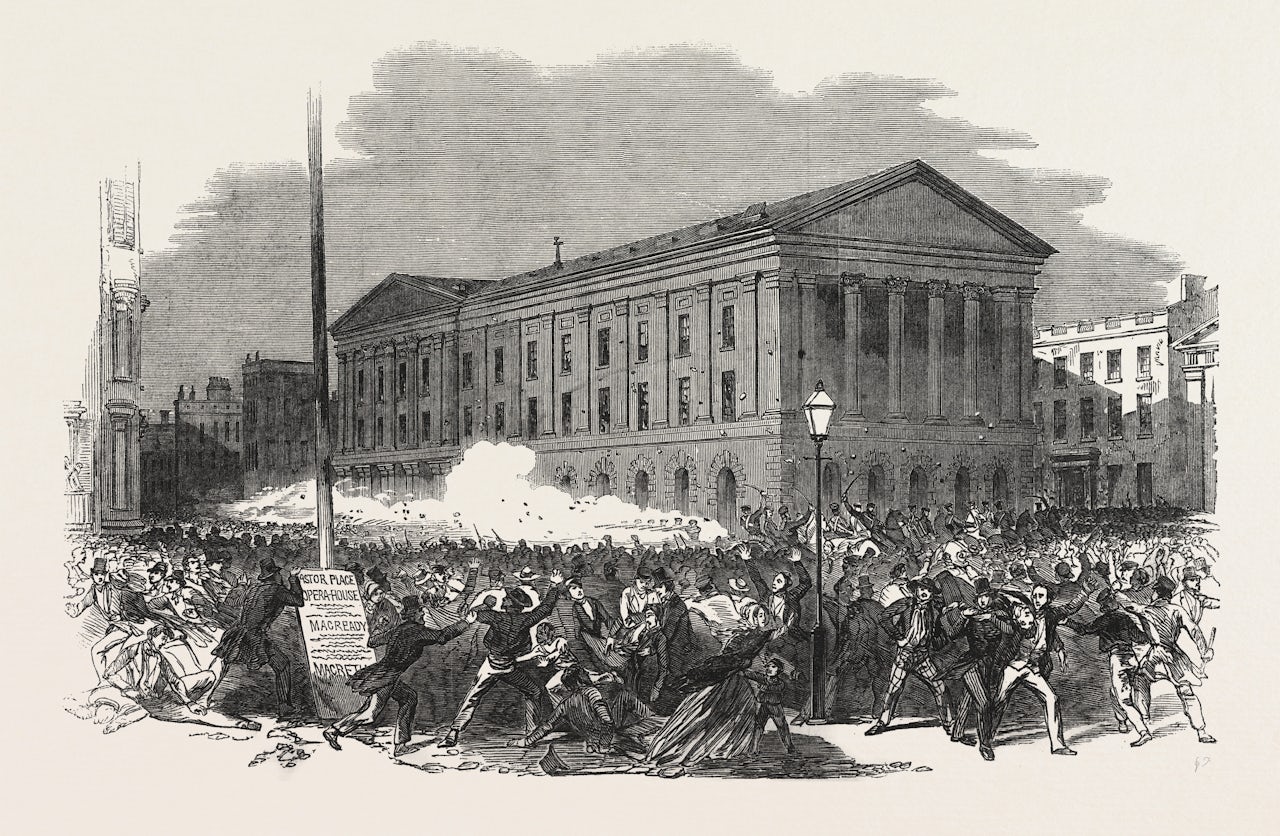
The little-known Astor Place Opera Riot of 1849

Whenever I’m walking through a city like New York, or any city or town in Europe, I’m always on the lookout for a metal plaque on the wall commemorating something, and this is a great example of why. I haven’t seen it personally, but according to this Outline piece, there is one near Astor Place in Manhattan, and what it commemorates is a riot I had never heard of until now — the great Astor Place Opera Riot of 1849, in which a mob of thousands attempted to storm a theater over a performance of Macbeth, the National Guard had to be called up, 31 people were killed and more than 100 wounded, “all because of the personal jealousies of two vain and insecure actors,” an Englishman with aristocratic airs named William Macready, and an American, Ned Forrest.

According to the Outline piece, Forrest “had previously hissed at a performance of Macready’s in Edinburgh, which he later proudly admitted in a letter to a newspaper. Forrest believed that, in revenge, Macready had deliberately set the English press against him and damaged his career there. In any case, neither of them comes off well in the incessant letters lambasting each other that were published in the newspapers in both countries. By the time he arrived in America for his performance of Macbeth, a considerable section of the public had turned against Macready, especially those in the working class, who despised anything fancy and British.” There was also resentment of Astor Place, which required people to be clean-shaven and wear white gloves.

The Astor Place riot combined two of 19th-century America’s favorite pastimes: going to the theater and rioting. This was especially true in the period after the election of Andrew Jackson in 1828, who was swept into office on a wave of raucous populism and expanded suffrage to all white men. Jackson’s inauguration was very nearly a riot itself: a horde of drunken men packed the White House, destroyed furniture and overturned the food laid out. The crowd could only be lured onto the lawn with the promise that more whiskey-spiked punch would be served outside. The violence peaked in 1835, when the country saw some 147 riots, according to David Grimsted’s American Mobbing: 1828-1861: Toward Civil War.

https://theoutline.com/post/8659/the-astor-place-opera-house-riot-of-1849-was-lit?zd=2&zi=b7qgsnud

Note: I found this Outline piece via Ann Friedman’s excellent newsletter, which I highly recommend subscribing to.

Fighting words: Journalism is under attack in Europe

Note: This is something I originally wrote for the daily newsletter at the Columbia Journalism Review, where I’m the chief digital writer

The United States is far from the only country where journalists work in a toxic political environment, one in which the leader of the nation routinely attacks and demonizes the media. A recently published report from the Reuters Institute for the Study of Journalism at Oxford University in the UK describes how similar patterns can be seen in a number of other countries in central and eastern Europe, including Hungary — where leader Viktor Orban has centralized control of the press — and Turkey, where president Recep Erdogan has done more or less the same thing. The report, entitled “Fighting Words: Journalism Under Assault in Central and Eastern Europe,” surveyed working journalists in 16 countries about the working conditions and attacks they face. And this week on CJR’s Galley discussion platform, we hosted a series of interviews based around the publication of the report, including a discussion with Meera Selva, the director of Reuters Institute’s fellowship program (and a veteran journalist with experience in Singapore, London, and Nairobi), as well as a number of discussions with fellows about their perceptions on the topic of journalism under attack.

Selva noted in her interview that there has been a notable decline in press freedom in many countries in the region, including Poland and Hungary, where populist parties came to power and exerted partisan control over the media. There are similar problems in countries like Bulgaria and Serbia, Selva said, where journalists have become targets for threats and violence. In Slovakia, an investigative journalist named Ján Kuciak was murdered, along with his fiancee, Martina Kušnírová, while working on a story about government corruption. His death sparked protests across the country and eventually brought down the government. In other countries, however, attacks continue, a process that Selva says has two prongs: “One part involves verbally criticizing journalists, and the other part involves weakening the legal, economic and structural frameworks that support independent journalism. This can involve changing laws on media ownership so that only government-friendly investors can buy media outlets.”

One aspect of this toxic environment that she found really striking, Selva says, was how many journalists talked about attacks that came not from the government but from other journalists. In many of the countries the media have split on pro-government and anti-government lines and journalists from one side have no solidarity with those from the other, she says, and so “the idea of a journalist as an impartial, independent observer is being undermined.” In some countries there has been support for the press, such as in Slovakia after Kuciak was murdered, but “in other countries, protests have been a general howl of anger against the establishment, and the media is seen as part of that establishment,” says Selva. Reuters fellow Nana Ama Agyemang Asante, who is from Ghana, said that she has noticed a similar trend in her country as well. “There has been a shift in the relationship between journalists and the Ghanaian public,” she says. “They are no longer trusted and in some cases are seen as part of the problem, as part of the corrupt class and now face constant attacks online and offline.”

Continue reading “Fighting words: Journalism is under attack in Europe”

Facebook lays out the rules for its new Supreme Court for content

Note: This is something I originally wrote for the daily newsletter at the Columbia Journalism Review, where I’m the chief digital writer

Until recently, Facebook founder and CEO Mark Zuckerberg rejected any suggestion that his company was a media entity, despite the fact that the platform’s all-powerful News Feed algorithm chooses what to show users based on a series of unknown editorial criteria, and that tens of millions of posts, photos, and other pieces of content are taken down every year because they breach the company’s rules. In the spring of 2018, however, in an interview with Ezra Klein of Vox, the Facebook CEO seemed to be growing accustomed to the idea that the company was a kind of media entity, and even mused out loud that maybe Facebook should have a kind of editorial board — or a Supreme Court, as he described it; an external body that would “ultimately make the final judgment call on what should be acceptable speech.” Over the past two years, Facebook has been trying to fulfil that promise, designing what it calls an Oversight Board, and this week the company announced the bylaws or rules that the board will operate under, as well as its first staff member.

The director of the new entity is Thomas Hughes, former executive director of a group called Article 19, an international non-governmental organization that focuses on freedom of expression and digital rights (named after the section of the Universal Declaration of Human Rights that deals with freedom of expression). Hughes will essentially run a limited liability company called Oversight Board LLC that Facebook created, which in turn will be financed by Facebook through an arms-length trust (which the company has committed to funding for six years). As it did with its star-crossed attempt at launching a cryptocurrency called Libra, the social network is going above and beyond in order to show that it is taking a hands-off approach to the new entity. The bylaws for the group even state explicitly that the board can overrule Zuckerberg or any other Facebook executive when it comes to content decisions. That said, however, there are some pretty large caveats.

For example, the three co-chairs who will be in charge of running the board (Hughes will run the administrative side of things, rather than the group that makes the actual decisions) are to be chosen by Facebook, which for many will raise immediate questions about the impartiality of those who are selected. Those co-chairs will then have the responsibility of choosing the rest of the board, which could number as many as 40 people (the Facebook bylaws don’t specify an exact number, but say that the “ideal number” of members is 40). And when it comes to the kinds of cases that this board will hear, Facebook has placed some restrictions on that — at least initially. For example, at least for the first while, the company says that the board will only be able to hear cases about content that was taken down, and make decisions about whether these removals were appropriate. It won’t be able to adjudicate whether content that wasn’t taken down should have been — such as the video of Speaker Nancy Pelosi that was slowed down to make her appear drunk. Facebook said that this restriction could change over time, but didn’t say when or why.

Continue reading “Facebook lays out the rules for its new Supreme Court for content”

Rebecca Elson, Canadian astronomer and poet

I had never heard of Rebecca Elson before, until I came across a piece last year that was written by Maria Popova, who publishes a wonderful newsletter/website called BrainPickings, which I highly recommend. Elson was born in Montreal and became a celebrated astronomer, getting her doctorate from Cambridge, followed by a post-doc research fellowship at Princeton’s Institute for Advanced Study (which was founded by Albert Einstein) to work on data from the Hubble telescope. Its launch was delayed after the explosion of the space shuttle Challenger, however, so she found refuge in creative writing, which she wound up teaching at Harvard while on a fellowship there. She was also diagnosed with non-Hodgkins lymphoma, a form of blood cancer. She returned to Cambridge to do research on the Hubble images — and to write poetry — while her disease was in remission, but it eventually returned and she died in 1999 at the age of 39. To celebrate her life, Maria Popova held a reading of her poetry by singer/songwriter Regina Spektor (via BrainPickings)

[vimeo 332976980 w=640 h=360]

The Universe in Verse: Regina Spektor reads “Theories of Everything” by Rebecca Elson from Maria Popova on Vimeo.

A photo essay of abandoned Italian mansions

Paris-based photographer Thomas Jorion has gone out of his way to prove that in Italy, even neglected things can be excessively beautiful. Over the past decade, Jorion has traveled across Italy to document the country’s most stunning abandoned buildings. His work—which mainly focuses on spaces from the 18th and 19th century—has culminated in the project Veduta (View). Jorion won’t reveal their exact locations, but we do know that the majority can be found between the regions of Umbria and Tuscany in central Italy, and Lombardy in the north. (via Vice)

Is the Salvator Mundi a lost $450M masterpiece or a fraud?

The art world is a strange place. Millionaires and billionaires bid ridiculous amounts for even trivial pieces of art, and anything by one of the masters routinely goes for hundreds of millions of dollars. But ancient art is far from an exact science, and that’s what makes the story of the so-called “Salvator Mundi” so fascinating. It was bought in a small New Orleans auction house in 2005 for about $1,000, and appeared to be a copy of the famous Leonardo da Vinci painting known as the Salvator Mundi — a portrait of Christ facing the viewer, with his right hand raised. Da Vinci painted it in 1500, possibly for Louis XXII. There are plenty of copies of it around, but as the painting was painstakingly restored, its owner and the restorers working on it became convinced that it was the original Da Vinci — at which point it went from being worth a few hundred thousand dollars to being worth a few hundred million.

The picture has since sold once for $127.5 million and again, in a record-setting auction at Christie’s, for close to half a billion dollars. It has been held up as the “male Mona Lisa” and the “Holy Grail of old-master paintings” and derided by this magazine’s art critic, Jerry Saltz, as a “two-dimensional ersatz dashboard Jesus.” It has been owned by a Swiss tycoon, a Russian oligarch, and Saudi royalty. Its rise is both an astonishing tale of restoration and historical sleuthing and — for those inclined to see the world less romantically — a parable of highbrow greed, P. T. Barnum–style salesmanship, and reputation laundering.

— via The Invention of the ‘Salvator Mundi’ Or, How to Turn a $1,000 Art-Auction Pickup Into a $450 Million Masterpiece

Government funding for journalism: necessary evil or just evil?


Note: This is something I originally wrote for the daily newsletter at the Columbia Journalism Review, where I’m the chief digital writer

It’s not news that many journalistic outlets in North America, with the exception of a select few like the New York Times or the Washington Post, are in the midst of a funding crisis. Advertising revenue continues to decline, thanks in part to the market power of digital giants such as Google and Facebook, and so virtually every publisher big or small has had to find other sources of funding. Some have turned to venture capital, while others are experimenting with nonprofit status, crowdfunding, and even selling shares to their supporters. And now there’s another controversial source of financing being added to the mix: Government funding. In New Jersey, the state has agreed to give a nonprofit entity called the Civic Information Consortium $2 million to hand out to publishers. And in Canada, the government created a $600 million fund aimed at supporting journalism through a variety of tax breaks and grants. But does government money come with too many strings attached and too many potential conflicts of interest? Or is it better than nothing?

To answer these and other related questions, we invited a range of experts, critics, and observers to join us on our Galley discussion platform for a virtual panel on the topic, including: Jeff Jarvis, director of the Tow-Knight Center for Entrepreneurial Journalism at the City University of New York; Victor Pickard of USC Annenberg’s School for Communication; Mike Rispoli of Free Press in New Jersey, one of the architects of the Civic Information Consortium proposal; Molly de Aguiar, who runs the Independence Public Media Foundation in Philadelphia; Emily Bell, director of the Tow Center for Digital Journalism at Columbia; Caitlin Johnson of Policy Matters Ohio; Jeremy Klaszus of The Sprawl in Calgary, Alberta and Saima Desai, editor of Briarpatch magazine in Saskatchewan. All of those interviews—along with featured interviews from previous Galley panels—can be found on the Galley site.

On the question of whether taking government funding is a necessary evil or just evil, Jarvis definitely came down in favor of the latter. “I see danger everywhere if government funds or in any way approves or interferes with journalism and speech,” he said. “To accept funding from government, no matter the alleged safeguards, puts us at risk of mortal conflict of interest. Whom do we serve then? Need I say it? Follow the money.” Jarvis also admitted, however, that every revenue source brings with it the potential for conflicts of interest (the News Integrity Initiative, which is part of the Tow-Knight Center and the Craig Newmark School of Journalism at CUNY, is partially funded by Facebook). Many people hold the BBC in Britain up as an example of how government funding for journalism can work, and it has done much good, Jarvis says.
“But now my fears are coming to life as we see Boris Johnson coming to attack the BBC, its franchise, its funding, and its legitimacy. If given similar power in this country, I shudder to think what Trump would do.”

Continue reading “Government funding for journalism: necessary evil or just evil?”