
Another great one on Siesta Key #sunsettime

Links that interest me and maybe you
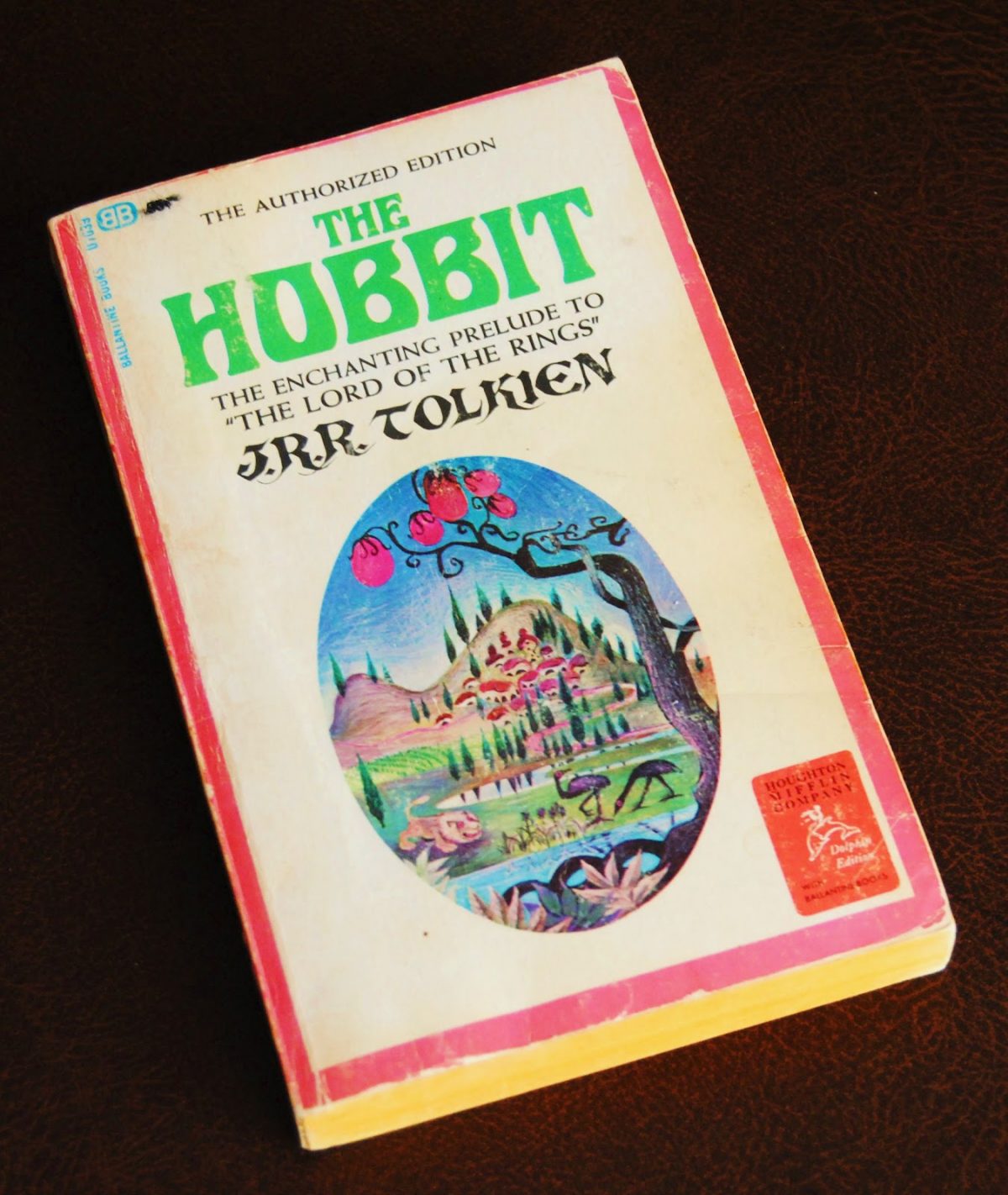
If you’ve ever seen the original paperback versions of JRR Tolkien’s Lord of the Rings trilogy, or the prequel The Hobbit, you might have wondered why the cover illustrations looked so odd. There’s a simple reason: The artist who did them never actually read any of the books, but went on brief descriptions of them. “I tried to get a copy through my friends,” she said in an interview later. “I tried finding people that had read them, but the books were not readily available in the states, so I had sketchy information at best.” Needless to say, the illustrations puzzled Tolkien.
“I must ask about the vignette,” Tolkien wrote his publisher, “what has it got to do with the story? Where is this place? Why a lion and emus? And what is the thing in the foreground with pink bulbs? I do not understand how anybody who had read the tale (I hope you are one) could think such a picture would please the author.” The image was supposed to depict Hobbiton, a landscape very much inspired by the tranquil English countryside.


This is a fascinating (and long) story about a school shooting in Austin in 1978, and the lasting scars it left on the eighth-grade students who were there to see John Christian shoot and kill his teacher, Roy Grayson — a man he looked up to and may have even idolized. After just 20 months in a reform school, Christian was released and went on to study law and become a tax attorney, and still lives in Austin, where former schoolmates have run into him from time to time. Why did he kill his teacher that day? And did his short treatment have anything to do with how well-connected his father was in Texas social and political circles?
Ray listened to the others recite the latest reports about their former classmate, the shooter, John Christian, the son of President Lyndon B. Johnson’s former press secretary George Christian: He lives a few blocks from here. He’s practicing law. Someone saw him recently. What do people say about him? Is he . . . normal? For Ray’s part, the last he had seen of John was when his friend had disappeared into the back seat of a police car. Yet John continued to hover over his life like a spectral question mark, both inexplicable and utterly familiar. “He wasn’t some monster you could easily explain away,” Ray said later. “Hell, he was one of us.”
Source: The School Shooting That Austin Forgot – Texas Monthly

Mary Anning was born in 1799 in Dorset, in an area of southwest England now known as the Jurassic Coast, because of all the ancient fossils that Mary discovered — discoveries she often didn’t get credit for, because the burgeoning field of palaeontology was controlled by men. Mary’s father, Richard, was a cabinetmaker and amateur fossil collector, and he taught her how to look for and clean the fossils they would find together on the beach, which he often displayed in his shop. When Richard died suddenly in 1810, Mary’s mother encouraged her to sell her fossils to collectors in order to help pay off the family’s debts.

At the time, Georges Cuvier — known as the ‘father of palaeontology’ — had just introduced the theory of extinction. Charles Darwin’s “Origin of Species” wouldn’t be published for another 48 years. But fossil collecting was becoming a popular past-time. In 1823, Mary was the first to discover the complete skeleton of a Plesiosaurus and she also unearthed an entire ichthyosaur. But many male scientists didn’t credit her for her discoveries in their scientific papers, and the Geological Society of London refused to admit her (they didn’t admit women until 1904). Mary died from breast cancer in 1847, at the age of 47. (via Google Arts and Culture)

Note: This is something I originally wrote for the daily newsletter at the Columbia Journalism Review, where I’m the chief digital writer
As part of its ongoing efforts to deal with the spread of misinformation on its platform, Twitter is experimenting with adding colored labels that would appear directly beneath any inaccurate statements posted by politicians and other public figures, according to a leaked demo of new features sent recently to NBC. The labels would contain fact-checks either by Facebook’s team of third-party checkers, or by journalists and other users who agreed to participate in a kind of “community reports” crowdsourcing effort.
Twitter later confirmed to the network that the leaked demo (which was accessed via a publicly available website), is one possible version of a new policy aimed at curbing the spread of misinformation. The original NBC News report said the new features would be rolling out on March 5, but the story was later updated to say Twitter doesn’t have plans to roll out the labels — or any other misinformation features — on any specific date. Whether such a feature would actually help curb misinformation even if it was rolled out, meanwhile, is still an open question.
After NBC ran its report, communications researcher Rebekah Tromble of George Washington University posted a tweet that said: “Please, @Twitter, do NOT do this. Do NOT add this massive flag. As @shannimcg and I argued, Facebook already made this mistake. This will only increase the circulation of false info.” Tromble included a link to a research paper that she and a colleague wrote last year about social-network design, which described how Facebook tried a similar type of misinformation flag, and later scrapped the feature because it was concerned that the flags would backfire and made the problem worse. Research, the company said, appeared to show that highlighting that something was inaccurate in some cases made users believe it even more, instead of less, something that has come to be known as the “backfire effect.” But a Facebook researcher responded and said that further research shows the backfire effect is not as strong as it was once believed to be.
Continue reading “Twitter plans misinfo labels, but are they a good idea?”
In 1530, to escape the wrath of the Pope, Michelangelo holed up in a tiny secret room under the Medici Chapel of the Basilica di San Lorenzo. The artist had been working on the lavish tomb when all hell broke loose in Florence, and he was forced into hiding. With nothing but time and a little charcoal on his hands, he covered the bare walls with some prisoner graffiti.
Michelangelo owed his career to the Medici, one of the wealthiest and most powerful families in Europe. But in 1529 he joined ranks with other Florentines who had grown weary of their rule, hoping for a more democratic system of governance, and defied the formidable family, which included Pope Clement VII.
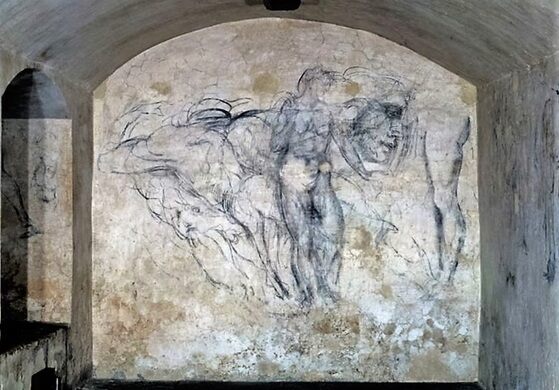
After ten months of struggle the Pope and his family won, and the rebels were swiftly punished. This would have included Michelangelo, had he not retreated for those three months to his subterranean hideaway to wait it out. In November of 1530, after the Pope let it be known that Michelangelo could go back to work—unpunished–to complete the Chapel, he reemerged. All was forgiven.
His hiding place remained secret for more than 500 years. Michelangelo never let on where he had been, and some believed he had been staying with a friend or in a church bell tower. The room and the drawings weren’t discovered until 1976, when they were stumbled upon by the director of the Museum of the Medici Chapel (via Michelangelo’s Hidden Drawings – Atlas Obscura)

It’s a mystery that wouldn’t be out of place in one of the author’s famous stories: Edgar Allen Poe was found by a passer-by in October of 1849, lying in a gutter near a public house in Baltimore, delirious and dressed in shabby second-hand clothes that appeared not to belong to him. He was only semi-conscious, and unable to move, and couldn’t (or didn’t) say what had happened to him, or how he came to be there. Poe spent his final days wavering between fits of delirium, gripped by visual hallucinations. The night before his death, according to his attending physician, Poe repeatedly called out for “Reynolds”—a figure who, to this day, remains a mystery. The famous poet and author died four days later, but to this day, no one knows what happened to him.

Poe had departed Richmond, Virginia almost a week earlier, bound for Philadelphia, to edit a collection of poems for Mrs. St. Leon Loud, a minor figure in American poetry. But he never arrived. When he was found in the gutter, it was the first time anyone had heard or seen of him after he left Richmond. After editing the poem collection, he was supposed to travel to his home in New York, to escort his aunt back to Richmond for his impending wedding, but he never arrived in New York. His death certificate listed the cause of death as phrenitis, or swelling of the brain, but the mysterious circumstances surrounding his death have led many to speculate about the true cause. “Maybe it’s fitting that since he invented the detective story,” says Chris Semtner, curator of the Poe Museum in Richmond, Virginia, “he left us with a real-life mystery.”
Among the theories about his death are:
1) He was beaten by thugs: In 1867, biographer E. Oakes Smith theorized that Poe was beaten “at the instigation of a woman who considered herself injured by him,” and a brain fever followed. Eugene Didier wrote in 1872 that while he was in Baltimore, Poe ran into some friends who asked him to join them for drinks, and he became so intoxicated that he left his friends and wandered the streets, and was “robbed and beaten by ruffians, and left insensible in the street all night.” This theory doesn’t explain why Poe was wearing clothes that appeared to belong to someone else, however.
2) He was a victim of “cooping”: Some believe Poe died as a result of a practice called cooping, a method of voter fraud practiced by gangs in the 19th century, where an unsuspecting victim would be kidnapped, disguised and forced to vote for a specific candidate multiple times under multiple identities — often under the influence of alcohol. Voter fraud was extremely common in Baltimore around the mid 1800s, and the polling site where Walker found the disheveled Poe was a known place that coopers brought their victims.
Continue reading “The ongoing mystery of Edgar Allen Poe’s death”Note: This is something I originally wrote for the daily newsletter at the Columbia Journalism Review, where I’m the chief digital writer
Donald Trump’s presidential campaign in 2016 used to be the high-water mark (or low-water mark, depending on your perspective) for the aggressive use of social networks in targeting voters. This time around, it’s a different billionaire — Mike Bloomberg — who is testing the limits of what is permitted on various platforms, and so far they seem to be treating him very differently. To take just one example, Twitter recently suspended 70 accounts because they each posted identical pro-Bloomberg messages as part of the campaign’s social-media marketing blitz. According to a number of reports, Bloomberg has hired hundreds of social-media “influencers” to post messages about him on various networks, and is paying them $2,500 a month. But while Twitter reacted harshly, Facebook seems untroubled by this kind of behavior. It says such posts are fine so long as they are labeled as ads.
In one sense, this difference of opinion on the Bloomberg campaign’s digital strategy is tied to the corporate DNA of each company. Historically, Twitter always placed a premium (for better or worse) on making “authentic” communication on its platform as friction-less as possible, although it has muddied those waters somewhat by introducing images, auto-play videos, algorithmic filtering, and advertising. But regardless, from Twitter’s point of view, the posting of dozens or hundreds of identical messages — whatever their content or intention — meets the definition of spam, or what the company calls “platform manipulation,” and therefore must be removed. Twitter’s rules forbid creating multiple accounts to post “duplicative content,” posting identical or similar Tweets or hashtags from multiple accounts operated by a single individual or corporate entity, and “coordinating with or compensating others to engage in artificial engagement or amplification.”
Coordinating with and/or compensating others for generating artificial engagement and amplification, of course, is exactly what the Bloomberg campaign is designed to do. To Twitter, that might look like spam, but to Facebook it just looks like advertising, and therefore the social network is more than happy to facilitate it. In fact, as the Trump campaign discovered in 2016, the company isn’t just happy to have it exist on the platform, if you are important enough and pay Facebook enough, it will embed Facebook staffers inside your campaign and help you do it better. But isn’t that kind of thing what the company calls “coordinated inauthentic behavior?” Apparently not. Facebook says that term is reserved for coordinated campaigns where people pretend to be other people, not campaigns where people pretend to like or admire someone they don’t. That’s just called advertising.
Continue reading “Why Twitter and Facebook treat Bloomberg’s tricks differently”
Dean Kamen is the inventor of the Segway, among other things. When he bought a two-acre island off the coast of Connecticut, he wanted to put up a wind turbine, but the state wouldn’t allow it. So he seceded from the United States, and made North Dumpling Island an independent nation. He signed a non-aggression pact with his friend George Bush, issued his own money, created his own flag, and named the founders of Ben & Jerry’s as his “Ministers of Ice Cream.” The island has a lighthouse, a replica of Stonehenge, and a “navy” consisting of one amphibious vehicle. The official vehicle of the island is (of course) the Segway. /via
https://www.atlasobscura.com/places/north-dumpling-island