From Science.org: “Harvard University honesty researcher Francesca Gino, whose work has come under fire for suspected data falsification, may also have plagiarized passages in some of her high-profile publications. A book chapter co-authored by Gino, who was found by a 2023 Harvard Business School (HBS) investigation to have committed research misconduct, contains numerous passages of text with striking similarities to 10 earlier sources. The sources include published papers and student theses, according to an analysis shared with Science by University of Montreal psychologist Erinn Acland. Science has confirmed Acland’s findings and identified at least 15 additional passages of borrowed text in Gino’s two books.”
The Brazilian special-forces unit that is fighting to save the Amazon
From The New Yorker: “The men—fighters with combat gear and assault rifles—belonged to a tiny special-forces unit known as the Specialized Inspection Group, or G.E.F. Their leader and co-founder was Felipe Finger, a wiry man in his forties with a salt-and-pepper beard. Finger trained in forestry engineering, and his unit works under the Brazilian ministry for the environment. But he has spent much of his adult life in armed operations to protect the wilderness, and he talks like a soldier, with frequent references to operations and objectives and neutralizing threats. The current mission was known to national authorities as Operation Freedom. Finger and his men called it Operation Xapirí, from a Yanomami word for nature spirits.”
Note: This is a version of my personal newsletter, which I send out via Ghost, the open-source publishing platform. You can see other issues and sign up here.
You see a news story talking about the need for a national privacy law and how Congress is working on one—or, at least, should be. What year is it?
Trick question: it could be almost any year in the last two decades. Including, now, 2024. Last week, theWashington Post reported that the leaders of two key congressional committees were “nearing an agreement on a national framework aimed at protecting Americans’ personal data online.” (The news was first reported by Punchbowl News, a political newsletter). As the Post noted, this would mean that Congress is close to passing legislation that has “eluded them for decades.” Cathy McMorris Rodgers, a Republican representative from Washington State who chairs the House Energy and Commerce Committee, and Maria Cantwell, a Democratic senator from the same state and chairperson of the Senate Commerce Committee, are expected to announce the deal next week.
According to The Hill, the two members of Congress decided that the time is right to push for a national privacy law, in part because of recent fears that social platforms are harming children (a debate that I wrote about last week in this newsletter), but also due to concerns about the impact of artificial intelligence. In a statement, Cantwell said that a federal data privacy law must “make privacy a consumer right, and it must give consumers the ability to enforce that right,” adding that the bill is the protection “Americans deserve in the Information Age.” Under the draft law, companies would face limits as to what data they can collect and use, and individuals would be allowed to sue “bad actors” for violating their privacy. New data security standards would also hold companies accountable if data is hacked or stolen. And the Federal Trade Commission would form a new bureau in order to enforce the law.
Note: this post was originally published as the daily newsletter for the Columbia Journalism Review, where I am the chief digital writer
From The Gazette: A former University of Iowa Hospital employee pleaded guilty to living under another man’s identity since 1988, which caused the other man to be falsely imprisoned for identity theft and sent to a mental hospital. Matthew David Keirans, 58, was convicted of one count of false statement to a National Credit Union Administration insured institution — punishable by up to 30 years in federal prison — and one count of aggravated identity theft — punishable by up to two years in federal prison. Keirans worked as a systems architect in the hospital’s IT department from 2013 to 2023, when he was terminated for misconduct related to the identity theft.”
A six hundred year old blueprint for weathering climate change
From The Atlantic: “Beginning in the 13th century, the Northern Hemisphere experienced a very dramatic climatic shift. First came drought, then a period of cold, volatile weather known as the Little Ice Age. In its depths, the annual average temperature in the Northern Hemisphere may have been 5 degrees colder than in the preceding Medieval Warm Period. It snowed in Alabama and South Texas. Famine killed perhaps 1 million people around the world. But native North Americans and Western Europeans responded very differently to the changes. Western Europeans doubled down on their preexisting ways of living, whereas Native North Americans devised whole new economic, social, and political structures to fit the changing climate.”
Note: This is a version of my personal newsletter, which I send out via Ghost, the open-source publishing platform. You can see other issues and sign up here.
From Quillette: “In the fall of 2004, Frank came up with an idea for a project. After work, he’d drive through the streets of Washington, D.C., with stacks of self-addressed postcards. At metro stops, he’d approach strangers. “Hi,” he’d say. “I’m Frank. And I collect secrets.” Some people shrugged him off, or told him they didn’t have any secrets; others were amused, or intrigued. They took cards and, following instructions he’d left next to the address, wrote down secrets they’d never told anyone before, and mailed them back to Frank. All the secrets were anonymous. They told stories of infidelity, longing, abuse. Some were funny. By 2024, Frank would have more than a million.”
How Japanese Americans created an art form while interned in WWII camps
From High Country News: “As a child, I’d creep down the basement stairs and watch him: hunched over a table, a single lamp lighting his work. The end result: a bird pin so delicate it could fit into the palm of my 8-year-old hand. I always thought they were unique to him. But in recent years, I’ve learned that he was part of something much larger. It all began in February 1942, when President Franklin D. Roosevelt issued Executive Order 9066, which led to the incarceration of roughly 122,000 Japanese Americans. Many were given just 48 hours to pack, forcing them to sell their houses, farms, businesses and possessions. They were sent to 10 War Relocation Authority camps in remote parts of Wyoming, California, Utah, Arizona, Colorado, Idaho and Arkansas.”
Note: This is a version of my personal newsletter, which I send out via Ghost, the open-source publishing platform. You can see other issues and sign up here.
From the Chicago Sun-Times:“DEAR ABBY: My grandfather sold me an old farmstead that has been in the family for 200 years. Last week, he showed me a wooded area behind the barn with a human skull. He told me that when his father died more than 50 years ago, he was curious about how long it would take a body to decompose, so he left his body in the woods to keep track of its progress. He has 50 years’ worth of pictures and notes. He told the rest of the family that Great-Grandpa had been cremated, and apparently no one questioned him about the ashes. I checked with a lawyer, who tells me that in my state no laws were broken. My husband says I should quietly bury thes kull, burn the pictures and notes and forget about it. That just doesn’t feel right to me.”
Scientists say they aren’t sure how animals will react to the solar eclipse
From the New York Times: “Cows may mosey into their barns for bedtime. Flamingoes may huddle together in fear. The giant, slow-motion Galápagos tortoise may even get frisky and mate. Circadian rhythms might take a noticeable hit, with nocturnal animals mistakenly waking up and starting their day only to realize that, whoa, nighttime is already over. And then there will be some animals, perhaps particularly lazy domestic cats or warthogs focused on foraging, who might not give the dark sky a second thought. One study in 1560 cited that “birds fell to the ground.” Other studies said birds went to roost, or fell silent, or continued to sing and coo — or flew straight into houses. Dogs either barked or whimpered, or did not bark or whimper.”
Note: This is a version of my personal newsletter, which I send out via Ghost, the open-source publishing platform. You can see other issues and sign up here.
From USA Today: “Just before Thomas Randele died, his golfing buddies and co-workers from the car dealership came by to say goodbye to a guy they called one of the nicest people they’d ever known – a devoted family man who never bent the rules, a friend to so many that a line stretched outside the funeral home a week later. He never told them his secret: that he was a fugitive wanted in one of the largest bank robberies in history, living in Boston under a new name he created six months after the heist in 1969. Not even his wife or daughter knew until he told them in what authorities described as a deathbed confession.”
People with this form of synesthesia see subtitles when someone speaks
From Scientific American: “My brain automatically translates spoken words into written ones in my mind’s eye. I see subtitles that I can’t turn off whenever I talk or hear someone else talking. This same speech-to-text conversion even happens for the inner dialogue of my thoughts. This mental closed-captioning has accompanied me since late toddlerhood, almost as far back as my earliest childhood memories. And for a long time, I thought that everyone could “read” spoken words in their head the way I do. What I experience goes by the name of ticker-tape synesthesia. It is not a medical condition—it’s just a distinctive way of perceiving the surrounding world that relatively few people share.”
Note: This is a version of my personal newsletter, which I send out via Ghost, the open-source publishing platform. You can see other issues and sign up here.
From Science.org: “In the late 18th and early 19th centuries, a succession of wars ravaged Europe. Massive armies squared off and massacred each other using cannon and rifle fire and mass cavalry charges that claimed tens of thousands of casualties in hours. At the 1815 Battle of Waterloo, Napoleon Bonaparte’s final battle, more than 10,000 men and as many horses were killed in a single day. Yet today, archaeologists often struggle to find physical evidence of the dead from that bloody time period. How did so many bones up and vanish? An international team of historians and archaeologists argues the bones were depleted by industrial-scale grave robbing. The introduction of phosphates for fertilizer and bone char as an ingredient in beet sugar processing at the beginning of the 19th century transformed bones into a hot commodity. Skyrocketing prices prompted raids on mass graves.”
The US tried permanent Daylight Saving Time but people hated it
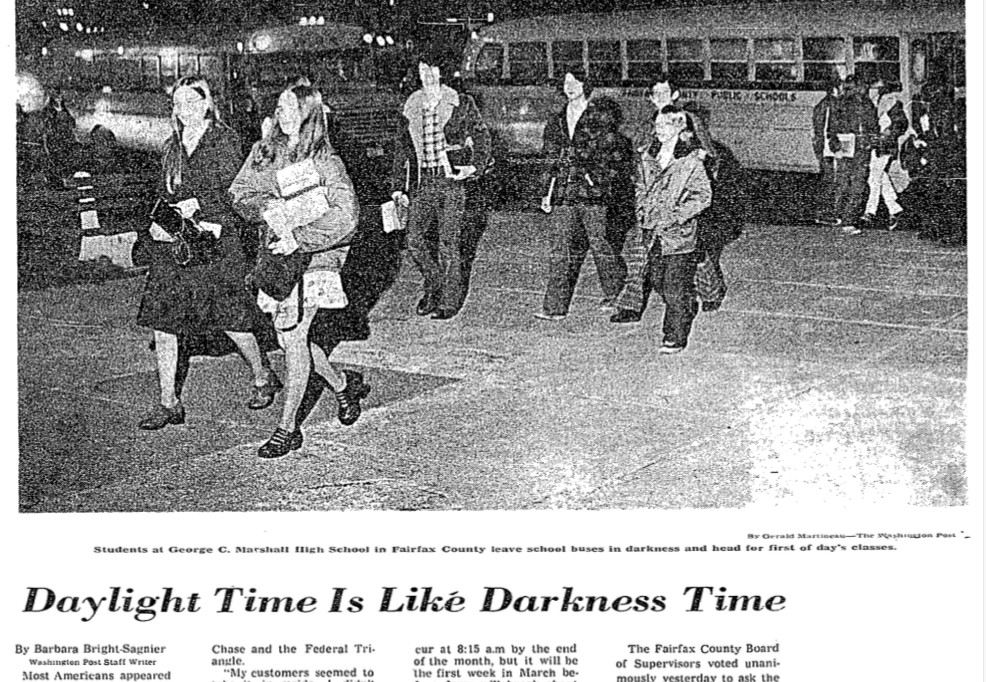
From The Washingtonian: “Congress voted on December 14, 1973, to put the US on daylight saving time for two years. President Nixon signed the bill the next day. The US had gone to permanent daylight saving time before, during World War II. Then, too, the measure was enacted to save fuel. Permanent DST wasn’t close to the wackiest idea about time floating around—Paul Mullinax, a geographer who worked at the Pentagon, came up with the idea of putting the continental US on a single time zone. “USA Time” would apply from Bangor to Barstow, eliminate jet lag, and standardize TV schedules. But permanent DST quickly proved dangerous: A 6-year-old Alexandria girl was struck by a car on her way to school on January 7; the accident broke her leg. Two Prince George’s County students were hurt in February. In the weeks after the change, eight Florida kids were killed in traffic accidents. Florida’s governor, Reubin Askew, asked for Congress to repeal the measure and it did so.”
Note: This is a version of my personal newsletter, which I send out via Ghost, the open-source publishing platform. You can see other issues and sign up here.
Over the past decade or so, The Atlantic has published a series of articles warning ofthe harm that social media and smartphone apps are doing to teenagers. These articles have had headlines like “The Terrible Costs of a Phone-Based Childhood,” “The Dark Psychology of Social Networks,” “The Dangerous Experiment on Teen Girls,” and “Get Phones Out of Schools Now.” These articles have one other thing in common: they were all written by Jonathan Haidt, a social psychologist at New York University’s Stern School of Business and a co-author of the 2019 book The Coddling of the American Mind.
Now Haidt is out with a new book (whose themes will be familiar to readers of his Atlantic articles), The Anxious Generation: How the Great Rewiring of Childhood Is Causing an Epidemic of Mental Illness. After 2010, there was a sharp increase in depression, anxiety, loneliness, and suicide among young people, Haidt writes; rates of depression and anxiety in the US, for example, rose by more than 50 percent over the following decade, a figure that rises to 130 percent for girls between the ages of ten and nineteen. Haidt says that similar patterns arose around the same time in other countries, including Canada, the UK, and Australia. And he says that they were caused by smartphones and social media. Giving young people smartphones in the early 2010s was “the largest uncontrolled experiment humanity has ever performed on its own children,” he writes in The Anxious Generation, adding that we may as well have sent “Gen Z to grow up on Mars.”
Haidt wrote last year, in another of his Atlantic essays, that smartphones and social media “impede learning, stunt relationships, and lessen belonging,” and that they have created an environment for children that is “hostile to human development.” In his view, governments, schools, and other organizations should take a number of steps in response, including banning social media for children under sixteen and removing smartphones from schools. All children “deserve schools that will help them learn, cultivate deep friendships, and develop into mentally healthy young adults,” he writes. And he notes that last year, Vivek Murthy, the US Surgeon General, issued a public advisory warning that social media can create a “profound risk” of harm to the “mental health and well-being of children and adolescents.”
Note: This was originally published as the daily email newsletter for the Columbia Journalism Review, where I am the chief digital writer
From the Washington Post: “Last month, I found out I have Stage 4 uterine leiomyosarcoma, a rare and aggressive cancer. Doctors say I may have just a few months to live. Treatment could buy me a little extra time, but not much. My disease is advanced and incurable. My prognosis has left me shocked, sad, angry and confused. I wake up some mornings raging at the universe, feeling betrayed by my own body, counting the years and the milestones I expected to enjoy with my family. I am leaving behind a husband and 14-year-old daughter I adore, and a writing and teaching career I’ve worked so hard to build. I’ve been doing a lot of thinking about my life, and in addition to the horror, a surprising feeling has taken hold: I am dying at age 49 without any regrets.”
He lived in a hotel room for five years and it only cost him $200 but then he went too far
From the New York Times: “On a June afternoon in 2018, a man named Mickey Barreto checked into the New Yorker Hotel. He was assigned Room 2565, a double-bed accommodation with a view of Midtown Manhattan almost entirely obscured by an exterior wall. For a one-night stay, he paid $200.57. But he did not check out the next morning. Instead, he made the once-grand hotel his full-time residence for the next five years, without ever paying another cent. Now, that deal could land him in prison. The story of how Mr. Barreto, a California transplant with a taste for wild conspiracy theories and a sometimes tenuous grip on reality, gained and then lost the rights to Room 2565 might sound implausible — another tale from a man who claims without evidence to be the first cousin, 11 times removed, of Christopher Columbus’s oldest son. But it’s true.”
Note: This is a version of my personal newsletter, which I send out via Ghost, the open-source publishing platform. You can see other issues and sign up here.
From Every.to: “In 1981, journalists from around the world gathered at NASA’s headquarters to watch as the Voyager 2 spacecraft became the first man-made object to reach Saturn. In the aftermath of this historic event, the main attraction wasn’t NASA’s staff. It was fellow journalist Jerry Pournelle. Pournelle had something none of them had ever seen before: a portable computer, the Osborne 1, the first mass-market personal computer in history. Just six years earlier, when the Altair 8800 was unveiled, Steve Jobs recognized that the future of computing lay in the consumer market, not the hobbyist. But Jobs was not alone. He stood alongside someone who would go on to become a frenemy of sorts: That man was Adam Osborne, Jobs’s first true rival.”
Here’s why the state of Oklahoma is shaped like a panhandle
From JSTOR Daily: “More popularly known as the Panhandle, the three counties extending in a row west of the rest of the “pan” of the state are one of those geographical quirks of history that really jump off of the map. The Panhandle is also the location of the only county in the country with four states on its borders: Cimarron County, the westernmost part of the state, borders Colorado, Kansas, Texas, and New Mexico. Today fewer than 1% of Oklahomans live in the 168 x 34 mile-wide strip. It was Spanish territory until 1821, when it became part of independent Mexico. The Republic of Texas claimed it when declaring independence. But then, upon entering the Union as a slave state in 1845, Texas surrendered its claim to the region because slavery was prohibited north of 36°30′ latitude by the Missouri Compromise of 1820.”
Note: This is a version of my personal newsletter, which I send out via Ghost, the open-source publishing platform. You can see other issues and sign up here.
From the BBC: “Des Destinées de l’Ame (Destinies of the Soul) has been housed at Houghton Library since the 1930s. In 2014, scientists determined that the material it was bound with was in fact human skin. But the university has now announced it has removed the binding “due to the ethically fraught nature of the book’s origins and subsequent history”. Des Destinées de l’Ame is a meditation on the soul and life after death, written by Arsène Houssaye in the mid-1880s. He is said to have given it to his friend, Dr Ludovic Bouland, a doctor, who then reportedly bound the book with skin from the body of an unclaimed female patient who had died of natural causes. Harvard said it was looking at ways to ensure “the human remains will be given a respectful disposition that seeks to restore dignity to the woman whose skin was used”.
Plastic manufacturing companies deceived the public about recycling
From The Guardian: “Plastic producers have known for more than 30 years that recycling is not an economically or technically feasible plastic waste management solution. That has not stopped them from promoting it, according to a new report. “The companies lied,” said Richard Wiles, president of fossil-fuel accountability advocacy group the Center for Climate Integrity (CCI), which published the report. Plastic, which is made from oil and gas, is notoriously difficult to recycle. Doing so requires meticulous sorting, since most of the thousands of chemically distinct varieties of plastic cannot be recycled together. That renders an already pricey process even more expensive. The industry has known for decades about these existential challenges, but obscured that information in its marketing campaigns, the report shows.”
Note: This is a version of my personal newsletter, which I send out via Ghost, the open-source publishing platform. You can see other issues and sign up here.
From Atlas Obscura: “It was the spring of 1938, and a woman sailing on the Bay of Bengal was dreaming of snow. Maybe it was the burn blisters on her skin or the escape from the Indian Imperial Police that had made the adventurer Aina Cederblom sentimental. After two and a half years of sailing solo through Asia, she was ready to head home to Sweden—at least that was the 39-year-old’s plan. Fate had other ideas. During the early 20th century, Aina Cederblom kept popping up in unexpected corners of the world, from Greenland to India to the Philippines. By the 1930s, Cederblom and her solo sailing adventures were well-known throughout Europe. Newspapers reported about how she went missing in Greenland’s glacier-filled waters, hid from the police in Tibet, and was shot at in the Black Sea. Yet, the memory of her achievements has almost disappeared.”
The longest bus route in the world used to run from London to Calcutta and took 50 days
From Vintages: “The bus service from London, England to Calcutta, India is considered to be the longest bus route in the world. The service, which was started in 1957, was routed to India via Belgium, Yugoslavia and West Pakistan – a route known as the Hippie Route. According to reports, it took about 50 days for the bus to reach Calcutta from London. The voyage was 32, 669 km long and was in service until 1976. The cost of the trip was £85 and this included food, travel and accommodation. The trip was equipped with reading facilities, separate sleeping bunks for everyone, and fan-operated heaters. There was a kitchen with all equipment and amenities. There was a forward observation lounge on the upper deck of the bus, and it took time to spend at major tourist destinations along the way, including the Taj Mahal on the banks of the Ganges. Shopping was also allowed in Tehran, Salzburg, Kabul, Istanbul and Vienna.”
Note: This is a version of my personal newsletter, which I send out via Ghost, the open-source publishing platform. You can see other issues and sign up here.
From Quanta: “Electroconvulsive therapy has a public relations problem. The treatment, which sends electric currents through the brain to induce a brief seizure, has barbaric, inhumane connotations — for example, it was portrayed as a sadistic punishment in the film One Flew Over the Cuckoo’s Nest. But for patients with depression that does not improve with medications, electroconvulsive therapy can be highly effective. Studies have found that some 50% to 70% of patients with major depressive disorder see their symptoms improve after a course of ECT. In comparison, medications aimed at altering brain chemistry help only 10% to 40% of depression patients. Still, even after many decades of use, scientists don’t know how ECT alters the brain’s underlying biology.”
How birdwatching’s biggest record threw its online community into chaos
From The Guardian: “In late 2023, 70-year-old birder Peter Kaestner was within striking distance of a goal that had never been accomplished: seeing more than 10,000 different species of birds in the wild. Such a record had previously been unthinkable, but with new technology facilitating rare bird sightings, improved DNA testing identifying a growing number of bird species, and public listing platforms making it easier to keep track of and share findings, more super-birders are inching towards the five digits. Just as Kaestner approached the finish line for his record 10,000 birds, though, a previously unknown competitor by the name Jason Mann flew in out of nowhere to snatch the record out from under him. The mystery birder seemed to have uploaded a backlog of thousands of species he had seen over several decades, listing more than 9,000 birds.”
This ancient Japanese tradition of female freediving is dying out
From Nautilus: “On the last day of fishing season, Ayami Nakata starts her morning by lighting a small fire in her hut beside the harbor. The temperature outside hovers around freezing and she changes into a wetsuit. For an hour and a half, Nakata takes minute-long plunges into the frigid water, free-diving 20 feet down to the rocky seabed and kelpy shore, and picking up any abalone, sea cucumbers, and turban shells. Nakata, 44 years old and a mother of five, is an ama diver: a freediving fisherwoman harvesting shellfish and seaweed according to an ancient Japanese technique. She’s been diving for seven years, but her profession is slowly dying: Climate change has depleted the shellfish along Japan’s coasts, and younger generations have lost interest in the craft, abandoning coastal villages to pursue careers in big cities. Women like Nakata are left to question whether they’ll be the last to embody this way of life.”
Editor’s note: If you like this newsletter, please share it with someone else. And if you really like it, perhaps you could subscribe, or contribute something via my Patreon. Thanks for being a reader!
When the Eiffel Tower was first built many Parisians hated it
From JSTOR Daily: When construction of the now-iconic Eiffel Tower began in 1887, many Parisians were less than enamored by the project-in-progress. In fact, some were outright hostile towards it. But perhaps the Eiffel Tower’s greatest rejection came from the people who held the most authority on what worked aesthetically for the city and what didn’t: Parisian artists and writers. To them, the Eiffel Tower, spindly and bare like a skeleton, posed an unforgivable threat to the city’s sacred reputation as a lush, beatific urban ideal for nurturing creative minds. Unlike the Lost Generation of the 1920s, their spiritual descendants, the late-nineteenth-century intellectuals didn’t feel “inspired” by the looming presence over their city. The unusual structure hadn’t yet achieved its modern status, which William Thompson describes as “the acknowledged foremost universal symbol of Paris and France.”
Driving with Mr. Gil: A retiree teaches Afghan women the rules of the road
From The New York Times: Bibifatima Akhundzada wove a white Chevy Spark through downtown Modesto, Calif., on a recent morning, practicing turns, braking and navigating intersections. “Go, go, go,” said her driving instructor, as she slowed down through an open intersection. “Don’t stop. Don’t stop.” Her teacher was Gil Howard, an 82-year-old retired professor who happened upon a second career as a driving instructor. And no ordinary instructor. In Modesto, he is the go-to teacher for women from Afghanistan, where driving is off limits for virtually all of them. In recent years, Mr. Howard has taught some 400 women in the 5,000-strong Afghan community in this part of California’s Central Valley. According to local lore, thanks to “Mr. Gil,” as he is known in Modesto, more Afghan women likely drive in and around the city of about 220,000 than in all Afghanistan.
This kind of elevator has no doors and never stops moving
From Why Is This Interesting: “A cyclic elevator runs on a continuous loop, with two columns of small, doorless, closet-sized chambers in constant motion, one going up and one going down. A rider steps into a moving chamber to ride the elevator, and steps carefully off when the desired floor is reached. It doesn’t require much more dexterity than riding an escalator, but the consequences of failure are gruesome to imagine. Cyclic elevators are commonly called “paternosters,” a name that reflects their resemblance to a string of rosary beads. When praying a rosary, one recites the “Our Father” prayer, or “Paternoster” in Latin. The development of the paternoster elevator roughly coincided with the conventional elevator in the second half of the 19th century. Paternosters never became as ubiquitous as conventional elevators, and as the public became more familiar with conventional elevators, many paternosters succumbed to disrepair, disuse, or were converted into normal elevators.”
He built a fantasy castle in his backyard without plans because he felt like it
Apparently there's a dude who lives like half an hour away from me who built a massive fantasy castle in his backyard without any plans just because he felt like it pic.twitter.com/WnhUOhOB3X
Acknowledgements: I find a lot of these links myself, but I also get some from other newsletters that I rely on as “serendipity engines,” such as The Morning News from Rosecrans Baldwin and Andrew Womack, Jodi Ettenberg’s Curious About Everything, Dan Lewis’s Now I Know, Robert Cottrell and Caroline Crampton’s The Browser, Clive Thompson’s Linkfest, Noah Brier and Colin Nagy’s Why Is This Interesting, Maria Popova’s The Marginalian, Sheehan Quirke AKA The Cultural Tutor, the Smithsonian magazine, and JSTOR Daily. If you come across something interesting that you think should be included here, please feel free to email me.
Last week, Donald Trump looked to be in dire straits, both legally and financially. He owed four hundred and fifty million dollars in legal penalties after a New York judge found that he fraudulently inflated the value of his assets in order to get bank loans, on top of the eighty-three million dollars he owed after losing a defamation case brought by the writer E. Jean Carroll, who has accused Trump of sexual assault. (He also faces several smaller judgments for defying a subpoena, disparaging a law clerk, and contempt of court.) Despite Trump’s repeated claims to be a billionaire, his legal team told the court that he didn’t have enough cash on hand to resolve the first judgment, and that he had been unable to find anyone to lend him the money or finance a bond until he could pay. In the end, the court allowed him to post a smaller bond, but only gave him ten days to come up with the full amount. If he does not, then Letitia James, New York’s attorney general, will be able to start seizing his assets.
This week, though, Trump appeared to be handed a lifeline: Trump Media and Technology Group—the social media company through which he owns Truth Social, a Trumpian clone of X—merged with Digital World Acquisition Corporation, a special-purpose acquisition company, or SPAC. (A SPAC is an investment vehicle created for the purpose of buying other companies and taking them public.) The combined entity, now known as Trump Media and Technology Group, went public on Tuesday and quickly hit a market value of around eight billion dollars. Since Trump owns about 60 percent of the shares, his net worth has suddenly risen by more than four billion dollars.
So, is Trump on easy street now, with such vast resources that he no longer needs to worry about his legal penalties? Not exactly. Both he and Trump Media must clear a number of roadblocks before that happens. Success is by no means assured. And either way, business appears to be tied up here, to an unusual extent, with politics.
Note: This was originally published as the daily email newsletter for the Columbia Journalism Review, where I am the chief digital writer
From The Atlantic: “One night last winter, over drinks in downtown Los Angeles, the biologist David Gruber told me that human beings might someday talk to sperm whales. In 2020, Gruber founded Project CETI with some of the world’s leading artificial-intelligence researchers, and they have so far raised $33 million for a high-tech effort to learn the whales’ language. Gruber said that they hope to record billions of the animals’ clicking sounds with floating hydrophones, and then to decipher the sounds’ meaning using neural networks. Sperm whales are the planet’s largest-brained animals, and their nested social structures are immense. About 10 whales swim together full-time as a unit. They will sometimes meet up with others in groups of hundreds. All of the whales in these larger groups belong to clans that can contain as many as 10,000 animals, or perhaps more.”
I thought my father was killed by a teenage gang but the truth was very different
From The Guardian: “I was 12, only a year from being a teenager, and the holidays stretched out before us. Such an atmosphere called for celebration. For us, a real treat meant a takeaway – we usually couldn’t afford them. My dad, Mike, was going to drive to the town centre: there was a chip shop Emily was keen on and it was her special day. A little later, Jackie was in the living room watching TV when the phone rang. It was Mike. He said the queue at the chip shop in town was too long so he’d driven back to our council estate and was calling from the public phone box at the local shops. There was a loud knock at the front door. “There’s been an accident, Mrs King. Your husband has collapsed.” Then later, the newspaper reported that police had arrested a gang, first four, then a fifth young man, on suspicion of murder.”
Note: This is a version of my personal newsletter, which I send out via Ghost, the open-source publishing platform. You can see other issues and sign up here.