
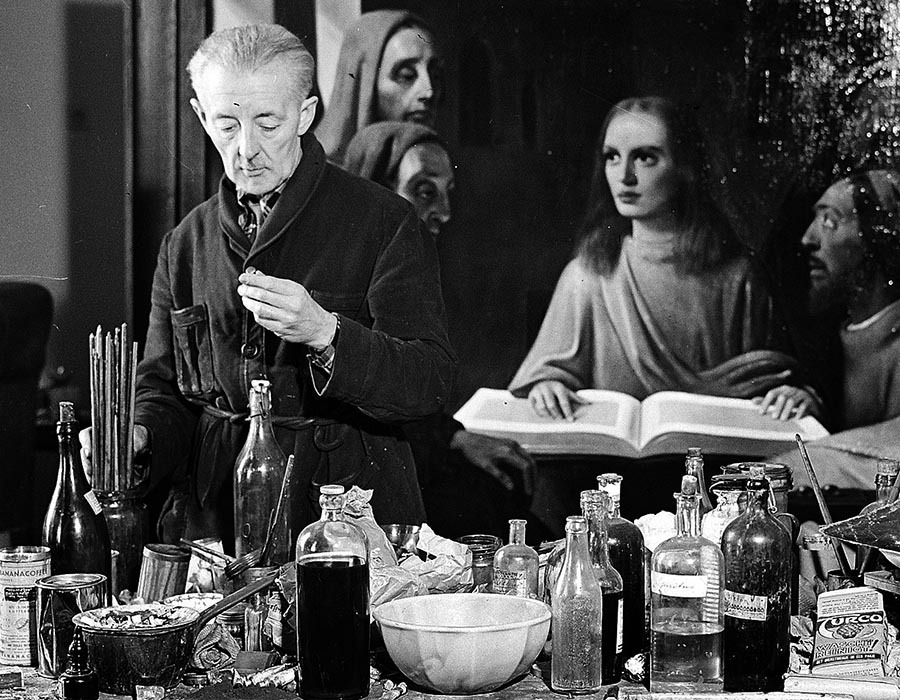
In July of 1945, Han van Meegeren picked up his badger-hair brush and began to paint his last forgery. Over a decade, the wiry Dutchman had surreptitiously become Europe’s premier conman — a disgruntled artist-turned-forger who’d sold his works for tens of millions of dollars. He had duped leading critics, wealthy collectors, and even a high-ranking Nazi official into believing his works were real. What’s more, he had chosen to do so by emulating the works of Jan Vermeer, a technically-immaculate master of the Dutch Golden Age. Post-World War II, a “Vermeer” painting sold to Hermann Göring was traced back to van Meegeren — a painting of such high quality that experts agreed no one could have possibly fabricated it. Accused of plundering for the Germans, the artist was sentenced to death. In an odd twist, van Meegeren was given one last chance to prove his innocence: If he could produce a brilliant forgery before the eyes of court-appointed witnesses, he’d be spared. What ensued would make the man one of the most popular figures in the Netherlands. (via Priceonomics)
Scientists found an ancient sheep virus hiding in a medieval parchment

In ancient Rome, shepherds feared the appearance of bumpy pustules on their sheep—a telltale sign of deadly sheeppox. Even today, the disease poses a major threat, capable of wiping out entire flocks. Yet the disease’s origins—and historical impact—have remained mysterious. In a study published today in Science Advances, researchers pin the virus’ emergence to about 5000 years ago, roughly the same time people started to intensively shear sheep for wool. The peek into the pathogen’s past came from an unusual source: dozens of medieval books and legal documents written on parchment, which is made from specially treated animal skins. “It turns out parchment is an extremely good preserver of this type of biological data,” says University of Leicester historian Joanna Story, a co-author of the new study. Researchers rubbed pages of the books with erasers, then extracted DNA from the eraser rubbings. That there was DNA to recover at all came as a surprise. Before becoming pages in a book, cow, goat, and sheep skins were soaked for days in pits filled with lime. (via Science.org)
Note: This is a version of my When The Going Gets Weird newsletter, which I send out via Ghost, the open-source publishing platform. You can see other issues and sign up here.
Salted caramel seems like it’s everywhere now but not that long ago it was unknown

Walmart sells 753 items with “salted caramel” in the name. Target has 312, which includes all manner of food plus perfumes, lip balms, energy gels, sea moss dietary supplements, collagen, a quick bread mix sold with a special Bundt pan, and a book called Salted Caramel Sorcery. Salted caramel’s roots are well-documented: a chocolatier in Brittany named Henri Le Roux invented it sometime in the late 1970s. The candy’s appeal is obvious: it’s both an updated version of a classic treat and a sensory one-two punch, the combination surprising but delightful. People are hard-wired to enjoy salty and sweet together (see, for example, peanut brittle, kettle corn, caramel corn, and salt water taffy. The jump from Brittany to the rest of the world is much harder to track. There’s no tangible trail to follow throughout the 1980s and early ’90s, no specific data points of who was making or eating salted caramel. (via Snackstack)
Hi everyone! Mathew Ingram here. I am able to continue writing this newsletter in part because of your financial help and support, which you can do either through my Patreon or by upgrading your subscription to a monthly contribution. I enjoy gathering all of these links and sharing them with you, but it does take time, and your support makes it possible for me to do that. I also write a weekly newsletter of technology analysis called The Torment Nexus.
He invented the first vehicle with an internal combustion engine but he isn’t well known
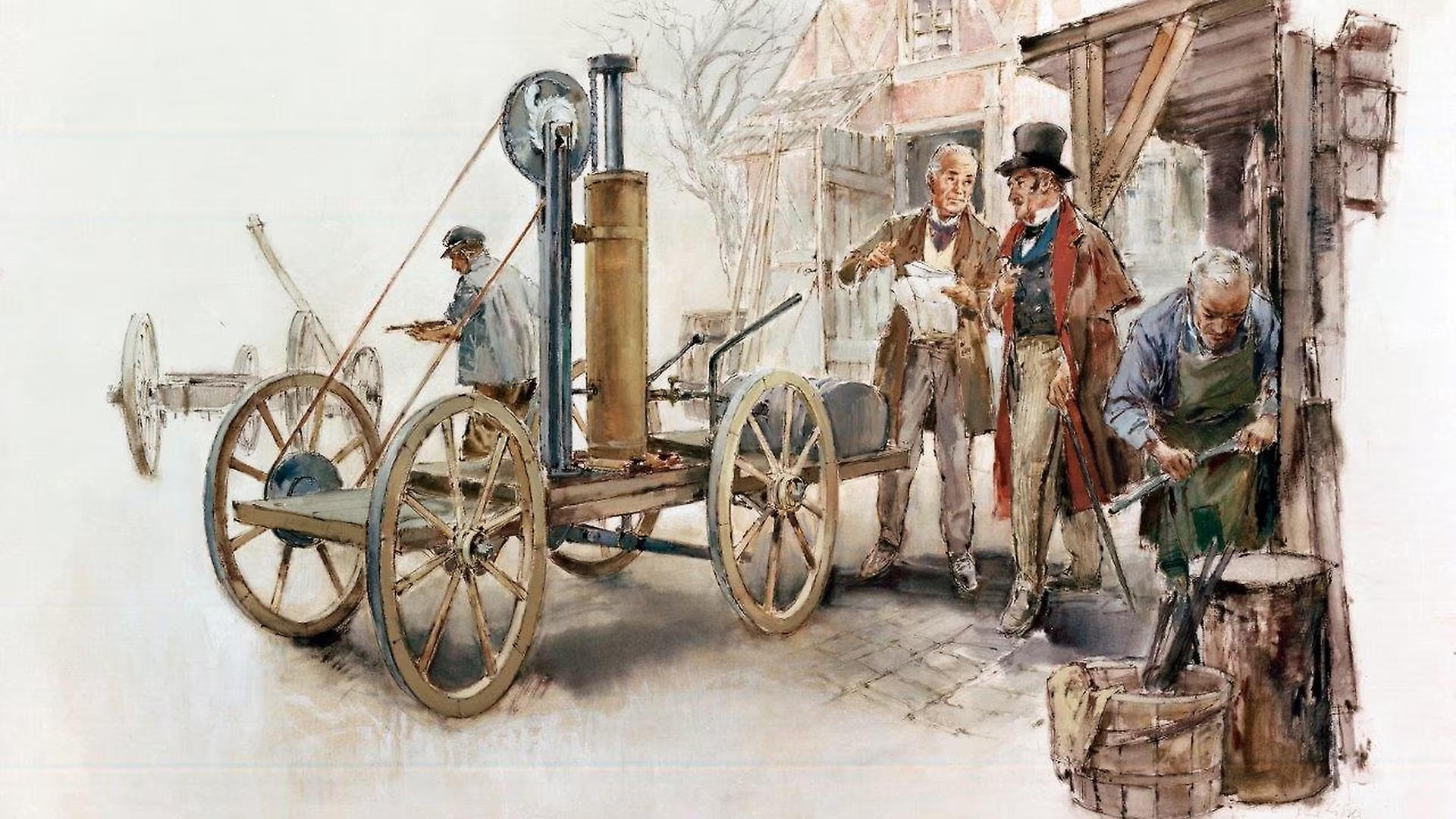
The de Rivaz engine was a pioneering reciprocating engine designed and developed from 1804 by the Franco-Swiss inventor François Isaac de Rivaz. The engine is said to be the world’s first internal combustion engine. It incorporated some features of modern engines such as spark ignition and the use of hydrogen gas as a fuel. Starting with a stationary engine suitable to work a pump in 1804, de Rivaz progressed to a small experimental vehicle built in 1807, which was the first wheeled vehicle to be powered by an internal combustion engine. In subsequent years de Rivaz developed his design, and in 1813 built a larger 6-meter long vehicle, weighing almost a ton. de Rivaz, a Franco-Swiss artillery officer and inventor, designed several successful steam powered carriages, or charrettes as he called them. His army experience with cannons had led him to think about using an explosive charge to drive a piston instead of steam. (via Wikipedia)
It might sound bizarre but tapping on your shin can help heal your brain

Your brain is talking to your skeleton, and more than you probably realize. For example, doctors have long noticed something odd about people with traumatic brain injuries—their bones heal faster. When some brain cells are damaged, they release vesicles filled with proteins that travel to the bone stem cells and stimulate growth. Naturally, researchers began to wonder: If damaged brains can heal bones, can bones heal damaged brains? To find out, researchers from Southern Medical University in China flipped the script on TBI-accelerated bone growth. They artificially caused traumatic brain injuries and strokes in the brains of mice and pigs. They then outfitted the brain-damaged animals with electronic devices that would rhythmically tap on their shin bones a couple times a second for five days. Remarkably, it worked. According to their study, the tapping reduced brain cell loss, promoted neuron growth, and relieved chronic inflammation. (via Nautilus)
He locked himself inside a glass and metal box and a polar bear took an interest

Acknowledgements: I find a lot of these links myself, but I also get some from other places that I rely on as “serendipity engines,” such as The Morning News from Rosecrans Baldwin and Andrew Womack, Jodi Ettenberg’s Curious About Everything, Dan Lewis’s Now I Know, Robert Cottrell and Caroline Crampton’s The Browser, Clive Thompson’s Linkfest and Why Is This Interesting by Noah Brier and Colin Nagy. If you come across something you think should be included here, feel free to email me at mathew @ mathewingram dot com