A tip for media companies: Facebook isn’t your enemy, but it’s not your friend either

There’s been a lot of discussion in the media-sphere lately about the risks and rewards of Facebook for media companies and publishers of all kinds — a debate that was reignited at the recent Online News Association conference, where former New York Times social-media editor Liz Heron was put on the hot seat about Facebook’s impenetrable algorithm and its effect on the news business. It was simultaneously an admission of the network’s immense power and a revolt against the fundamental inscrutability of that power.

Frustration with that reality has been building for some time now, as media organizations have come to realize that social is the new search — and so they are now just as beholden to Twitter and Facebook as they once were to Google, and the new bosses are just as opaque as the old one.

You can see that frustration when people like NYU journalism professor Jay Rosen start trying to game the algorithm by pretending that it’s a personal update instead of a blog post, using words like “congratulations,” etc. Or when Facebook product manager Mike Hudack writes about how the news business has turned to crap, and is quickly besieged by media types who claim his company is to blame.

Note: This was originally published at Gigaom, where I was a senior writer from 2010 to 2015. The site still exists, but the archive has been taken down.

Continue reading “A tip for media companies: Facebook isn’t your enemy, but it’s not your friend either”

So Facebook controls the way large numbers of people get their news. What should we do about it?

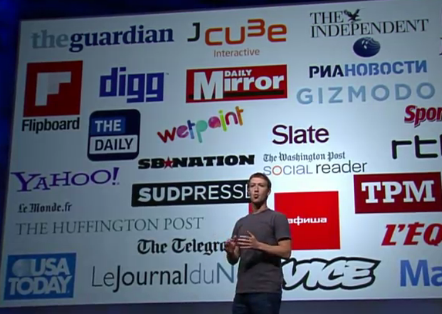
The New York Times seems to have finally awoken to the idea that Facebook exerts a growing amount of control over how millions of people get their news, and that it would very much like to increase that control as much as possible — in order to serve the best interests of its users, of course. This is something that I have been writing about for some time now, and it is not going away. If anything, the pressure on media companies to play ball with Facebook is only growing more intense.

As David Carr and Ravi Somaya note in their pieces, the structure of the media business has changed dramatically thanks to the rise of the social web — of which Facebook is by far the largest part. Where media companies used to control the distribution of their content because they owned the printing presses and the trucks, now entities like Facebook control who sees what and when.

In classic internet fashion, this is both a good thing and a bad thing simultaneously: on the one hand, it allows news and other content to reach a far larger audience than it ever would have otherwise, and that’s arguably a positive thing not just for news companies but for society as a whole — the web is far better than trucks or satellites could ever be.

Note: This was originally published at Gigaom, where I was a senior writer from 2010 to 2015. The site still exists, but the archive has been taken down.

Continue reading “So Facebook controls the way large numbers of people get their news. What should we do about it?”

Trust seems to be a crucial aspect of journalism, but it is a slippery concept and difficult to measure

A recent piece by CUNY professor and author Jeff Jarvis about how to improve the public’s trust in journalism sparked a Twitter debate among some leading figures in the media industry on the weekend — a debate that centered on whether trust is a meaningful way of looking at the value of news. Since this is a topic that some people even outside the media might be interested in, I collected some of the Twitter discussion in a Storify module, and have also embedded some of it below.

Jarvis’s post was a response to a Medium piece written by Richard Gingras — the head of Google News — and Sally Lehrman, a fellow at the Markkula Center for Applied Ethics who specializes in journalism. In the piece, the two wrote about how the lack of public trust in the media industry is a growing problem, and described some ways in which media companies could try to change that, including:

— Posting a mission statement and ethics policy: “Both news organizations and individual journalists could build trust by stating their objectives, their capabilities and their standards,” Gingras and Lehrman argue.

Note: This was originally published at Gigaom, where I was a senior writer from 2010 to 2015. The site still exists, but the archive has been taken down.

— More disclosure about the editing process: “News outlets could signal editing levels by creating a clear labeling system or listing all participants in the process such as fact checkers, editors, and even lawyers.”

— Citations (via links) and corrections: Citations “would allow audiences to assess their effort and accuracy. An effective system would also allow audiences to alert editors to perceived inaccuracies.”

In a nutshell, Gingras and Lehrman argue that more transparency about the way that the news business or the journalism business works would serve readers better and increase trust — and that this in turn would help create value for media companies. They said they have created the Trust Project in partnership with the Markkula Center to pursue such changes in the industry.

In his response, Jarvis suggested that since Gingras is concerned about such issues, he could get his employer to “encourage these behaviors by favoring news organizations, journalists, and other sources that follow standards such as these.” This would be an addition signal of quality that Google could use when surfacing news stories, he argued. Google could also rank sites that produce original work higher than sites that just copy or aggregate it, Jarvis said.

After both Gingras and News Corp. executive Raju Narisetti posted a link to Jarvis’s piece, Emily Bell — who runs the Tow Center for Digital Media at Columbia University — questioned whether looking at trust was the right way to think about value in journalism, or increasing the likelihood of success in media.

Bell argued that identifying “trustworthiness” was a difficult concept to begin with, since some people might find a certain news source interesting or valuable without it necessarily being trustworthy — and others might disagree on whether a specific outlet was trustworthy or not because of their political views. Bell and others also said that asking Google to measure quality journalism was problematic.

One point that Bell seemed to be making was that the success of a media outlet — and particularly its financial success — doesn’t really have any relationship to whether it is “trusted” or not, with BuzzFeed being a good example: in a recent Pew survey, the site ranked low on trustworthiness, and yet its readership and its revenue base appears to be large and growing rapidly.

Gingras admitted that trust might not be a good substitute or proxy for journalistic value, but he argued that good journalism can’t exist unless readers trust either the news source or the reporter, or both. But Bell countered that in both the NSA leaks case and the Pentagon Papers case, the source of the information was widely mis-trusted, and yet the news stories were still worthwhile.

At this point, Chris Anderson — a ** at ** who has written about media topics, including a book on the decline of the news business in Philadelphia — pointed out that there is no real correlation between the trustworthiness of journalism and the quality of that journalism, noting that the media was trusted more in the 1950s than at any time since, but the journalism was arguably terrible.

https://twitter.com/Chanders/status/526417314527600641

Bell pointed out that large numbers of people distrust major news entities such as the New York Times or the Guardian — in other words, people from one side of the political likely distrust the Times but trust Fox News, and others feel the opposite. And she argued that while Walter Cronkite may have been widely trusted during the heyday of TV news, no one would argue that was the best time for journalism.

It’s worth noting that despite her criticism of some aspects of the argument, or about trust as a measure of value, Bell made a point of saying that she agrees with the approach outlined by Gingras and Lehrman, and noted that she was part of the original thinking behind the Guardian‘s embrace of “open journalism.” But trust is a difficult way to measure value because it so subjective, she said. What follows is the Storify I created to capture some of the discussion.

Trust seems to be a crucial aspect of journalism, but it is a slippery concept and difficult to measure

A recent piece by CUNY professor and author Jeff Jarvis about how to improve the public’s trust in journalism sparked a Twitter debate among some leading figures in the media industry on the weekend — a debate that centered on whether trust is a meaningful way of looking at the value of news. Since this is a topic that some people even outside the media might be interested in, I collected some of the Twitter discussion in a Storify module, and have also embedded some of it below.

Jarvis’s post was a response to a Medium piece written by Richard Gingras — the head of Google News — and Sally Lehrman, a fellow at the Markkula Center for Applied Ethics who specializes in journalism. In the piece, the two wrote about how the lack of public trust in the media industry is a growing problem, and described some ways in which media companies could try to change that, including:

— Posting a mission statement and ethics policy: “Both news organizations and individual journalists could build trust by stating their objectives, their capabilities and their standards,” Gingras and Lehrman argue.

Note: This was originally published at Gigaom, where I was a senior writer from 2010 to 2015. The site still exists, but the archive has been taken down.

— More disclosure about the editing process: “News outlets could signal editing levels by creating a clear labeling system or listing all participants in the process such as fact checkers, editors, and even lawyers.”

— Citations (via links) and corrections: Citations “would allow audiences to assess their effort and accuracy. An effective system would also allow audiences to alert editors to perceived inaccuracies.”

In a nutshell, Gingras and Lehrman argue that more transparency about the way that the news business or the journalism business works would serve readers better and increase trust — and that this in turn would help create value for media companies. They said they have created the Trust Project in partnership with the Markkula Center to pursue such changes in the industry.

In his response, Jarvis suggested that since Gingras is concerned about such issues, he could get his employer to “encourage these behaviors by favoring news organizations, journalists, and other sources that follow standards such as these.” This would be an addition signal of quality that Google could use when surfacing news stories, he argued. Google could also rank sites that produce original work higher than sites that just copy or aggregate it, Jarvis said.

After both Gingras and News Corp. executive Raju Narisetti posted a link to Jarvis’s piece, Emily Bell — who runs the Tow Center for Digital Media at Columbia University — questioned whether looking at trust was the right way to think about value in journalism, or increasing the likelihood of success in media.

Bell argued that identifying “trustworthiness” was a difficult concept to begin with, since some people might find a certain news source interesting or valuable without it necessarily being trustworthy — and others might disagree on whether a specific outlet was trustworthy or not because of their political views. Bell and others also said that asking Google to measure quality journalism was problematic.

One point that Bell seemed to be making was that the success of a media outlet — and particularly its financial success — doesn’t really have any relationship to whether it is “trusted” or not, with BuzzFeed being a good example: in a recent Pew survey, the site ranked low on trustworthiness, and yet its readership and its revenue base appears to be large and growing rapidly.

Gingras admitted that trust might not be a good substitute or proxy for journalistic value, but he argued that good journalism can’t exist unless readers trust either the news source or the reporter, or both. But Bell countered that in both the NSA leaks case and the Pentagon Papers case, the source of the information was widely mis-trusted, and yet the news stories were still worthwhile.

At this point, Chris Anderson — a ** at ** who has written about media topics, including a book on the decline of the news business in Philadelphia — pointed out that there is no real correlation between the trustworthiness of journalism and the quality of that journalism, noting that the media was trusted more in the 1950s than at any time since, but the journalism was arguably terrible.

https://twitter.com/Chanders/status/526417314527600641

Bell pointed out that large numbers of people distrust major news entities such as the New York Times or the Guardian — in other words, people from one side of the political likely distrust the Times but trust Fox News, and others feel the opposite. And she argued that while Walter Cronkite may have been widely trusted during the heyday of TV news, no one would argue that was the best time for journalism.

It’s worth noting that despite her criticism of some aspects of the argument, or about trust as a measure of value, Bell made a point of saying that she agrees with the approach outlined by Gingras and Lehrman, and noted that she was part of the original thinking behind the Guardian‘s embrace of “open journalism.” But trust is a difficult way to measure value because it so subjective, she said. What follows is the Storify I created to capture some of the discussion.

Trust seems to be a crucial aspect of journalism, but it is a slippery concept and difficult to measure

A recent piece by CUNY professor and author Jeff Jarvis about how to improve the public’s trust in journalism sparked a Twitter debate among some leading figures in the media industry on the weekend — a debate that centered on whether trust is a meaningful way of looking at the value of news. Since this is a topic that some people even outside the media might be interested in, I collected some of the Twitter discussion in a Storify module, and have also embedded some of it below.

Jarvis’s post was a response to a Medium piece written by Richard Gingras — the head of Google News — and Sally Lehrman, a fellow at the Markkula Center for Applied Ethics who specializes in journalism. In the piece, the two wrote about how the lack of public trust in the media industry is a growing problem, and described some ways in which media companies could try to change that, including:

— Posting a mission statement and ethics policy: “Both news organizations and individual journalists could build trust by stating their objectives, their capabilities and their standards,” Gingras and Lehrman argue.

— More disclosure about the editing process: “News outlets could signal editing levels by creating a clear labeling system or listing all participants in the process such as fact checkers, editors, and even lawyers.”

— Citations (via links) and corrections: Citations “would allow audiences to assess their effort and accuracy. An effective system would also allow audiences to alert editors to perceived inaccuracies.”

In a nutshell, Gingras and Lehrman argue that more transparency about the way that the news business or the journalism business works would serve readers better and increase trust — and that this in turn would help create value for media companies. They said they have created the Trust Project in partnership with the Markkula Center to pursue such changes in the industry.

In his response, Jarvis suggested that since Gingras is concerned about such issues, he could get his employer to “encourage these behaviors by favoring news organizations, journalists, and other sources that follow standards such as these.” This would be an addition signal of quality that Google could use when surfacing news stories, he argued. Google could also rank sites that produce original work higher than sites that just copy or aggregate it, Jarvis said.

After both Gingras and News Corp. executive Raju Narisetti posted a link to Jarvis’s piece, Emily Bell — who runs the Tow Center for Digital Media at Columbia University — questioned whether looking at trust was the right way to think about value in journalism, or increasing the likelihood of success in media.

Bell argued that identifying “trustworthiness” was a difficult concept to begin with, since some people might find a certain news source interesting or valuable without it necessarily being trustworthy — and others might disagree on whether a specific outlet was trustworthy or not because of their political views. Bell and others also said that asking Google to measure quality journalism was problematic.

One point that Bell seemed to be making was that the success of a media outlet — and particularly its financial success — doesn’t really have any relationship to whether it is “trusted” or not, with BuzzFeed being a good example: in a recent Pew survey, the site ranked low on trustworthiness, and yet its readership and its revenue base appears to be large and growing rapidly.

Gingras admitted that trust might not be a good substitute or proxy for journalistic value, but he argued that good journalism can’t exist unless readers trust either the news source or the reporter, or both. But Bell countered that in both the NSA leaks case and the Pentagon Papers case, the source of the information was widely mis-trusted, and yet the news stories were still worthwhile.

At this point, Chris Anderson — a ** at ** who has written about media topics, including a book on the decline of the news business in Philadelphia — pointed out that there is no real correlation between the trustworthiness of journalism and the quality of that journalism, noting that the media was trusted more in the 1950s than at any time since, but the journalism was arguably terrible.

https://twitter.com/Chanders/status/526417314527600641

Bell pointed out that large numbers of people distrust major news entities such as the New York Times or the Guardian — in other words, people from one side of the political likely distrust the Times but trust Fox News, and others feel the opposite. And she argued that while Walter Cronkite may have been widely trusted during the heyday of TV news, no one would argue that was the best time for journalism.

It’s worth noting that despite her criticism of some aspects of the argument, or about trust as a measure of value, Bell made a point of saying that she agrees with the approach outlined by Gingras and Lehrman, and noted that she was part of the original thinking behind the Guardian‘s embrace of “open journalism.” But trust is a difficult way to measure value because it so subjective, she said. What follows is the Storify I created to capture some of the discussion.

Trust seems to be a crucial aspect of journalism, but it is a slippery concept and difficult to measure

A recent piece by CUNY professor and author Jeff Jarvis about how to improve the public’s trust in journalism sparked a Twitter debate among some leading figures in the media industry on the weekend — a debate that centered on whether trust is a meaningful way of looking at the value of news. Since this is a topic that some people even outside the media might be interested in, I collected some of the Twitter discussion in a Storify module, and have also embedded some of it below.

Jarvis’s post was a response to a Medium piece written by Richard Gingras — the head of Google News — and Sally Lehrman, a fellow at the Markkula Center for Applied Ethics who specializes in journalism. In the piece, the two wrote about how the lack of public trust in the media industry is a growing problem, and described some ways in which media companies could try to change that, including:

— Posting a mission statement and ethics policy: “Both news organizations and individual journalists could build trust by stating their objectives, their capabilities and their standards,” Gingras and Lehrman argue.

— More disclosure about the editing process: “News outlets could signal editing levels by creating a clear labeling system or listing all participants in the process such as fact checkers, editors, and even lawyers.”

— Citations (via links) and corrections: Citations “would allow audiences to assess their effort and accuracy. An effective system would also allow audiences to alert editors to perceived inaccuracies.”

In a nutshell, Gingras and Lehrman argue that more transparency about the way that the news business or the journalism business works would serve readers better and increase trust — and that this in turn would help create value for media companies. They said they have created the Trust Project in partnership with the Markkula Center to pursue such changes in the industry.

In his response, Jarvis suggested that since Gingras is concerned about such issues, he could get his employer to “encourage these behaviors by favoring news organizations, journalists, and other sources that follow standards such as these.” This would be an addition signal of quality that Google could use when surfacing news stories, he argued. Google could also rank sites that produce original work higher than sites that just copy or aggregate it, Jarvis said.

After both Gingras and News Corp. executive Raju Narisetti posted a link to Jarvis’s piece, Emily Bell — who runs the Tow Center for Digital Media at Columbia University — questioned whether looking at trust was the right way to think about value in journalism, or increasing the likelihood of success in media.

Bell argued that identifying “trustworthiness” was a difficult concept to begin with, since some people might find a certain news source interesting or valuable without it necessarily being trustworthy — and others might disagree on whether a specific outlet was trustworthy or not because of their political views. Bell and others also said that asking Google to measure quality journalism was problematic.

One point that Bell seemed to be making was that the success of a media outlet — and particularly its financial success — doesn’t really have any relationship to whether it is “trusted” or not, with BuzzFeed being a good example: in a recent Pew survey, the site ranked low on trustworthiness, and yet its readership and its revenue base appears to be large and growing rapidly.

Gingras admitted that trust might not be a good substitute or proxy for journalistic value, but he argued that good journalism can’t exist unless readers trust either the news source or the reporter, or both. But Bell countered that in both the NSA leaks case and the Pentagon Papers case, the source of the information was widely mis-trusted, and yet the news stories were still worthwhile.

At this point, Chris Anderson — a ** at ** who has written about media topics, including a book on the decline of the news business in Philadelphia — pointed out that there is no real correlation between the trustworthiness of journalism and the quality of that journalism, noting that the media was trusted more in the 1950s than at any time since, but the journalism was arguably terrible.

https://twitter.com/Chanders/status/526417314527600641

Bell pointed out that large numbers of people distrust major news entities such as the New York Times or the Guardian — in other words, people from one side of the political likely distrust the Times but trust Fox News, and others feel the opposite. And she argued that while Walter Cronkite may have been widely trusted during the heyday of TV news, no one would argue that was the best time for journalism.

It’s worth noting that despite her criticism of some aspects of the argument, or about trust as a measure of value, Bell made a point of saying that she agrees with the approach outlined by Gingras and Lehrman, and noted that she was part of the original thinking behind the Guardian‘s embrace of “open journalism.” But trust is a difficult way to measure value because it so subjective, she said. What follows is the Storify I created to capture some of the discussion.

Email newsletters are a hack, but they are an interesting one

In a world of virtual-reality headsets and Google Glass and responsive mobile websites, an email newsletter seems like the most antiquated technology since the buggy whip. It’s just words on a page! And don’t people hate email and want to kill it? They sure do — except when that email contains a list of the most important or interesting or relevant things they need to know, at which point it becomes more valuable than gold. And that alchemy is something worth thinking about.

Evidence of that value appeared again this week, when The Skimm — a newsletter run by two former NBC producers and aimed at a largely female fan base — raised a financing round of $6.5 million from a series of VCs. I saw many skeptical responses to this deal, as though the idea of an email newsletter raising millions was evidence of a gigantic bubble in media funding. But it isn’t, I don’t think.

There’s been a fair bit written recently about the rise of the email newsletter, including a piece from Rebecca Greenfield at Fast Company last year, but Millie Tran of the American Press Institute put her finger on the most important thing in a short item at the Nieman Lab, part of that site’s collection of forecasts for the future of media in 2015. One of the reasons why newsletters work is that they act as a smart filter for people overwhelmed by the stream of real-time news.

Note: This was originally published at Gigaom, where I was a senior writer from 2010 to 2015. The site still exists, but the archive has been taken down.

Continue reading “Email newsletters are a hack, but they are an interesting one”

Email newsletters are a hack, but they are an interesting one

In a world of virtual-reality headsets and Google Glass and responsive mobile websites, an email newsletter seems like the most antiquated technology since the buggy whip. It’s just words on a page! And don’t people hate email and want to kill it? They sure do — except when that email contains a list of the most important or interesting or relevant things they need to know, at which point it becomes more valuable than gold. And that alchemy is something worth thinking about.

Evidence of that value appeared again this week, when The Skimm — a newsletter run by two former NBC producers and aimed at a largely female fan base — raised a financing round of $6.5 million from a series of VCs. I saw many skeptical responses to this deal, as though the idea of an email newsletter raising millions was evidence of a gigantic bubble in media funding. But it isn’t, I don’t think.

There’s been a fair bit written recently about the rise of the email newsletter, including a piece from Rebecca Greenfield at Fast Company last year, but Millie Tran of the American Press Institute put her finger on the most important thing in a short item at the Nieman Lab, part of that site’s collection of forecasts for the future of media in 2015. One of the reasons why newsletters work is that they act as a smart filter for people overwhelmed by the stream of real-time news.

Note: This was originally published at Gigaom, where I was a senior writer from 2010 to 2015. The site still exists, but the archive has been taken down.

Continue reading “Email newsletters are a hack, but they are an interesting one”

You can make a living from a thousand true fans — blogger Ben Thompson is proof

Earlier this year, I wrote about Ben Thompson — who writes about technology and strategy at a blog called Stratechery — and his decision to launch a membership-based paywall for his one-man operation. At the time, I wondered whether someone without the kind of national following that Daring Fireball’s John Gruber or The Daily Dish’s Andrew Sullivan have would be able to make such a plan work. As it turns out, the answer to that question is yes.

In a follow-up interviews, Thompson told me that while there were some touch-and-go moments in the early days of his plan, the subscription part of his model has worked out far better than he ever hoped it would. Membership signups and the associated revenue have “vastly exceeded my expectations,” he said.

The Taiwan-based blogger, who previously worked as a product manager for companies like Apple and Microsoft, said that he was hoping to get about 500 members to sign up in the first year, and his most ambitious dream was that he might get a thousand — a goal that was based on veteran technology writer Kevin Kelly’s advice about needing only “a thousand true fans” to survive as an independent artist.

“My realistic goal was 500 in the first year, and my sort of crazy goal was to get a thousand — and I did that in the first six months. I’ve actually gone quite a bit past that now.”

Note: This was originally published at Gigaom, where I was a senior writer from 2010 to 2015. The site still exists, but the archive has been taken down.

Continue reading “You can make a living from a thousand true fans — blogger Ben Thompson is proof”

Email newsletters are a hack, but they are an interesting one

In a world of virtual-reality headsets and Google Glass and responsive mobile websites, an email newsletter seems like the most antiquated technology since the buggy whip. It’s just words on a page! And don’t people hate email and want to kill it? They sure do — except when that email contains a list of the most important or interesting or relevant things they need to know, at which point it becomes more valuable than gold. And that alchemy is something worth thinking about.

Evidence of that value appeared again this week, when The Skimm — a newsletter run by two former NBC producers and aimed at a largely female fan base — raised a financing round of $6.5 million from a series of VCs. I saw many skeptical responses to this deal, as though the idea of an email newsletter raising millions was evidence of a gigantic bubble in media funding. But it isn’t, I don’t think.

There’s been a fair bit written recently about the rise of the email newsletter, including a piece from Rebecca Greenfield at Fast Company last year, but Millie Tran of the American Press Institute put her finger on the most important thing in a short item at the Nieman Lab, part of that site’s collection of forecasts for the future of media in 2015. One of the reasons why newsletters work is that they act as a smart filter for people overwhelmed by the stream of real-time news.

In that sense, email newsletters are a hack — a way of short-cutting around the massive streams of information we get from Twitter and Facebook and blogs and news sites, to find what really matters or is important. And that is something we need more than we probably ever have.

In an analysis of the challenges facing the media industry that he wrote last year, Harvard disruption guru Clay Christensen talked about what he calls “jobs to be done” — by which he meant the needs of various readers when it comes to their media consumption. And one of the primary jobs they want done, he said, is to find out enough information about what is going on in the world to be able to make intelligent conversation at a meeting or social event.

This is something that the front page of a newspaper used to do, but to be honest they weren’t always that great at it — in part because they had to appeal to a mass audience. The best thing about email newsletters and other targeted solutions (blogs like Daring Fireball, for example, or sites like political blogger Andrew Sullivan’s Daily Dish or Politico) is that they can focus more closely on a specific subject, and give readers a lot more value.

In a way, this is what the New York Times is trying to do with its NYT Now app, which seems to have a fairly dedicated (if not rapidly growing) audience: in effect, it boils down the news into a selection of front-page style items, and when readers are done they feel like they are informed. Yahoo is trying to do the same with its app, and so are other mobile offerings such as Inside and Circa.

It’s not just them, either — Twitter is trying to get better at this with its recommendation tools, and Facebook is constantly tweaking its algorithm trying to learn what people like or want. And external data-driven services like Prismatic and Nuzzel and Trove are trying to take all those social signals in and make sense of them so that readers can save time.

But arguably one of the best solutions will always be a targeted email — newsletters like The Skimm boast of “open rates” (the percentage of people who actually open the email) as high as 50 percent, which is massive. And the best newsletters are as focused as possible on a specific subject area or topic.

For media entities trying to understand this phenomenon, I think one of the most important features of a successful email newsletter is that it has a very strong personal voice, in the sense that you know what to expect from it: Five Interesting Things, for example, which is put together by Fusion editor Alexis Madrigal, is a selection of interesting links with descriptions that make you feel like he chose them just for you.

Five Useful Articles, which is put together by Parker Higgins of the Electronic Frontier Foundation and writer Sarah Jeong and focuses on copyright issues, has a chatty tone that feels like you are part of a conversation with the authors — and so does Today In Tabs, from Rusty Foster, which has a snarky attitude and manages to cram literally hundreds of interesting links into something not much longer than the average blog post.

The challenge now, as I tried to suggest on Twitter, is that there are so many good email newsletters that what I really need is someone who can read them all and then curate the best links into a meta-newsletter for me (maybe they could even print it out and send it to my house, the way a satirical service called Neuze wanted to). The more information there is, the more value there is in smart curation.

The challenge for companies like The Skimm, or Jason Hirschhorn’s ReDef group — which started as a media newsletter of links selected by Jason and has now become a curation company with multiple products, and raised its own seed round in May — is that the broader you become, the less valuable you become for each individual reader. It’s like the law of diminishing returns, in a media sense. And so you need more and more readers to stay afloat.

So what do you do if you are already a broad media entity like a newspaper? Think of all the niche interests and micro-markets you could segment your content into, and figure out a way to put a voice and a curatorial intelligence behind it. You don’t have to make it an email newsletter, but it had better feel like one if you are going to add enough value for readers to care.

Email newsletters are a hack, but they are an interesting one

In a world of virtual-reality headsets and Google Glass and responsive mobile websites, an email newsletter seems like the most antiquated technology since the buggy whip. It’s just words on a page! And don’t people hate email and want to kill it? They sure do — except when that email contains a list of the most important or interesting or relevant things they need to know, at which point it becomes more valuable than gold. And that alchemy is something worth thinking about.

Evidence of that value appeared again this week, when The Skimm — a newsletter run by two former NBC producers and aimed at a largely female fan base — raised a financing round of $6.5 million from a series of VCs. I saw many skeptical responses to this deal, as though the idea of an email newsletter raising millions was evidence of a gigantic bubble in media funding. But it isn’t, I don’t think.

There’s been a fair bit written recently about the rise of the email newsletter, including a piece from Rebecca Greenfield at Fast Company last year, but Millie Tran of the American Press Institute put her finger on the most important thing in a short item at the Nieman Lab, part of that site’s collection of forecasts for the future of media in 2015. One of the reasons why newsletters work is that they act as a smart filter for people overwhelmed by the stream of real-time news.

In that sense, email newsletters are a hack — a way of short-cutting around the massive streams of information we get from Twitter and Facebook and blogs and news sites, to find what really matters or is important. And that is something we need more than we probably ever have.

In an analysis of the challenges facing the media industry that he wrote last year, Harvard disruption guru Clay Christensen talked about what he calls “jobs to be done” — by which he meant the needs of various readers when it comes to their media consumption. And one of the primary jobs they want done, he said, is to find out enough information about what is going on in the world to be able to make intelligent conversation at a meeting or social event.

This is something that the front page of a newspaper used to do, but to be honest they weren’t always that great at it — in part because they had to appeal to a mass audience. The best thing about email newsletters and other targeted solutions (blogs like Daring Fireball, for example, or sites like political blogger Andrew Sullivan’s Daily Dish or Politico) is that they can focus more closely on a specific subject, and give readers a lot more value.

In a way, this is what the New York Times is trying to do with its NYT Now app, which seems to have a fairly dedicated (if not rapidly growing) audience: in effect, it boils down the news into a selection of front-page style items, and when readers are done they feel like they are informed. Yahoo is trying to do the same with its app, and so are other mobile offerings such as Inside and Circa.

It’s not just them, either — Twitter is trying to get better at this with its recommendation tools, and Facebook is constantly tweaking its algorithm trying to learn what people like or want. And external data-driven services like Prismatic and Nuzzel and Trove are trying to take all those social signals in and make sense of them so that readers can save time.

But arguably one of the best solutions will always be a targeted email — newsletters like The Skimm boast of “open rates” (the percentage of people who actually open the email) as high as 50 percent, which is massive. And the best newsletters are as focused as possible on a specific subject area or topic.

For media entities trying to understand this phenomenon, I think one of the most important features of a successful email newsletter is that it has a very strong personal voice, in the sense that you know what to expect from it: Five Interesting Things, for example, which is put together by Fusion editor Alexis Madrigal, is a selection of interesting links with descriptions that make you feel like he chose them just for you.

Five Useful Articles, which is put together by Parker Higgins of the Electronic Frontier Foundation and writer Sarah Jeong and focuses on copyright issues, has a chatty tone that feels like you are part of a conversation with the authors — and so does Today In Tabs, from Rusty Foster, which has a snarky attitude and manages to cram literally hundreds of interesting links into something not much longer than the average blog post.

The challenge now, as I tried to suggest on Twitter, is that there are so many good email newsletters that what I really need is someone who can read them all and then curate the best links into a meta-newsletter for me (maybe they could even print it out and send it to my house, the way a satirical service called Neuze wanted to). The more information there is, the more value there is in smart curation.

The challenge for companies like The Skimm, or Jason Hirschhorn’s ReDef group — which started as a media newsletter of links selected by Jason and has now become a curation company with multiple products, and raised its own seed round in May — is that the broader you become, the less valuable you become for each individual reader. It’s like the law of diminishing returns, in a media sense. And so you need more and more readers to stay afloat.

So what do you do if you are already a broad media entity like a newspaper? Think of all the niche interests and micro-markets you could segment your content into, and figure out a way to put a voice and a curatorial intelligence behind it. You don’t have to make it an email newsletter, but it had better feel like one if you are going to add enough value for readers to care.

Instead of killing comments, we should be trying to fix them

Every month or so, it seems, a media outlet decides to get rid of their comments. The latest is The Week, which follows Reuters and Re/code, both of whom shut down their comments recently. Every outlet that does this says the same thing: conversation has moved to social media, etc. But as New York Times staffer Mat Yarow argues in a post at Medium, this argument is essentially a cop-out. Comments need to be fixed, not killed.

In its post about shutting down comments, The Week says that “in the age of social media, the smartest and most vibrant reader conversations have moved off of news sites and onto Facebook and Twitter.” But even if this is the case — which I’m not disputing — whose fault is that? Most sites have done virtually nothing to try and make their comment sections a more hospitable place for smart and vibrant discussion, so why wouldn’t it go elsewhere?

The Week piece also says that the site has “a deep respect for the intelligence and opinions of our readers.” But not enough respect, apparently, to allow those readers to post their thoughts about its articles on the same page where those articles appear.

Note: This was originally published at Gigaom, where I was a senior writer from 2010 to 2015. The site still exists, but the archive has been taken down.

Continue reading “Instead of killing comments, we should be trying to fix them”

Marc Andreessen on Edward Snowden, acts of treason, mass surveillance and Silicon Valley

While freedom-of-information advocates and critics of the U.S. government’s policies on mass surveillance were busy celebrating the 1st anniversary of Edward Snowden’s massive NSA leaks, venture capitalist and former Netscape founder Marc Andreessen was pushing a somewhat different message. In his view, Snowden is a traitor whose acts — along with the resulting confusion they have created about what the NSA is doing — have endangered U.S. foreign relations and U.S. companies, and therefore he shouldn’t be celebrated as a hero.

Andreessen made some of his remarks in a video interview with Andrew Ross Sorkin for the CNBC show Squawk Box (which is embedded below), and then followed up later with a discussion on Twitter, which I have edited into a Storify module and also embedded below. In the video, which is also embedded below, Andreessen says Snowden is clearly a traitor for leaking the NSA documents to then-Guardian blogger Glenn Greenwald and his partner, filmmaker Laura Poitras:

Obviously he’s a traitor — if you look up in the encyclopedia ‘traitor,’ there’s a picture of Edward Snowden. He’s like a textbook traitor, they don’t get much more traitor than that… Why? Because he stole national security secrets and gave them to everyone on the planet.

Note: This was originally published at Gigaom, where I was a senior writer from 2010 to 2015. The site still exists, but the archive has been taken down.

Continue reading “Marc Andreessen on Edward Snowden, acts of treason, mass surveillance and Silicon Valley”

While others shut down comments, the NYT wants to expand them

If there was a ranking of popularity for online behavior, internet comments would probably wind up somewhere just below pop-up ads or auto-play videos. Seen by many as a haven for trolls and spam, a number of sites — including Popular Science and Bloomberg — have gotten rid of them. But there are still those who believe allowing readers to comment is a worthwhile endeavor, and the New York Times appears to belong to this group: instead of getting rid of comments, the paper says it plans to expand its commenting features and invest more resources in them.

Community editor Bassey Etim told public editor Margaret Sullivan that in contrast to some other organizations, the Times sees the readers who leave comments on its site as a “celebrity class” of users, and wants to give them more features and recognize their contributions. How exactly it plans to do that isn’t clear, but Etim said the number of Times stories that are open to comments will increase — from an average of about 20 each day to more than twice that (opinion columns are almost always open).

Unlike many of the other organizations that have chosen to kill off their comments — including Re/code, Reuters and The Week — the New York Times apparently doesn’t believe that social-media networks such as Twitter and Facebook can take the place of reader interaction directly on the Times site. As I’ve tried to argue before, the fact that those tools exist should be seen as an addition to traditional commenting, not a replacement for it. In addition to the Times, sites like Quartz, Medium and Gawker have been experimenting with ways of improving comments rather than killing them.

Note: This was originally published at Gigaom, where I was a senior writer from 2010 to 2015. The site still exists, but the archive has been taken down.

Continue reading “While others shut down comments, the NYT wants to expand them”

In the age of niche media, everyone still really wants to be mass

One of the best things about the web is that it has meant an explosion of choices when it comes to media, especially recently — with the rise of BuzzFeed, the launch of sites like Vox and Fusion, and blog networks like Gawker. And of course we still have all the old places too, like the New York Times and Washington Post and The Atlantic. If anything, we have too many places publishing great content for anyone to keep up.

And that brings up a related problem, which Purdue University doctoral student Frederik De Boer wrote about in a recent blog post. In a nutshell, De Boer said that his problem with many of the new-media sites that have popped up over the past year, such as Fusion — which was launched recently by the Fusion network, a cable channel co-owned by Disney/ABC and Univision that caters to millennials — is that they share a certain sameness of content.

”It just isn’t about anything in the way that the site’s founders and editorial people clearly want it to be. You can write a manifesto, and you can have some sort of goofy TV channel side-piece going on, and you’re still another site publishing people writing about news and politics and culture and sometimes sports. And in that, you’re joining every other website that publishes about news and politics and culture and sometimes sports.”

Note: This was originally published at Gigaom, where I was a senior writer from 2010 to 2015. The site still exists, but the archive has been taken down.

Continue reading “In the age of niche media, everyone still really wants to be mass”