

A little over six months ago, I (and pretty much everyone else with a pulse) was writing about Bluesky’s meteoric growth, which seemed to be driven in equal parts by frustration with Elon Musk’s MAGAfication of Twitter/X and the search for somewhere to talk about Donald Trump and the ongoing dumpster fire that is his presidency. My headline at the time was “Is Bluesky the new Twitter, and if so is that a good thing?” — very similar to one that I wrote for the Columbia Journalism Review six months before that, when I was still the chief digital writer and Bluesky was also growing quickly, even though it was in invitation-only beta. A number of celebrity Twitter users like billionaire Mark Cuban, Alexandria Ocasio-Cortez and Senator Ron Wyden had joined, and plenty would follow. By last November, the network had close to 15 million users, having added more than a million since the election. Now it has about 36 million, or more than twice what it had when I first wrote about it, and it is adding a new user every second.
This is a picture of runaway success, no? A brand new social network born from virtually nothing, built on an open-source, decentralized protocol (I wrote more about that here), with customizable algorithms and other features, and it got 15 million users to sign up in six months, and more than 35 million in a year? Everyone looking for a Twitter replacement must be cheering, right? Wrong. While Bluesky has plenty of fans (and I am one of them) it also has what appears to be a growing number of prominent critics, who raise a number of points: 1) Bluesky is no longer growing quickly, and in fact is shrinking and/or dying; 2) Bluesky has become a noisy and expletive-filled place for those who want to talk dispassionately about a range of subjects, and is also a place that can’t take a joke; and 3) Bluesky has siphoned off progressive discussion and created a kind of echo chamber for the left, which blunts its effectiveness.
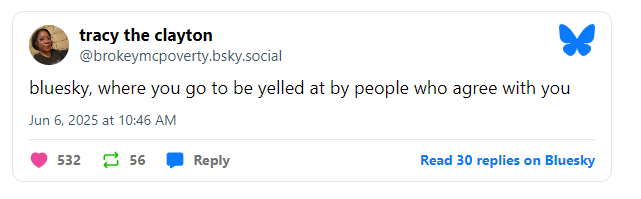
To take those in reverse order, Megan McArdle of the Washington Post argued that Bluesky isn’t doing progressive thought or action any favours, in a piece on June 8th titled “The Bluesky bubble hurts liberals and their causes.” The social network, she wrote, was “doomed to fail as users tried to re-create Twitter.” McArdle’s piece cited a Pew Research Center analysis that found many news influencers had set up accounts on Bluesky but about two thirds of them only posted to the network sporadically, while more than 80 percent of them still posted to X regularly. Engagement on Bluesky peaked in mid-November, she wrote, and is now down about 50 percent, and “the decline shows no sign of leveling out.” McArdle’s larger point was that exporting progressives from X onto Bluesky’s “beautiful blue bubble” wasn’t a good thing for the movement. This effort “isn’t just a doomed attempt to re-create the old Twitter,” she said, but is “likely to sap progressive influence and make the movement less effective.” She added:
Note: This is a version of my Torment Nexus newsletter, which I send out via Ghost, the open-source publishing platform. You can see other issues and sign up here.
Continue reading “Reports of Bluesky’s death have been greatly exaggerated”