This author’s suicide now appears to be a hoax

Note: This is a version of my personal newsletter, which I send out via Ghost, the open-source publishing platform. You can see other issues and sign up here.

The Ward, a reading group founded by Tennessee-based author Susan Meachen, largely went dormant after a September 2020 post — supposedly written by her daughter — was shared from her page announcing that she had died by suicide following bullying and harassment from members of the book community. Now, more than two years later, Meachen has decided that she wants her life back and returned to Facebook to reveal that she was never actually dead in the first place. “I debated on how to do this a million times and still not sure if it’s right or not,” Meachen wrote in her back-from-the-dead return to the group on Jan. 2. Those who mourned her are furious.

The truffle industry is a giant scam – not just truffle oil, the whole thing

Matt Babich writes: “Truffle-flavored oil is not made from truffles. What is sold as truffle flavor is 2,4-dithiapentane, an organosulfur compound that is naturally found in truffles. It is practically impossible to extract it from truffles, but it can be extracted from oil. There are several reasons why this is terrible. Synthetic garbage sold as a luxury gourmet item gives customers the idea that truffles have an intense gas-like aroma. It is a scam because it deceives customers; that is, it falsely represents a product that has nothing to do with truffles and puts all restaurateurs in an unfavorable position: if you don’t flavor truffle dishes with added aromas  the guests are used to, they will think you’re being cheap.”

Continue reading “This author’s suicide now appears to be a hoax”

An incomplete list of things Twitter was

From writer Helena Fitzgerald’s great newsletter Griefbacon (which is the literal translation of a German term meaning “the weight you gain after overeating for emotional reasons”). I’ve only extracted the list here, but you should click through and read all the descriptions as well:

“I hated Twitter because of course I hated Twitter; if you didn’t hate Twitter, you weren’t there. Hating it was the only way to live in it; that was word for love in its language. I hated Twitter, and I still hate Twitter, and an alarming percentage of everything I love or am proud of derives from the time I wasted on that stupid website, complaining about how the website is garbage. Here are some final ways I would describe Twitter.

  • A group of drunk girls in the bathroom
  • Times Square
  • What people who didn’t have friends in middle school think having friends in middle school was like.
  • A Denny’s at 2am in a town with a vibrant (derogatory) local theater scene.
  • The Titanic but everybody wants to talk about Joan Didion.
  • The Titanic but everybody wants to tell you why they don’t count as rich.
  • The JFK assassination episode of Mad Men.
  • The longest-form Jenny Holzer installation ever.
  • Listening to two people have an argument on the street directly underneath your window
  • Adderall.
  • Sitting at the kids’ table at Thanksgiving when you are supposed to be sitting at the adults’ table.
  • Sitting at the adults’ table at Thanksgiving when honestly you should still be sitting at the kids’ table.
  • Going into the downstairs bathroom at the home of a relative you actually don’t know very well on Thanksgiving and hiding out there while everybody argues
  • The fever dream of a high school freshman who has the flu but has come to school anyway and has fallen asleep in the middle of class.
  • The depiction of Hell in noted prestige television series Adventure Time.
  • Trying to leave a party where the vibe has soured
  • The mythical city of Babel”

The legendary dabbawalas of Mumbai

In Mumbai, thousands of “dabbawalas” deliver hot lunches to hundreds of thousands of customers throughout the city, and then return the empty dabbas (lunchboxes) the same day. They are a model of efficiency, a decentralized network that functions better than many mechanized or computerized ones, and yet they don’t even use smartphones. Harvard Business Review wrote about the dabbawala system in 2012 (found via the Why Is This Interesting newsletter):

“The 5,000 or so dabbawalas in the city have an astounding service record. Every working day they transport more than 130,000 lunchboxes throughout Mumbai, the world’s fourth-most-populous city. That entails conducting upwards of 260,000 transactions in six hours each day, six days a week, 52 weeks a year (minus holidays), but mistakes are extremely rare.

Amazingly, the dabbawalas—semiliterate workers who largely manage themselves—have achieved that level of performance at very low cost, in an ecofriendly way, without the use of any IT system or even cell phones.

The dabbawala service is legendary for its reliability. Since it was founded, in 1890, it has endured famines, wars, monsoons, Hindu-Muslim riots, and a series of terrorist attacks. It has attracted worldwide attention and visits by Prince Charles, Richard Branson, and employees of Federal Express, a company renowned for its own mastery of logistics.”

Wingsuit flying over Mont Blanc

Fred Fugen, Vincent “Veush” Cotte, and Aurélien “Bras Noir” Chatard set a new record for terrain-flying in wingsuits. They travelled 7.5 kilometres over Mont Blanc — the highest mountain in the Alps — in just 3 minutes and 5 seconds, after jumping in formation from a helicopter just above the summit.

The hit Italian song that sounds like English but is actually gibberish

In 1972, a popular Italian singer named Adriano Celentano released a single called “Prisencolinensinainciusol,” written by him amd performed with his wife Claudia Mori, a singer/actress turned record producer. Both the title of the song and its lyrics are gibberish. Celentano said later that his intention with the song was not to create a humorous novelty song but to explore communication barriers, and to demonstrate how English sounds to people who don’t understand the language proficiently.

“Ever since I started singing, I was very influenced by American music and everything Americans did,” Celentano said in an interview with NPR. “So at a certain point, because I like American slang—which, for a singer, is much easier to sing than Italian—I thought that I would write a song which would only have as its theme the inability to communicate. And to do this, I had to write a song where the lyrics didn’t mean anything.”

Update: Someone let me know that Adriano’s daughter Mina released a remake a few years ago. Adriano even makes an appearance in the video

Thor the walrus visits the UK and draws a crowd

Note: This is a version of my personal newsletter, which I send out via Ghost, the open-source publishing platform. You can see other issues and sign up here.

A young male walrus named Thor has ventured far from his usual polar habitat in the past few months, turning up in the town of Scarborough in Yorkshire (he has also been spotted on the south coast as well as in France and the Netherlands). Large crowds gathered behind a police cordon to watch Thor and volunteers from Scarborough Sea Life Centre monitored the scene in case he might be disturbed. Wildlife charities warned onlookers to keep their distance and keep dogs away from the walrus. Thor is believed to be the first walrus ever to have visited Yorkshire, though two others have been recorded in the UK.

The weird delights of making Foley sound effects for movies

The salvage yard at M. Maselli & Sons, in Petaluma is made up of six acres of angle irons, block pulleys, doorplates, digging tools, motors, fencing, tubing, reels, spools, and rusted machinery. To the untrained eye, the place is a testament to the enduring power of American detritus, but to Foley artists—craftspeople who create custom sound effects for film, television, and video games—it’s a trove of potential props. On a recent morning, Shelley Roden and John Roesch, Foley artists who work at Skywalker Sound, stood in the parking lot, considering the sonic properties of an enormous industrial hopper. “I’m looking for a resonator, and I need more ka-chunkers,” Roden said.

Continue reading “Thor the walrus visits the UK and draws a crowd”

She helped create Yoda and then disappeared

Note: This is a version of my personal newsletter, which I send out via Ghost, the open-source publishing platform. You can see other issues and sign up here.

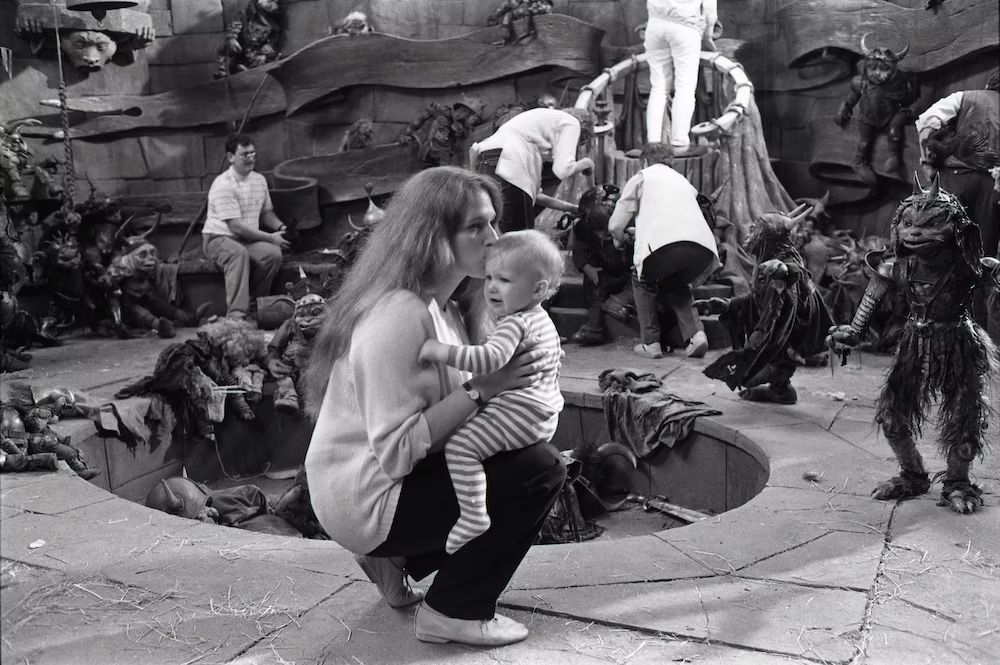
You might not recognize the name Wendy Froud (née Midener), but in the world of movie effects and puppetry, she’s practically a legend. Froud was sought out by directors like Jim Henson early in her career and created countless iconic TV and movie creatures. She played a crucial role in the birth of animatronics, providing the puppet design for groundbreaking films The Empire Strikes Back, The Dark Crystal, and Labyrinth. A Froud original can go for $4,500, and her work even earned her one of pop culture’s greatest monikers: the Mother of Yoda. But in 1988, at the height of Froud’s career, the woman who helped create some of the world’s most beloved puppets seemingly vanished.

The legend of the music tree

The tale of The Tree is shrouded in equal parts bravado and nostalgia. Few people know it, and those who do seem to have their own, very particular take. What is certain is that the story begins in 1965 deep in the Chiquibul jungle, a remote and largely uncharted broadleaf rainforest in what was then British Honduras and is now Belize. It was there that a clutch of vagabond loggers scouting for timber happened upon an ancient mahogany tree. Mahogany had for centuries been that nation’s primary export, and was a popular target of poachers and smugglers. Few large mahogany trees remained, and this one was enormous—12 feet in diameter at its base, soaring 100 feet into the canopy. If not the most massive tree in the forest, it was certainly a contender for the title.

Continue reading “She helped create Yoda and then disappeared”

The death-defying legend of cowpuncher Boots O’Neal

Note: This is a version of my personal newsletter, which I send out via Ghost, the open-source publishing platform. You can see other issues and sign up here.

The sun is not yet up when Boots O’Neal starts his workday. As the 89-year-old cowboy readies his mount in the predawn quiet, he stuffs his hands into well-worn leather gloves. He pulls down his silverbelly hat and grunts his way onto the saddle, planting his tall-topped boots in the stirrups. The horse he’s riding today is a dark sorrel named Cool. This morning’s chore: Boots and his coworkers must round up some two dozen bulls scattered across a vast grazing pasture, drive them to a set of pens about a mile away, and load them into a livestock trailer so they can be hauled to another division of the Four Sixes, the legendary West Texas ranch that sprawls across 260,000 acres.

The curious case of the Stone Age fossil known as Nebraska man

In 1917, the year the United States entered World War I, a rancher named Harold Cook assisted paleontologists from the Denver Museum and the American Museum in digs at fossil beds along Snake Creek, some 20 miles south of his family’s ranch. Whether he picked up the tooth while scouting for those excavations, during one of them, or sometime after, he never said. But Cook believed he had found something truly special. Based on his knowledge of fossils, he suspected that the tooth belonged to a primate, and not a mere monkey—an ape perhaps. An even more tantalizing prospect was that the tooth belonged to an early human. Cook was correct about one thing: The tooth was important. But it would become part of history in a way he never imagined.

Continue reading “The death-defying legend of cowpuncher Boots O’Neal”

Interesting things from Astral Codex Ten

I think I’ve linked to Scott Alexander’s blog Astral Codex Ten before (the name of the blog is an anagram of his name). He publishes lists of links that he comes across from time to time, and some of them are quite fantastic. Here are some from a recent collection that I liked, or that I wanted to save for later:

Impossible colours: Researchers did a test in which they restricted participants’ vision and forced them to view a field made up of two colours, and they would up seeing not a combination of those two colours but “new colors entirely, which are not in the CIE 1931 color space, either in its real part or in its imaginary parts. Some of the volunteers reported that afterward, they could still imagine the new colors for a period of time.”

Luck-based medicine: Elizabeth Van Nostrand is a software engineer who writes about her lifelong problems with food and digestion, and how modern medicine was almost completely useless until a doctor accidentally helped her. “This finalized some already fermenting changes in how I view medical interventions and research,” she writes. “Namely: sometimes knowledge doesn’t work and then you have to optimize for luck. I assure you I’m at least as unhappy about this as you are.”

The effect of open-label placebos in clinical trials: In other words, if you give patients a placebo, saying “This is a placebo, try taking it and maybe the placebo effect will make you feel better”, do they? This gets investigated a lot, but the latest study says yes, with a medium-to-large effect size.

Do anti-depressants work? Despite decades of research, there’s still quite a bit of debate about whether SSRI drugs — which are prescribed for millions of people every year — actually help those with depression. A large meta-analysis of the research seems to show that if they do work at all, they don’t make much of a difference for those who suffer.