I guess books are okay…

but nothing beats a good hand-illustrated manuscript, am I right? You know, by a monk who really knows his stuff. Or a good old papyrus for that matter. I mean, it was good enough for our ancestors, right? They did okay with their papyruses and whatnot. What do we need with all these so-called “books.” Dumb word anyway. Waste of time and money.
They tried to raise an army and invade an island near Haiti
Two men from North Texas have been charged over violent plans that included an armed coup on the Haitian island of Gonave, according to the Justice Department. Gavin Weisenburg, 21 years old of Allen, and Tanner Thomas, 20 years old of Argyle, along with other co-conspirators planned to murder all men on the Haitian territory before taking over the island, and enslaving the women and children as “sex slaves,” according to an indictment filed in U.S. District Court on Thursday. “The co-conspirators conducted research, reconnaissance, recruiting, planning, and sought training to effectuate their plan,” the indictment reads. “It was the goal of the conspiracy to take military control of the Island of Gonave by murdering all the men on the island and capturing all the women.” Both men are charged with conspiracy to kill or kidnap persons in a foreign country and face one count of producing child pornography. (via NPR)
The man who wrote Apocalypse Now also created the Ultimate Fighting Championship

John Milius got an Academy Award nomination for penning the Apocalypse Now screenplay and also wrote and directed Conan the Barbarian. But, Milius’s larger-than-life persona extends far beyond the world of cinema. For 29 years, UFC has been a juggernaut in the world of combat sports. While CEO Dana White has long been viewed as the face of the organization, it was Milius, along with several others, who helped to conceptualize UFC in the first place. Milius saw himself in many of the male characters that he crafted, which led to him pursuing several high-octane activities, including shooting guns, surfing, and Brazilian jiu-jitsu. Milius’s teacher was a man named Rorion Gracie, a skilled BJJ practitioner whose father Helio actually helped develop the now widely-popular self-defense martial art. Eventually, Milius’s interest in Brazilian jiu-jitsu morphed from a pastime to a lucrative business opportunity. (via MovieWeb)
Note: This is a version of my When The Going Gets Weird newsletter, which I send out via Ghost, the open-source publishing platform. You can see other issues and sign up here.
Continue reading “They tried to raise an army and invade an island near Haiti”It’s a pyramid scheme
Cat for Christmas
It’s illegal to make fried rice on this one specific day in China
If you share a recipe for or photo of fried rice in China on November 25th, you may get a visit from the authorities. To understand why, you have to go back 75 years. North Korea, backed by the Soviet Union and China, launched a surprise invasion into South Korea, hoping to unify the Korean peninsula. More than three years and as many as three million lives later, the two sides signed an armistice. One of the lives lost was Mao Anying, the oldest son of the chairman of China’s Communist Party, Mao Zedong. His death has become a major moment in the narrative shared by Chinese dissidents today, who celebrate November 25 as China’s Thanksgiving Day. But because of censorship, those who want to mark the day do so by sharing a fried rice recipe or pictures of the dish. It’s a reference to the mythic story behind Anying’s demise, which says he was trying to cook fried rice, and the smoke from the fire exposed his position. (via Now I Know)
He popularized a famous Italian coffee pot and when he died he was buried in one

Renato Bialetti, the Italian businessman who turned an aluminum coffee pot into a classic global design, died last week at the age of 93. In accordance with his and his family’s wishes, his ashes were interred in an urn shaped like a large version of a Moka pot, the stovetop coffee maker he introduced to the world. Bialetti didn’t invent the Moka. He just made it famous. A man named Luigi di Ponti designed the appliance in 1933 and sold the patent to Renato’s father Alfonso Bialetti, an aluminum vendor. Sales lagged under the elder Bialetti, but Renato had bigger, coffee-scented dreams when he took over the business in the 1940s. He spearheaded a massive marketing campaign across Italy for the pots, which were branded with a charmingly mustachioed caricature—based either on himself or his father, depending on the legend you read. (via Quartz)
Note: This is a version of my When The Going Gets Weird newsletter, which I send out via Ghost, the open-source publishing platform. You can see other issues and sign up here.
Continue reading “It’s illegal to make fried rice on this one specific day in China”What did Mark Zuckerberg know and when did he know it?
My last Torment Nexus piece was about how weak the FTC’s antitrust case against Meta was, weak enough that it was thrown out by a federal court judge. But don’t take that argument as evidence that I am a Meta fan — far from it. It may not be a monopoly, but that doesn’t mean it isn’t harmful and in some cases actually dangerous. The one I have the most experience with is the situation in Myanmar, where Facebook ignored the signs that its platform was being used to promote violence against the Rohingya population in that country, and ignored them for so long that a United Nations panel came to the conclusion that the company enabled a genocide that killed thousands and left thousands more maimed and homeless. Did Facebook deliberately do this? Of course not. They’re not monsters (or at least not that specific kind of monster). Instead, they simply overlooked the evidence in front of them, or more likely decided it wasn’t important enough to get in the way of the platform’s growth and engagement goals.
Whenever something like this happens — not just with Facebook, but plenty of other tech companies — the response has become a kind of ritualized theater performance, a stylized exercise of going through the motions without any real outcome or change. In Meta’s case, it involves Mark Zuckerberg or some other functionary from Facebook or Instagram commenting in the press about something hateful or dangerous that its platform enabled, and then in some cases appearing before Congress, shamefaced and sometimes truculent about the said wrongdoing. Zuckerberg or his stand-in will say that they are sorry, and that they had no idea that (insert hateful or dangerous conduct here) was being enabled by the platform. At some point, months or even years later, it will be revealed that Facebook or Instagram knew exactly what was happening and chose not to do anything about it, or at least nothing substantive anyway.
One of the examples of this that I am the most familiar with was when former Facebook staffer Frances Haugen blew the whistle on the company’s behavior involving young and mostly female users of Instagram, in 2021. According to the thousands of pages of internal documents that Haugen took with her when she left the company — which were shared with the Wall Street Journal and other outlets, as well as with members of Congress — Meta senior executives knew from their internal research that Instagram was increasingly linked to emotional distress and body-image issues among young women. As Haugen described in an interview with me at the Mesh conference in 2023, she and a number of other staffers worked on ways of trying to reduce or even eliminate this problem, but time and again their work was ignored — because doing so might decrease engagement or interfere with Meta’s growth and revenue targets. So did Meta know? Yes. Did they care? No. Or, at least not enough to do anything about it.
Note: This is a version of my Torment Nexus newsletter, which I send out via Ghost, the open-source publishing platform. You can see other issues and sign up here.
Continue reading “What did Mark Zuckerberg know and when did he know it?”Stop saying you censored yourself
You didn’t “censor” yourself — censorship is something someone else does to you when they prevent you from speaking. You just decided not to say something dumb and/or hateful, and now you want to make it seem like someone else made you do it.
A totally normal thing for your printer to tell you
Just for fun I actually read the agreement before installing the 105-megabyte software update for my Epson printer, which (like many printers) is a gigantic piece of crap that rarely works properly. This is the best part:
SECTIONS 19-23 OF THIS DOCUMENT APPLY TO YOU. SECTION 22 CONTAINS A BINDING ARBITRATION PROVISION THAT LIMITS YOUR ABILITY TO SEEK RELIEF IN A COURT BEFORE A JUDGE OR JURY, AND WAIVES YOUR RIGHT TO PARTICIPATE IN CLASS ACTIONS OR CLASS ARBITRATIONS FOR CERTAIN DISPUTES
President Calvin Coolidge had a pet racoon in the White House
After the 1913 death of Horace Vose, the traditional provider of the White House Thanksgiving turkey, numerous farmers sent animals to the president for Thanksgiving dinner. In 1926, a Mississippi supporter sent a racoon. Coolidge, who had never eaten raccoon and had no appetite to try it, kept the racoon as a pet and named it Rebecca. For Christmas, an embroidered collar was made for Rebecca, inscribed “White House Raccoon”. She enjoyed participating in the annual White House Easter egg roll. She was fed shrimp and persimmons, and eggs were a favorite. Rebecca was let loose in the White House and walked on a leash outdoors. At times, she could be mischievous and was known to unscrew lightbulbs, open cabinets, and unpot houseplants. She was known to nestle in Coolidge’s lap when he sat by the fireplace. (via Wikipedia)
The story behind Alexander Fleming’s discovery of penicillin has a bunch of holes in it
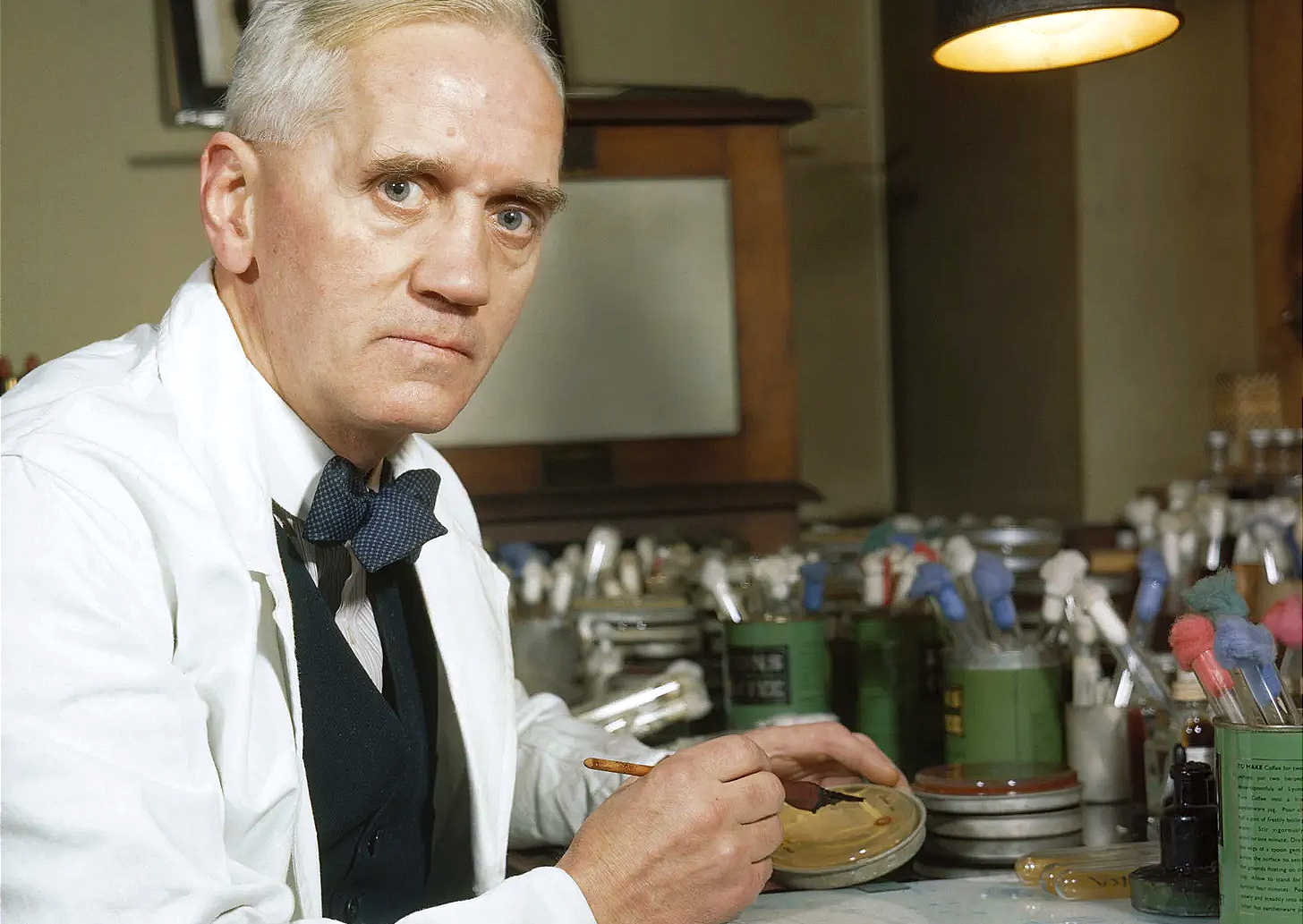
Many know the story of Alexander Fleming’s chance discovery of penicillin. Fleming left culture plates streaked with Staphylococcus on his lab bench while he went away. When he returned, he found that “a mould” had contaminated one of his plates, having floated in from an open window. He noticed that, within a “ring of death” around the mold, the bacteria had disappeared. Fleming immediately began investigating this strange new substance. He identified the mold as Penicillium rubrum and named the substance penicillin. A decade later, pharmacologist Howard Florey and biochemist Ernst Chain at Oxford would pick up where Fleming left off, developing penicillin into a life-saving drug and usher in the era of antibiotics. This is the kind of science story everyone likes. One of serendipity and accidental discovery; a chance observation that changed the world. But is it true? For decades, scientists and historians have puzzled over inconsistencies in Fleming’s story. (via Asimov Press)
Note: This is a version of my When The Going Gets Weird newsletter, which I send out via Ghost, the open-source publishing platform. You can see other issues and sign up here.
Continue reading “President Calvin Coolidge had a pet racoon in the White House”It’s 1925 and I’m leaning against a lamppost
You can rent a hotel room that looks like Goodnight Moon

If you were one of the millions of children who grew up reading Goodnight Moon before bed, chances are its iconic green bedroom is permanently seared into your memory. Now, for the next four months, you have the opportunity to sleep in the Goodnight Moon room IRL. The Goodnight Moon room has been faithfully re-created—down to the red balloon, bowl of mush, and cow jumping over the moon—for a new immersive suite at the Sheraton Boston Hotel. The room can accommodate up to two adults and two children, and a booking in the suite comes with perks like four tickets to the View Boston observation deck, a $150 daily food and beverage credit, complimentary moon and star cookies, and even the supplies to make your own bowl of mush. It’s available to book now through February 28, 2026, starting at $399 per night. (via Fast Company)
Study finds that people behave better if there’s someone nearby dressed as Batman

After making a guy dressed as Batman stand around in a subway car, a team of researchers found that the behavior of people around him suddenly improved the moment he showed up. No longer was everyone completely self-involved; with the presence of a superhero, commuters started helping each other more than they would’ve without him around. The findings of the unorthodox study, published in the journal npj Mental Health Research, demonstrate the power of introducing something offbeat into social situations to jolt people out of the mental autopilot they slip into to navigate the drudgery of everyday life. In a series of experiments, the researchers had a woman who visibly appeared pregnant enter a busy train, and observed how often people offered to give up their seats. They then repeated this scenario with a crucial change: when the pregnant woman entered the train from one door, a man dressed as Batman entered from another. (via Futurism)
Note: This is a version of my When The Going Gets Weird newsletter, which I send out via Ghost, the open-source publishing platform. You can see other issues and sign up here.
Continue reading “You can rent a hotel room that looks like Goodnight Moon”Hands in the air Venn diagram