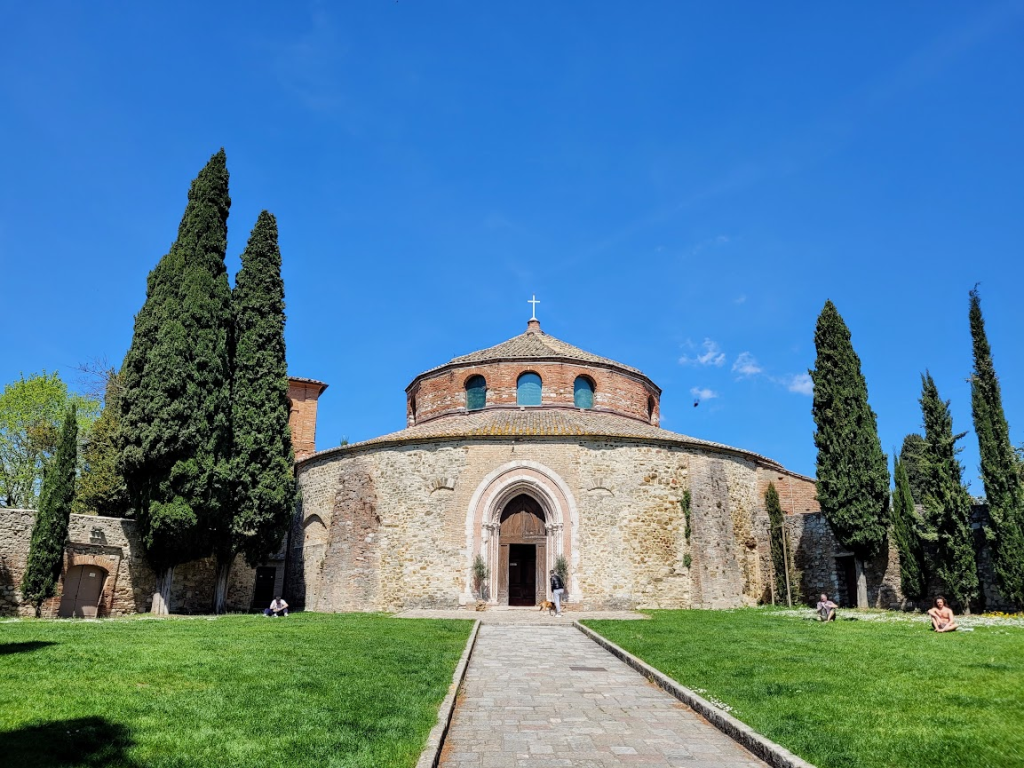
My wife and I have spent a number of years travelling to Perugia, a small town in Umbria, just a couple of hours north of Rome, for the fantastic journalism festival that is put on there by our friends Arianna and Christopher (Arianna was adamant that it not be called a conference when they started it). We haven’t been for the past couple of years for a number of reasons, but this was the 20th anniversary of the festival, so we had to go — and it was our 10th visit; we went for the first time in 2013 (in addition to the past couple of years when we didn’t attend, we missed a couple due to COVID). It was great to be back in the old city, which dates back to the Etruscan empire in the year 300 or so. One of the things we make sure to visit every year is a fascinating circular church that was originally a pagan temple, built in about 500 AD or so. You can just walk in and look around whenever you want — it is still used as a church — and nearby is an ancient tower from the same period that has a small museum you can visit as well.
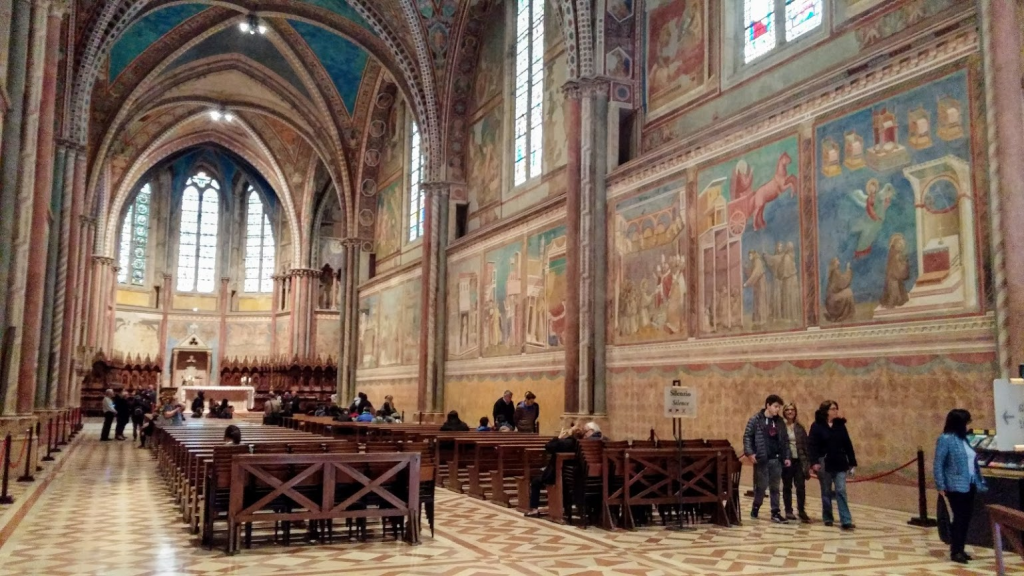
Across from the main conference hotel there’s an escalator that goes down into the ruins of an ancient palace known as the Rocco Paolina, named for Pope Paul III, who built it in the 1500s after he took control of the city following the great Salt War. It seems that the new pope decided to levy a new tax on salt, which enraged the Perugians — according to legend, traditional Perugian bread is baked without salt, in memory of this grudge from 500 years ago. The pope squashed the rebellion with his armies, and took control of the city, and it remained under papal control until Italy was unified in 1860. Also, from what I understand, a guy named Frank from Assisi was injured in a war between Perugia and Assisi (which is about a two-hour drive away across a valley) in the year 1200 or so, and later got really religious and decided to become a monk, and eventually became Saint Francis of Assisi. The murals in his cathedral are truly spectacular.
Speaking of cathedrals and St. Francis, one of the amazing venues for the Perugia journalism festival is the church of San Francesco al Prato (which translates as St. Francis in the meadow). It was built in the 13th century sometime, as one of the first churches of the Franciscan order, which Francis created. Much of the church was destroyed due to landslides and neglect, and the interior was demolished after it stopped being a church, but in the 2000s it was renovated and rebuilt, with the original stone walls incorporated into a modern glass and steel structure. During reconstruction it was discovered that the church was built on top of an even older church from the 12th century. It is one of the most spectacular venues I have ever spoken in, to the point where I often apologize to the audience for becoming distracted by how beautiful it is.
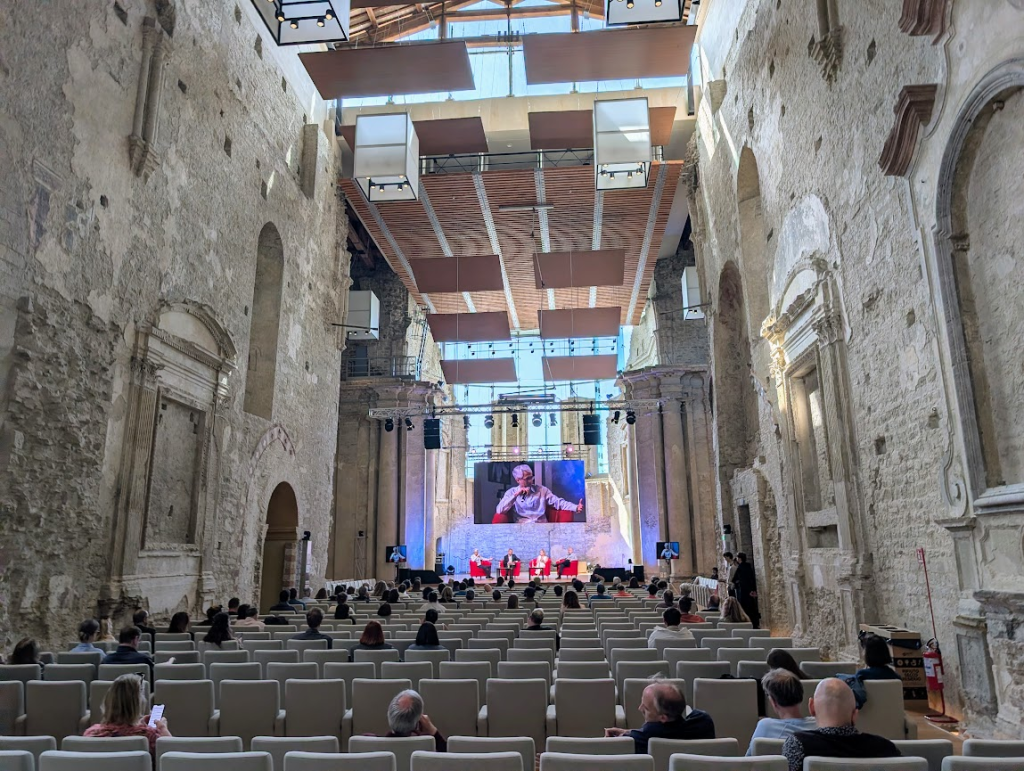
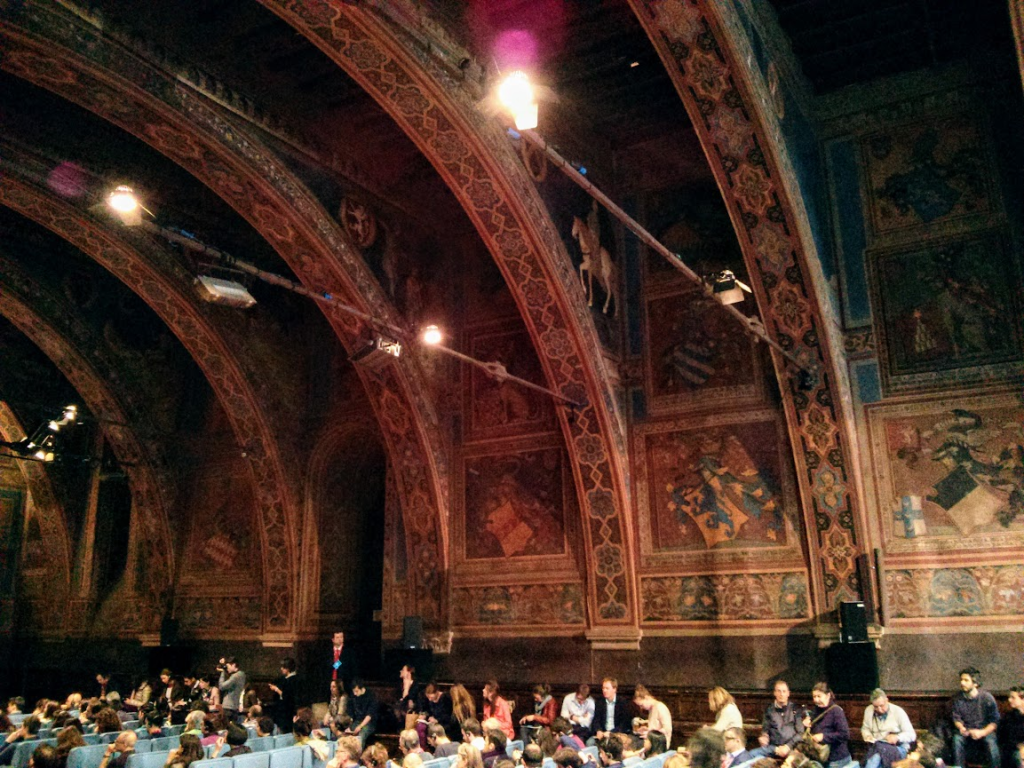
I moderated a panel in the church that was entitled “How a desire to tell stories can lead to bad journalism,” featuring a discussion with Emily Bell from the Tow Center at Columbia, former Guardian editor Alan Rusbridger, and former Google head of news Richard Gingras (you can read more about it and even see video of it here if you are interested in my thesis about the dangers of storytelling). The other venue that I really love is the Sala dei Notari, which is in the centre of town — it was built in the 1200s — in other words, it was hundreds of years old when the printing press was invented — and has a soaring ceiling made of huge curved timbers decorated with beautiful ancient frescoes. I gave a keynote here in 2013.
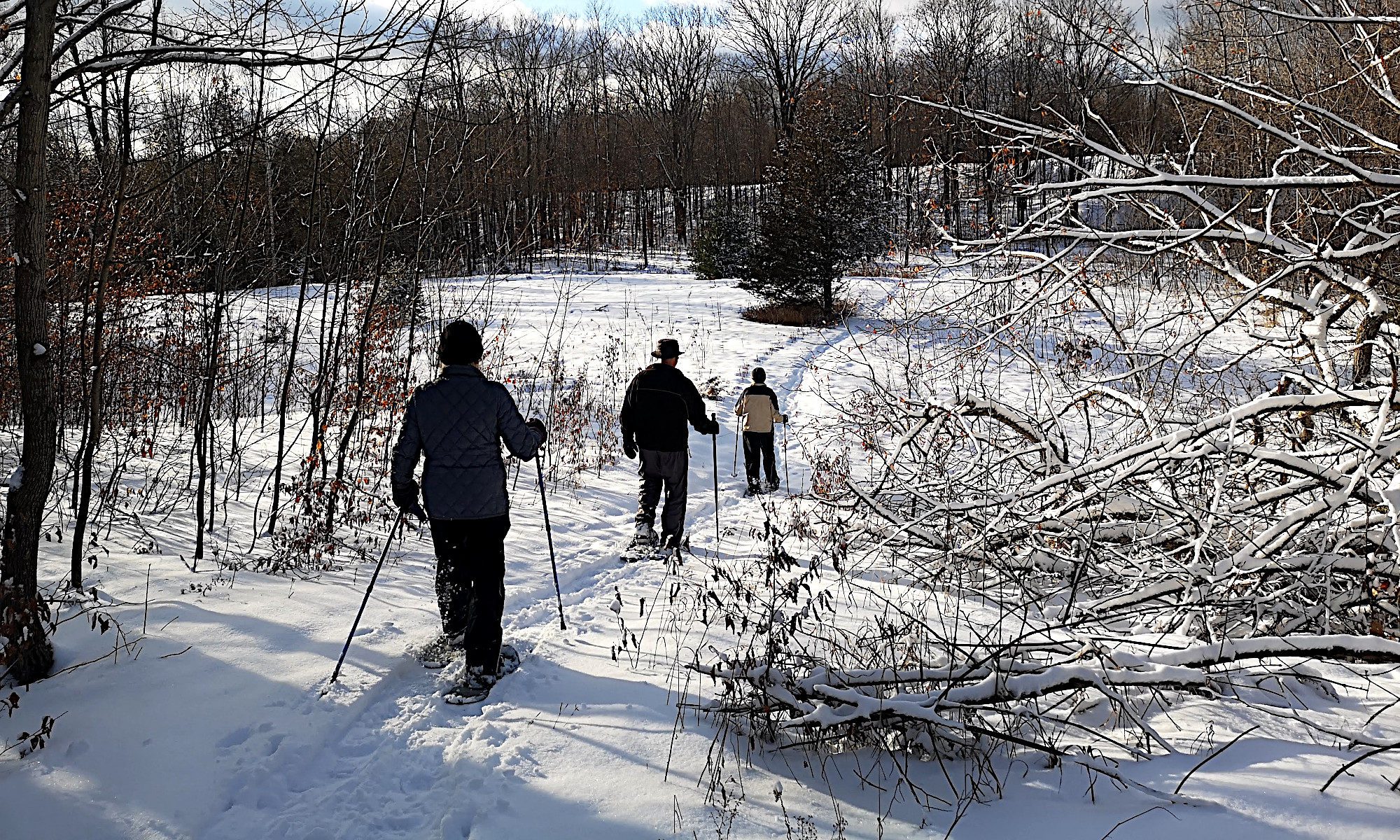
The 20th journalism festival was great as always, but I think the highlight this year was a huge rooftop party for the anniversary, which was held on the rooftop patio of the Citi de Chocolat, overlooking the hillside of Perugia and the town of Assisi across the valley. Chris and Arianna had a stage set up with a DJ, lights and smoke machines, and then there was cake and champagne for anyone who wanted some. You can see some photos and videos here. After the party, we got up early and took the cute little mini-metro funicula train down to the train station and got a train to Turin. In Turin we connected with a friend who had arranged for us to rent kayaks and paddle on the Po river, which flows through the center of Turin. It was a beautiful sunny day and so we paddled for a couple of hours up and down the river, past a couple of gorgeous bridges, gazing at all the beautiful flowers and trees all blooming (this was especially gratifying because we still had snow where we live in Canada). The next day, we drove a couple of hours south to the seaside, where our friend rents an apartment in the tiny medieval town of Cervo.
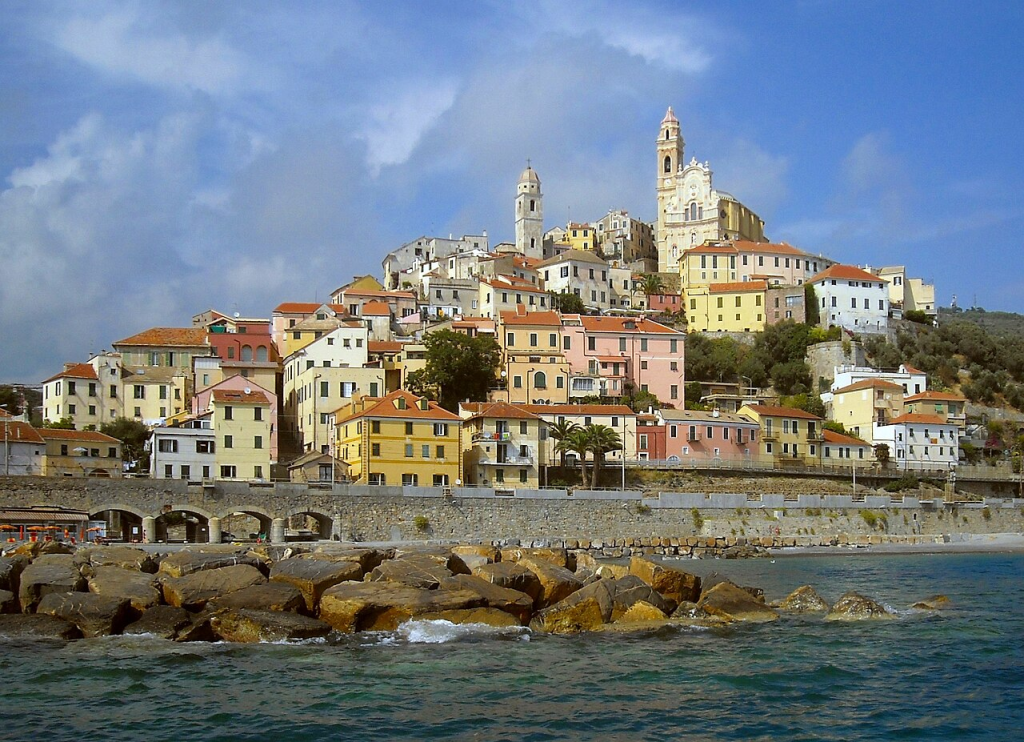
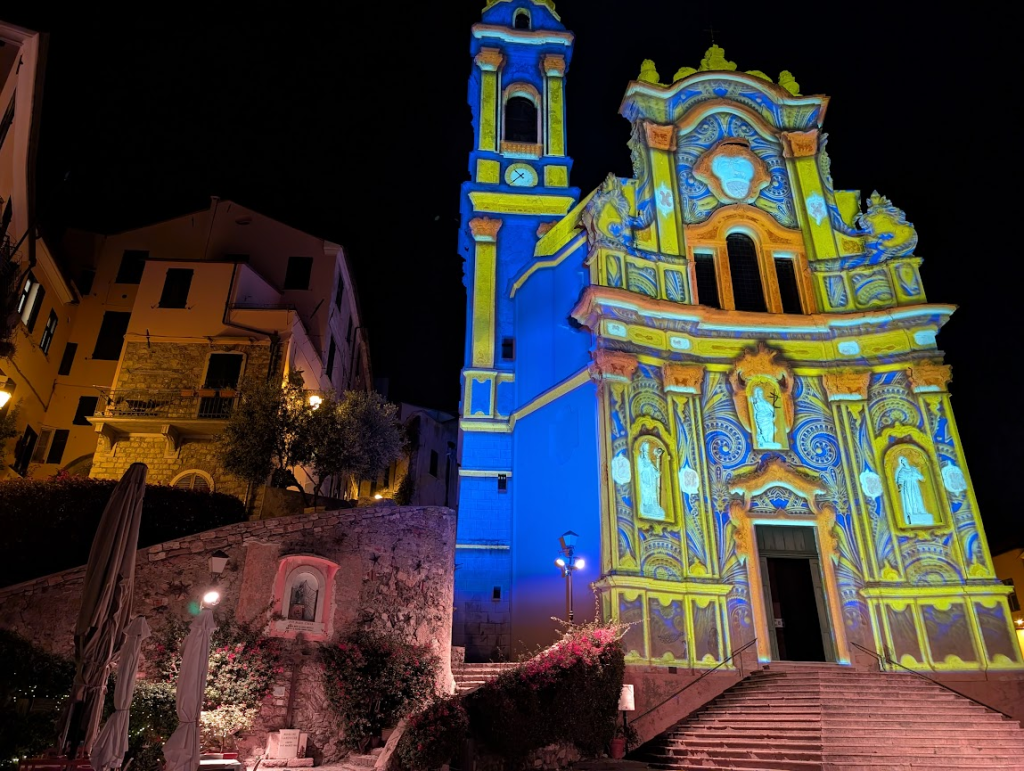
Like many of the ancient towns of Cinque Terre directly across the Ligurian Sea, the “streets” in old Cervo are tiny alleys that bend and twist between ancient buildings (the town is over a thousand years old) and going anywhere requires hiking up or down a dozen flights of stone steps. Living here would be quite the quad workout. The cathedral at the top is a baroque masterpiece that is lit up in a spectacular way at night — I know it looks like I’ve enhanced this picture somehow but that’s actually what it looks like!
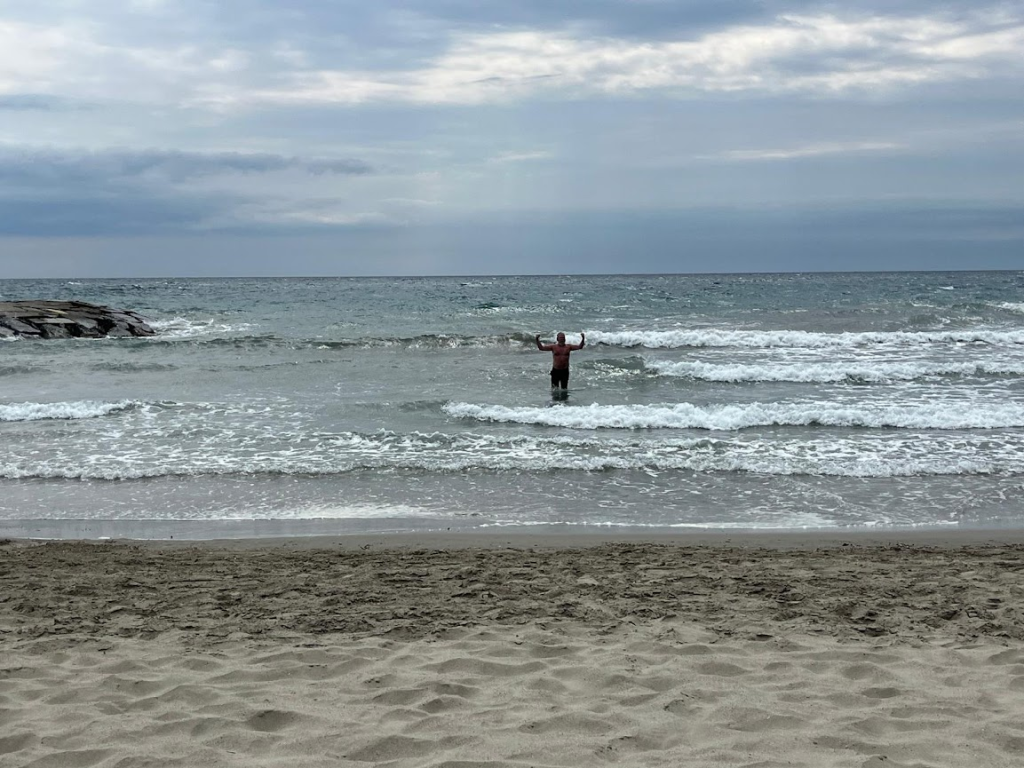
We walked down those twisty alleys and dozens of stone steps until we finally got to the seaside, where we walked down the beach — there was no one there, of course, because it was only April (except for a few hardy souls sun-tanning). But regardless, we changed into our bathing suits and went for a swim anyway! It was beautiful and sunny, and not that wavy at all. After the swim we climbed back up a dozen flights of stairs or so to sit in the piazza outside the cathedral, where we had gelato and espresso (of course). The following day was not quite as nice and sunny, but we didn’t let that stop us — we hiked along the old railway line along the coast, which has been transformed into a biking and walking trail, and about three miles later we were in the neighbouring town of Andora (not to be confused with the tiny European country with a similar name). And despite it being cool and cloudy, we stopped at a little lunch place by the seaside, where they rented us chairs and served us lunch and coffee, even though they weren’t really open yet. And because I can never resist a swim, no matter how cold or wavy it is, I went for one.
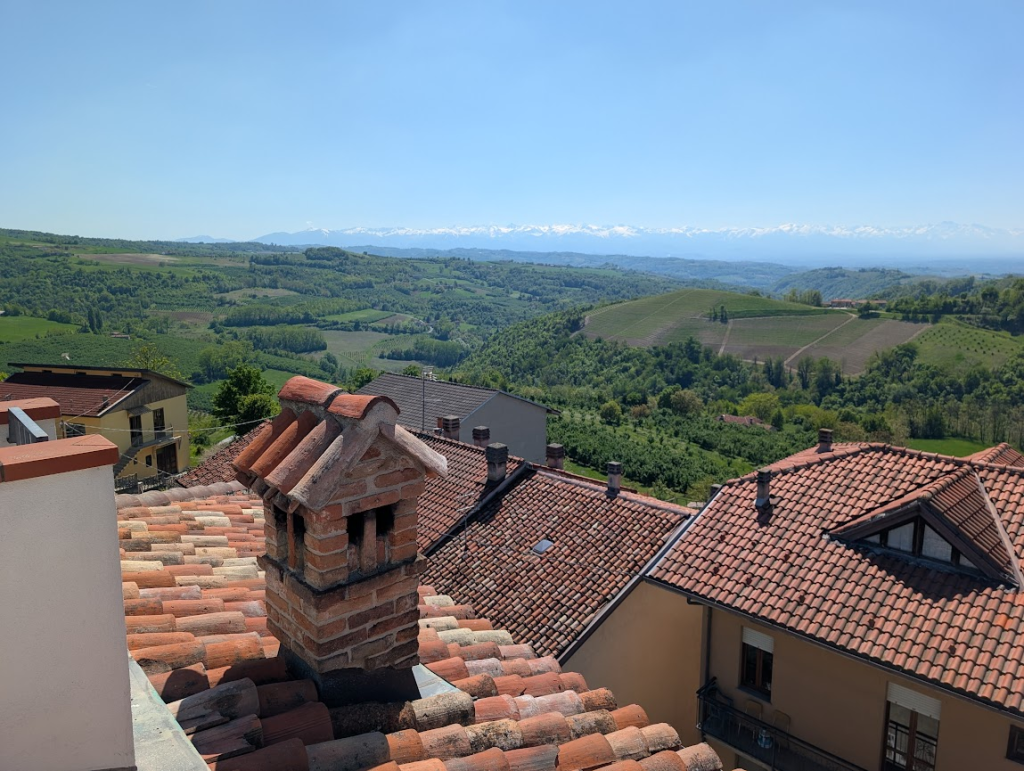
The next day, we drove back to Turin, and this time instead of taking the highway we took a secondary road through the massive foothills, navigating hairpin turns and passing through a number of medieval towns until we got to Roddino, a tiny hillside town famous for Barolo wines and one other thing: A Michelin-recommended restaurant called Osteria da Gemma that has to be reserved months in advance, where the eponymous owner cooks up a fixed menu consisting of about six courses of Piedmontese dishes, including roast rabbit and wild boar, as well as beef tartare, numerous local pasta dishes including “plin,” a tiny local variation on ravioli, and several desserts including one with whipped cream and meringue that was to die for. By the time we were done all that we needed a nap, so we headed to the rooftop patio, which has an incredible view of the hillside wineries and of the alps. And then it was back to Turin and a flight back to Toronto!