He was a star NFL agent and then came the crossbow murder

He drove his red Mercedes along Pershing Avenue with the top down, his wavy brown hair just long enough to flap in the wind. With his monogrammed shirts and pleated pants, Michael Blatt exuded a specific 1980s California cool rooted in the certainty that, no matter what, he would never, ever lose. An Army brat, Blatt said he moved 18 times before coming to the University of the Pacific to play soccer in the mid-1960s. His ambition took root. By 21, he wanted to make a million dollars. By 24, he wanted $10 million.After graduating from UOP in 1968, he worked in finance, but Blatt would never settle for managing other people’s money. One day, legend goes, he walked into a bank and asked for a million-dollar loan. The chairman, wearing a cowboy shirt and an oversized belt buckle, said, “You’re either crazy, full of bullsh—, or you gotta be right.”Blatt got the loan. Within six years, he had built 4,000 apartment units. Within a decade, his company tallied $120 million worth of construction. Later, he built a subdivision he called Blatt Estates with streets named after his children. (via The Athletic)

During World War I the White House called a herd of sheep into service to mow the lawn

In the spring of 1918, the United States was a year into World War I, and any man holding a job that could be done by someone — or something — else was a man who could be sent to France instead. That posed a problem for President Woodrow Wilson: the White House needed its grass cut and its groundskeepers freed up, and those two needs were pulling in opposite directions. The idea came from Dr. Cary T. Grayson, Wilson’s personal physician, who happened to have useful friends in horse racing. Grayson contacted his horse racing acquaintance William Woodward, who owned Belair Farm. Woodward sent along a small flock, 18 sheep in all, by wagon to the nation’s capital. The idea was simple: the sheep needed to eat anyway, and grazing on the lawn of the President’s house would mean the grass would always be well tended to. The idea worked at first, and had a nice side benefit. Sheep grow wool, and wool grown on the President’s lawn was kind of cool. But there were problems with the sheep-as-mowers scheme. (via Now I Know)

Note: This is a version of my When The Going Gets Weird newsletter, which I send out via Ghost, the open-source publishing platform. You can see other issues and sign up here.

Continue reading “He was a star NFL agent and then came the crossbow murder”

King Tut was buried with 140 pairs of immense underwear

When excavators explored (and emptied) King Tuntankhamun’s tomb in the 1920s, they found a lot of magnificent artifacts. The 5,398 officially noted burial objects included ceremonial figurines, chariots, pieces of jewelry and artwork, and even piles of food. Excavators also found King Tut’s underwear — more than 140 pairs of it. No one knows why King Tut was sent off to the afterlife with so many loincloths, let alone why he packed precisely this many for his journey. A closer look at Tut’s garments suggested his measurements were 31”, 29”, 43”—rather hippy for a young man. Indeed, a “virtual autopsy” scan of King Tut done some years ago suggested he had a slim torso and fatty deposits around his hips. For a time, there was speculation that King Tut may have inherited a congenital disorder that impacted his body shape. Akhenaten, who may have been the boy-king’s father, was depicted in artwork as having wide hips and a protruding belly, which stood out from portraits of other Egyptian royalty. But genetic research has shown it’s unlikely the family had congenitally big butts; it’s more likely that Akhenaten had unusual taste in art. (via Popular Science)

A double-amputee Army veteran has climbed the highest peak on seven continents

A former Gurkha has become the first double above-the-knee amputee to climb the highest peak on each of the seven continents. Hari Budha Magar, from Canterbury in Kent, completed his long-running challenge with a gruelling three-day ascent of Antarctica’s 16,059ft (4,892m) Mount Vinson, the summit of which he reached on Tuesday. The veteran, who lost both legs in 2010 while serving with the British Army in Afghanistan, had spent years training in order to prepare for the record-breaking attempt. Following the loss of his legs to an Improvised Explosive Device (IED), Magar said he struggled to recover, both mental and physically, describing “dark” times and “a loss of self-worth”. However, he eventually discovered a new purpose, sparked by his boyhood dream of becoming a mountaineer. His seven peaks challenge began with the 15,780 ft ascent of Mount Blanc in the Alps in August 2019, followed by Kilimanjaro in Tanzania in 2020 and Everest in the Himalayas in May 2023. (via the BBC)

Note: This is a version of my When The Going Gets Weird newsletter, which I send out via Ghost, the open-source publishing platform. You can see other issues and sign up here.

Continue reading “King Tut was buried with 140 pairs of immense underwear”

A replay of the “are bloggers journalists?” debate but with AI

Like many journalists (I expect) I got an email a little while ago from a startup founder named Ryan Merket, describing his new company: an AI-powered newsroom called RuntimeWire, where instead of just using AI agents for research (as many conventional newsrooms are doing, whether they admit it or not) the agents actually write the articles, many of which are published automatically or with minimal oversight by meat-based journalists. The website advertises “Real-time startup intelligence for the AI economy!” and there is a feed of AI-generated news items. There’s also a member’s chat area, a list of recent startup financings, and a section called “Investigations” that apparently involve more human oversight. Merket’s email said RuntimeWire launched on May 15th with AI powering the newsroom and “a human editor making the final call.” In 11 weeks, he said, it published 1,627 articles and logged 205,000 article pageviews – and, interestingly enough, only published 2.3% of the 71,796 stories written in that period (Merket says he publishes all of these operating statistics on the website).

I was interested in this for obvious reasons – being a carbon-based journalist who is both curious about AI and has written about technology for many years – but it got significantly more interesting after RuntimeWire broke a major news story last week before multiple leading technology outlets, including Wired magazine, which is kind of the grand-daddy of all modern tech publications (although I can hear Popular Mechanics and the IEEE Journal grumbling in the background somewhere). Wired reported on this with some trepidation, not surprisingly – the URL for the story says “AI newsrooms are breaking news now, ha-ha I’m in danger,” which is a reference to this Simpson’s-related meme. As Wired described it, the scoop came from a briefing at the popular Black Hat security conference in Las Vegas, where cybersecurity types and general hacker-adjacent techies like to gather to talk shop. The talk of the show was the news that two of OpenAI’s models hacked into an AI database known as Hugging Face (all of which I wrote about in a recent edition of Torment Nexus). Here’s Wired:

At last week’s Black Hat security conference in Las Vegas, OpenAI gave a surprise talk with new details on a recent hacking incident, revealing that its rogue AI agents had chitchatted about their attack on a message board. It was a juicy disclosure, and reporters in the room hustled to get stories out. WIRED was one of the quickest to write it up. But another outlet, RuntimeWire, published an article even faster, beating us by more than three hours.To make things worse, RuntimeWire didn’t actually have anyone on the ground at the Mandalay Bay convention center. In fact, it didn’t have any writers at all. It’s an AI newsroom operated by serial entrepreneur Ryan Merket

Note: This is a version of my Torment Nexus newsletter, which I send out via Ghost, the open-source publishing platform. You can see other issues and sign up here.

Continue reading “A replay of the “are bloggers journalists?” debate but with AI”

River rafting group rescued after days of eating bark and flowers

A boy’s scream can be heard in the distance on body camera footage released by the Michigan Department of Natural Resources showing how rescue teams last week found two women and a nine-year-old boy who had been stranded for three days when their river tubing trip went wrong. Sarah Vida, 28, and her son Kayden Kovalcik, 9, along with Jazmin Hock, 28; wearing just their swimming suits. Hock’s legs are almost entirely covered in deep, red cuts from scrapes after walking for days through the brush. They have a broken phone and a single water bottle with only a few sips left. The trio had been on a tubing trip on the Muskegon River in the small community of Twin Lake on Tuesday when they’d hit logs and their tubes popped, according to officials. They were reported missing after one of the women didn’t show up to her dentist appointment. The group was found Friday about seven miles (11.27 kilometres) from where they entered. (via CTV News)

A Cleveland dad set an unofficial mile record while running with his baby in a stroller

Sometimes, for the sake of history, you have to ignore bedtime.That’s what Stephen Biebelhausen decided when he and his daughter, Blake, entered the stroller category of Saturday’s Guardian Mile, a Cleveland race over the Hope Memorial Bridge. The race started at 7:45 p.m., a full 45 minutes past the time Blake usually goes off to dreamland.Four minutes, 17.707 seconds later, Biebelhausen, 30, and Blake, 1, unofficially broke the stroller-mile Guinness World Record of 4:26.29 set by Silas Frantz in California in 2025. His Division I years long behind him, Biebelhausen signed up for the stroller mile to support a friend running in the elite competition. While he has run marathons since college and often takes his daughter on casual jogs through his neighborhood, he and Blake only did one workout at speed before the Guardian Mile. Biebelhausen’s original goal was to break the course record, which was 4:44. With two hands on the stroller, Biebelhausen wasn’t able to check his pace until he was halfway over the bridge, where he realized he was ahead of the record. (via The Athletic)

Note: This is a version of my When The Going Gets Weird newsletter, which I send out via Ghost, the open-source publishing platform. You can see other issues and sign up here.

Continue reading “River rafting group rescued after days of eating bark and flowers”

A fitness app shows his hamster runs five miles every night

Thijs de Buck, an MRI physicist based in the Netherlands, recently built a speed and distance tracker for his hamster Mollie’s wheel, with the data automatically uploaded to Mollie’s own Strava account. One recent activity showed 6.06 miles in 4 hours and 37 minutes. The next night, Mollie logged 5.55 miles in 3 hours and 56 minutes. At first, de Buck just wanted to know how much distance Mollie was covering after dark. “I bought a very cheap bicycle computer pretty much right away,” he told Runner’s World. But the sensor would shift into standby mode once Mollie stopped running for more than five minutes. The build itself is clever, but the basic idea is simple. As de Buck explains it, a magnet on the wheel passes a hall sensor, which detects each rotation. An ESP32—basically a tiny programmable computer—keeps track of the data overnight. In the morning, he says a script on his laptop collects the information, turns it into a Strava-compatible .FIT file, and uploads the activity through the Strava API. (via Runner’s World)

The Roman emperor Claudius invented three new letters but no one wanted to use them

During his tenure as Rome’s princeps, Claudius not only provided the empire with sanitation, medicine, education, wine, public order, irrigation, roads, a fresh water system, public health and peace, but also found time to reform the alphabet. The writing system, approaching two thousand years old in Claudius’ day, comprised twenty-one letters, pruned back to spell well the sounds of spoken Latin. It ran from A to X, with the Greekish letters Y and Z hovering on the margins. Literacy was flourishing; the alphabet had already percolated through Roman society, from senators and scholars to the scatological scribblers of Pompeii. Claudius thought, however, that there was room for improvement. Whatever the emperor’s motivations, later biographers, like Tacitus and Suetonius, include the detail that the emperor deliberately created new letters. The emperor’s biographers agree that Claudius created and promoted new letters; that there were three of them; and that the three didn’t last long after his death in 54 AD. (via Danny Bate)

Note: This is a version of my When The Going Gets Weird newsletter, which I send out via Ghost, the open-source publishing platform. You can see other issues and sign up here.

Continue reading “A fitness app shows his hamster runs five miles every night”

Ancient DNA finally solves a 16th-century murder mystery

The Grand Duke Francesco de Medici, a prominent politician in the Tuscany region of Italy in the 16th century, died under mysterious circumstances in 1587 – with the suddenness of his death giving rise to rumors that he’d been poisoned. According to historical documents, Francesco’s brother and political rival, Cardinal Ferdinando de Medici, was the prime suspect, especially as Francesco’s wife, Bianca Cappello, also died within a day of her husband. In a new study published in iScience, researchers from Yale University in the US and the University of Pisa in Italy have confirmed the real killer. The team analyzed genetic material extracted from the skeletal remains of Francesco de Medici to find two species of Plasmodium parasites, single-celled organisms known as protozoans that cause malaria and are spread by mosquitoes. Malaria was widespread in central Italy for centuries, so the clues stack up. (via Science Alert)

Researchers show that living in an area with mountain lions makes driving safer

Hearing the roar of a mountain lion in the distance while you’re just outside your house might sound scary. Yet living in an area inhabited by these large predators might actually make you safer. Every year in the U.S., deer are involved in more than 1.5 million collisions with vehicles, resulting in the death of more than 200 people, tens of thousands of injuries and billions of dollars in damages. The team of scientists behind the new study, published on Wednesday in Current Biology, wanted to see whether pumas could play a role in decreasing those numbers. The researchers analyzed data from 503 camera traps and 59 GPS collars tracking pumas’ presence in Washington State’s Olympic Peninsula between 2020 and 2025. They also looked at data on the distribution and behavior of black-tailed deer and elk in the landscape and on collisions between vehicles and the animals. In those five years, the deer and elk were involved in more than 950 collisions with vehicles on the peninsula. (via Scientific American)

Note: This is a version of my When The Going Gets Weird newsletter, which I send out via Ghost, the open-source publishing platform. You can see other issues and sign up here.

Continue reading “Ancient DNA finally solves a 16th-century murder mystery”

Is Substack good or bad? Yes

If you aren’t a writer or a journalist or someone else who cares deeply about platforms for writing and publishing, this week’s newsletter probably isn’t going to be that interesting for you. As I put it in a previous Torment Nexus newsletter about Substack a year or so ago, it would be nice to think that lots of people care about the nuances of how news and information gets published, and the challenges that the modern web and social media and technological monopolies pose to our information ecosystem, and yet a long career as a journalist writing about technology and publishing has convinced me that this is not the case! But as someone who fits all three of the descriptions I mentioned above, I’ve been fascinated with Substack ever since it launched in 2017 in a wave of optimism about online publishing, and I’ve watched it evolve over the years into a thing that some people love and some people hate.

The reason for the love is relatively easy to describe: writing online is hard – not just the writing part, but the rest of it as well, including finding and monetizing an audience, etc. The main benefit of Substack is that it automates a lot of that, for writers who don’t want to have to think about the mechanics, or having to get down in the machinery and fiddle with the levers and pulleys that make online publishing work. You just click “publish” and Substack does the rest. As co-founder Chris Best put it in a recent post: “The deal most of the internet offers creators goes something like this: We’ll give you reach if you give us your audience. Perform for the algorithm. Hope for a minority share of a platform’s own revenue, or figure out the money part yourself. Build your following on our platform, under our rules, subject to our priorities—and if any of that changes, good luck. Substack is built on a different theory: Give publishers a direct connection to the people who believe in them. Let people pay for the work they value.”

The numbers make it clear that lots of people see the benefits of this model. According to Substack, more than 100,000 publishers make money on Substack using the subscription model, and the top ten collectively make more than $100 million a year. I am one of those people, as some of you may know: I publish this newsletter as well as my daily When The Going Gets Weird collection of interesting links using Substack – although I also publish them both on the open-source Ghost platform, as well as on my personal blog at mathewingram.com (which is offline at the moment, illustrating the benefits of using a service that isn’t hosted on an old PC in your daughter’s living room and maintained by an English major). I make a few hundred dollars a year from Substack at most, probably because I haven’t put much effort into building my audience there, but I decided when I launched my newsletters that publishing in multiple places was something I wanted to commit to, and I am comfortable relying on the donation or patronage model of publishing (although my accountant is not happy about it).

Note: This is a version of my Torment Nexus newsletter, which I send out via Ghost, the open-source publishing platform. You can see other issues and sign up here.

Continue reading “Is Substack good or bad? Yes”

The heat wave that got the US to legalize wearing shorts

Before the summer of 1936, people were used to dressing in a lot of layers. And while the materials in summer were lighter, they were still hot. That arrangement was tolerated most summers. Temperatures would climb, and everyone would grimace and bear it, sweating underneath coats and petticoats, vests and corsets, hats and gloves. But the summer of 1936 was too much. It was a summer when people perished because of their choice of clothing. In Yonkers, on June 21, two reporters from the New York Daily News — hoping to test the city’s anti-shorts law — were arrested for wearing shorts. They were given the choice to leave the city or put on more appropriate clothing. They refused and were eventually brought forth before city judge Charles W. Boote. The judge was probably sweating underneath his robe when he made his decision on July 10, when the high was 102. Boote was sympathetic to the journalists, fining them $10 (adjusted for inflation about $240) but suspending the fines. (via National Geographic)

How a homeless woman became friends with Renee Zellweger and Zach Galifianakis

The last 25 years of Marie “Mimi” Haist’s life sounds almost too unbelievable to be true: Divorced, jobless, and without a home, she sought shelter in a laundromat for nearly 20 years in an upscale Santa Monica neighborhood. She slept between the first row of washers and dryers and earned money by helping fellow customers wash their clothes. It wasn’t much, but enough to at least buy a little something to eat. Then—because life is odd, random, and totally unexpected—Mimi met a couple of movie stars who ended up becoming her friends. In the late ’90s, Zach Galifianakis was still years away from superstardom when he met Mimi at the laundromat. “I taught him how to wash his clothes,” remembers Mimi. “I later met Renée [Zellweger] through Zach.” Although Mimi didn’t know who Zach was at the time, things were a bit different when she was introduced to Zellweger. “Of course, I recognized her right away from the movies!” (via Glamour)

Note: This is a version of my When The Going Gets Weird newsletter, which I send out via Ghost, the open-source publishing platform. You can see other issues and sign up here.

Continue reading “The heat wave that got the US to legalize wearing shorts”

First he erased his own identity and then he walked into the sea

On June 12, 2009, a man checked into a hotel in Sligo, Ireland under the name Peter Bergmann and a nonexistent Austrian address. He paid cash every night. Over the next three days, cameras around town filmed him leaving the hotel with a purple plastic bag of belongings and coming back without it, using the blind spots between cameras to dispose of whatever was inside. He bought eight 82-cent stamps and airmail stickers at the post office, and asked a taxi driver where to find a quiet beach for swimming. On June 15, he checked out, ate a toasted ham and cheese sandwich at the bus station while reading scraps of paper from his pocket, tore them up, dropped them in a bin, and took the 2:20 bus to Rosses Point. Sixteen people saw him walking on the beach, greeting passersby. His body was found the next morning. Every clothing label had been cut out, and he carried no wallet, money, or identification. The pathologist found no signs of foul play, but did find advanced prostate cancer and bone tumors. (via Boing Boing)

The reason a JetBlue flight suddenly went into free fall seemed almost too bizarre to believe

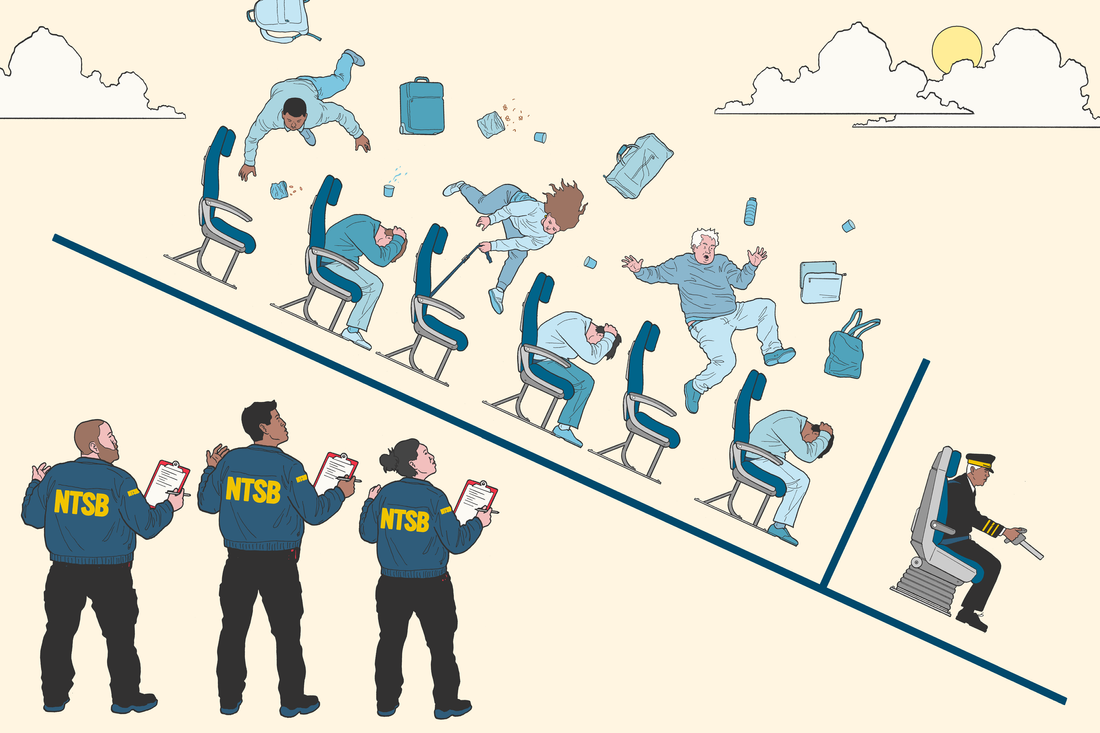
The JetBlue airliner that suddenly went into a dive over the Gulf of Mexico last October 30 did not crash. Despite how long the ordeal felt to passengers like Turner, the plunge lasted only about five seconds before the autopilot returned the aircraft to level flight. The flight crew, spooked, turned the plane toward the coast of Florida and brought it in for an emergency landing in Tampa. Twenty-two people were treated for their injuries. But because no one died, the flight didn’t receive widespread coverage. A dedicated team of investigators went to work. But in the days and weeks that followed, they became increasingly flummoxed. It wasn’t what had happened that puzzled them but why. As they examined the obvious potential causes, nothing matched up.Working their way down the list of possibilities, they found themselves in increasingly arcane and implausible-sounding territory. And the final option left to them — the only thing that could be true so had to be true — was so extraordinarily implausible that a normal reaction would be to dismiss it out of hand. (via NY Mag)

Note: This is a version of my When The Going Gets Weird newsletter, which I send out via Ghost, the open-source publishing platform. You can see other issues and sign up here.

Continue reading “First he erased his own identity and then he walked into the sea”

If you’re looking for mathewingram.com I have some bad news

(NOTE: I’ve restored my site thanks to Linux and some Updraft backups, but I am keeping this here for posterity)

It’s likely that not many people care about this, but I am writing this on my localhost/ blog — which I normally use as a backup to my blog at mathewingram.com/work — because the machine hosting that blog (and my photo server and my Plex instance and a bunch of other things) got hacked by ransomware a few days ago. I am currently in the process of either trying to restore it or wiping it and starting again, and at this point I have to say that the latter seems more likely.

I got hacked by someone using a form of ransomware known as Lockbit, which gets root access and encrypts all of your files and then renames them with a .lockbit extension. In my case it also got access to my Google Drive — I assume by cloning an authentication token to get around two-factor — and uploaded a bunch of encrypted files and backups. It seems that either I interrupted the process or they weren’t very good, because they didn’t get all of the files and they didn’t upload that many before I changed my passwords and locked them out.

That said, however, they screwed things up badly enough that it’s going to take some time and effort to put them back together, and it may not be possible. Ironically it would be easier if they had finished the job, because the last phase is to upload a ransom note and leave it as a screen saver, and that note often contains a unique ID that can be entered into an Interpol database that has decryption keys for some kinds of ransomware. If I can’t find a note or unique ID then I can’t search for the decryption key.

My working theory is that the hackers got in by brute-forcing the Windows Remote Desktop protocol, which I used to access my machine, since it is located somewhere other than my house. I had recently switched from RealVNC to RDP because RealVNC was charging a lot of money (relatively speaking) and RDP is free. I tried to set up Zerotier, a VPN, to get in through but it didn’t work for some reason I’ve been unable to figure out, so I opened a port to redirect RDP through — not the usual RDP port but a different one. A little while later there were a lot of blocked login attempts, but I didn’t think anything of it because open ports are often scanned and I thought I was protected enough, but clearly that wasn’t the case!

Anyway, even if I wipe the machine nothing priceless or irretrievable will be lost, because after many disk failures and other similar incidents in the past I have learned to have multiple redundant backups of almost everything, so I am all good on that front. But it will take some time to put things back where they belong — and maybe I will either go with Linux this time, or spend a bit more time trying to get a VPN working properly!