On The Abyss, a rat used to demonstrate the film’s oxygenated water technology drowned during filming. Faced with the prospect of a dead rat — and losing the production’s “No Animals Were Harmed” certification — Cameron performed CPR on the rodent. The rat sprang back to life, and Cameron adopted “Beanie” as his pet. One can understand why a director like Cameron would go to extremes to protect his film’s reputation. But why did a man running one of the most tortuous shoots in Hollywood history, who was reportedly saying things to crewmembers like, “Firing [you] is too merciful” … Why did that guy open his home to a mere rat? “Beanie and I bonded over the whole thing,” he says. “I saved his life. We were brothers. He used to sit on my desk while I was writing Terminator 2, and he lived to a ripe old age. (via The Hollywood Reporter)
A Nobel Prize-winning scientist thinks he can get water from the air
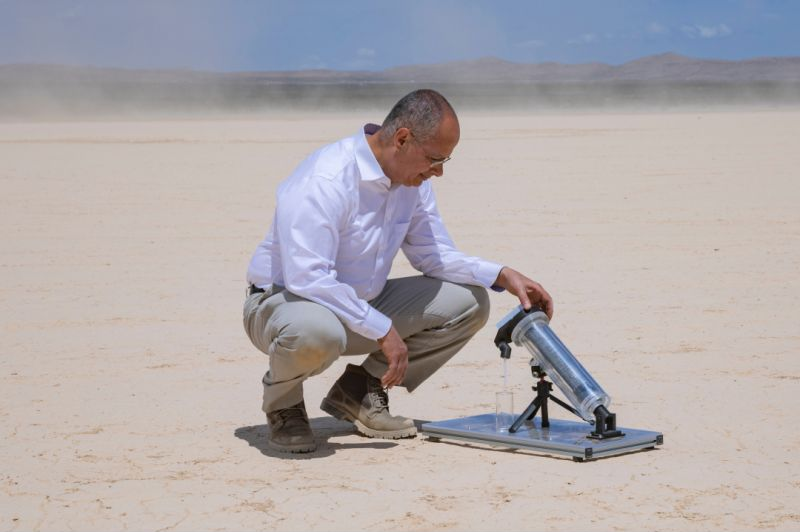
In October 2025, Omar Yaghi was one of three scientists who won a Nobel Prize in chemistry for identifying metal-organic frameworks, or MOFs — metal ions tethered to organic molecules that form repeating structural landscapes. Today that work is the basis for a new project that sounds like science fiction, or a miracle: conjuring water out of thin air. When he first started working with MOFs, Yaghi thought they might be able to absorb climate-damaging carbon dioxide — or maybe hold hydrogen molecules, solving the thorny problem of storing that climate-friendly but hard-to-contain fuel. But then, in 2014, Yaghi’s team of researchers at UC Berkeley had an epiphany. The tiny pores in MOFs could be designed so the material would pull water molecules from the air around them, like a sponge — and then, with just a little heat, give back that water as if squeezed dry. Just one gram of a water-absorbing MOF has an internal surface area of roughly 7,000 square meters. (via MIT)
Note: This is a version of my When The Going Gets Weird newsletter, which I send out via Ghost, the open-source publishing platform. You can see other issues and sign up here.
Continue reading “Director James Cameron once did CPR on a drowned rat”