
Expert says Jack the Ripper has been 100% identified by DNA

From the Tribune: “A researcher claims to have solved the 136-year-old mystery of Jack the Ripper, revealing a 100 per cent DNA match linking the infamous serial killer to a long-standing suspect. Russell Edwards, who has spent years investigating the case, says DNA extracted from a bloodstained shawl found at the crime scene of one of the Ripper’s victims, Catherine Eddowes, matches that of Polish-born barber Aaron Kosminski. Kosminski has long been a prime suspect in the brutal murders of five women in London’s Whitechapel district between August and November 1888. Edwards, working alongside genealogists, traced a living relative of Kosminski, who agreed to provide a DNA sample. When tested against the genetic material found on the shawl, it reportedly yielded a match. Now, the descendants of Eddowes and Kosminski are calling for an official inquest to legally confirm the killer’s identity.”

A private equity analyst quit to devote his life to the welfare of shrimp

From Asterisk: “I left private equity to work on shrimp welfare. When I tell anyone this, they usually think I’ve lost my mind. I know the feeling — I’ve been there. The transition from analyzing real estate deals to advocating for some of the smallest animals in our food system feels counterintuitive, to say the least. But it was the same muscle I used converting derelict office buildings into luxury hotels that allowed me to appreciate an enormous opportunity overlooked by almost everyone, including those in the animal welfare space. After years of practicing my response to the inevitable raised eyebrows, I now sum it up simply: ignoring shrimp welfare would have been both negligent and reckless. Shrimp may not be high up on the list of animals that most people think about when they consider the harms done by industrial agriculture, but we do know that if shrimp can suffer, they are doing so in the hundreds of billions.”

Note: This is a version of my When The Going Gets Weird newsletter, which I send out via Ghost, the open-source publishing platform. You can see other issues and sign up here.

Continue reading “Expert says Jack the Ripper has been 100% identified by DNA”

Elon Musk’s grandfather was a technocrat and apartheid fan

From the CBC: “Joshua Haldeman was just one of thousands of Saskatchewan farmers who lost their land in the drought of the Dirty ’30s. While that trauma shaped the lives of everyone who went through it, the crisis affected Haldeman so much that he never stopped raging at what he perceived were the causes of the Great Depression. Haldeman came to believe that an international communist conspiracy controlled the banks, the media and the universities and was aiming to run the world. “An ‘Invisible Government,’ working to carry out the objectives of the International Conspiracy, is operating in every country,” he wrote. He also said the conspiracy was pushing for the fluoridation of water supplies, mandatory milk pasteurization and mass vaccination programs. Haldeman embraced the solution proposed by a movement called Technocracy: that government should be run by scientists and engineers rather than politicians.” 

In the 1700s and 1800s pink was the color of princes and kings

From Literary Hub: “He was a prince whom all of Europe nicknamed “the pink prince”: Charles Joseph de Ligne (1735–1814), marshal of the army of the Holy Roman Empire, diplomat, thinker, writer, scholar, and a great ladies’ man. His courtly manner, wit, elegance, and gaiety charmed all the European courts. His nickname came from the traditional livery of his house along with his personal taste for pink, notably in clothing and furnishings, but also from his optimism and good humor. Hence we have proof that in the late seventeenth century, the color pink, symbolically, already evoked joie de vivre, pleasure, and lightheartedness, a pink that was not pale and delicate, but strong and saturated, closer to a light, vivid red. It would be anachronistic to see a sign of homosexuality or effeminate behavior in the wearing of pink by men. The prince of Ligne, who happily wore this color for many decades, had sixteen children by his wife and multiple affairs with women throughout Europe. All women found him charming.” 

Note: This is a version of my When The Going Gets Weird newsletter, which I send out via Ghost, the open-source publishing platform. You can see other issues and sign up here.

Continue reading “Elon Musk’s grandfather was a technocrat and apartheid fan”
Racecar driver lost both his legs and became an Olympic athlete

From Wikipedia: “Alessandro Zanardi is an Italian former professional racing driver who won the CART championship in 1997 and 1998, and took 15 wins in the series. He also raced in Formula One from 1991 to 1994 and again in 1999; his best result was a sixth-place finish in the 1993 Brazilian Grand Prix. He returned to CART in 2001, but a major crash in the 2001 American Memorial resulted in the amputation of his legs. He returned to racing less than two years after the accident, competing in the European Touring Car Championship in 2003–2004 and then in the World Touring Car Championship between 2005 and 2009; he scored four wins. In addition to continuing to race cars, Zanardi took up competition in handcycling, a form of paralympic cycling. In September 2012 he won gold medals at the London Paralympics and in September 2016 he won a gold and a silver medal at the 2016 Rio de Janeiro Paralympics.”

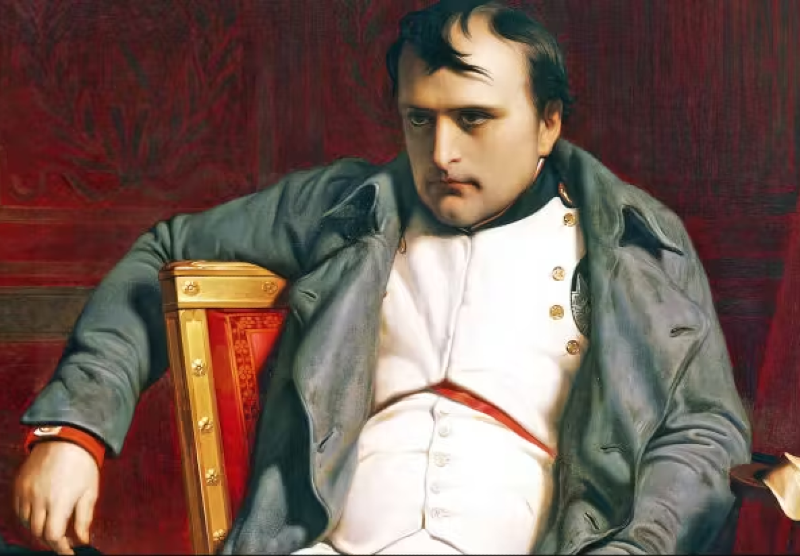
While in exile on Elba Island the former emperor Napoleon decided to take English lessons

From Public Domain Review: “Napoleon had had a rollercoaster eighteen months. First he had been forced to abdicate as Emperor of France and exiled to the island of Elba. Then he had managed to escape, march on Paris, and retake the throne. Finally a crushing loss at Waterloo had led to exile once again, this time to a far more remote island called Saint Helena. The watery walls of his new South Atlantic prison were at least a thousand miles thick in every direction. The British had agreed to provide Le Petit Caporal with plentiful wine, meat, and musical instruments, but he could not have what he most craved — family, power, Europe. To make matters worse, he had virtually nothing to read. Newspapers were banned, and those he did manage to get his hands on were nearly all in English. That was the main reason why, on January 16, 1816, three months after landing on the island, he decided to learn the language of his captors.”

Note: This is a version of my When The Going Gets Weird newsletter, which I send out via Ghost, the open-source publishing platform. You can see other issues and sign up here.

Continue reading “Racecar driver lost both his legs and became an Olympic athlete”

A rogue Romanian economist won the lottery 14 times

From The Hustle: “Just after 11 PM on February 15, 1992, a janky ball machine at the Virginia State Lottery HQ spit out 6 winning numbers on live television: 8… 11… 13… 15… 19… 20. In the coming days, officials would find out that one “person” had secured not only the $27,036,142 jackpot, but 6 second prizes, 132 third prizes, and 135k minor prizes collectively worth another $900k. What unfolded next was the strangest, most improbable lottery tale in history — one involving thousands of international investors, dozens of complex computer systems, and a mathematical savant. This is the story of the man who “gamed” the lottery by buying every possible combination. In the late 1960s, a young Romanian economist named Stefan Mandel was struggling to get by. Many Romanians might have turned to a life of crime. But Mandel, a self-described “philosopher-mathematician,” saw another way out: The lottery.”

Researchers have brought prehistoric algae back to life after 7,000 years in Baltic Sea mud

From Phys.org: “A research team led by the Leibniz Institute for Baltic Sea Research Warnemünde (IOW) was able to revive dormant stages of algae that sank to the bottom of the Baltic Sea almost 7,000 years ago. Despite thousands of years of inactivity in the sediment without light and oxygen, the investigated diatom species regained full viability. Many organisms, from bacteria to mammals, can go into a kind of “sleep mode,” known as dormancy, in order to survive periods of unfavorable environmental conditions. They switch to a state of reduced metabolic activity and often form special dormancy stages with robust protective structures and internally stored energy reserves. This also applies to phytoplankton, microscopically small plants that live in the water and photosynthesize. Their dormant stages sink to the bottom of water bodies, where they are covered by sediment over time and preserved under anoxic conditions.”

Note: This is a version of my When The Going Gets Weird newsletter, which I send out via Ghost, the open-source publishing platform. You can see other issues and sign up here.

Continue reading “A rogue Romanian economist won the lottery 14 times”

What can we learn from an AI’s thought process?

Before anyone gets upset about my headline, I am using the term “thought process” in the loosest possible way. I realize that many people (perhaps even most people) would not describe what an AI model does as “thinking.” After all, aren’t LLMs just a kind of super-autocomplete, as Noam Chomsky put it, with the whole internet to choose from? Aren’t they mostly just giant guessing machines, with no real intelligence behind them, or “stochastic parrots,” as AI scientists Emily Bender and Timnit Gebru described them? These are all fair questions, and I wish I had answers. But when it gets right down to it, we simply don’t know how LLMs do what they do — and when I say “we,” I’m not just referring to myself, or others like me who aren’t experts in artificial intelligence. Even the people who are building these AI engines and chatbots fundamentally don’t know exactly how they arrive at the outputs they produce (although some of them might pretend otherwise for marketing and/or fundraising purposes).

I know this probably sounds terrible, as though AI scientists are playing with explosives while not understanding how combustion works, but a surprising amount of science (the really interesting part anyway) is like this. Which is why I was so excited to see the recent reports from Anthropic, in which the company — founded by former OpenAI scientist Dario Amodei in 2021 — described at length its efforts to understand on a deeper level how its AI (nicknamed Claude) “thinks,” or why it arrives at the conclusions that it does. You might think that this should be fairly straightforward — couldn’t Anthropic just ask Claude a question, and then ask it to describe how it arrived at its answer? The short version is yes, Anthropic has done this with simple math problems, and Claude has gone into some detail about how it arrived at the answers it gave; but when the company tried looking under the hood at how it actually arrived at the answer, the real process it used was not even close to what it said it was doing.

Again, this is going to sound either ridiculous or disturbing to many people, or possibly a combination of the two. Doesn’t this mean that AI engines are making things up? How can we trust them? After all, companies are using artificial intelligence to perform all kinds of services, and government agents like Homeland Security and Elon Musk’s DOGE are even relying on it for more crucial functions, like figuring out who is a terrorist, and re-engineering the entire infrastructure of the government. Does any of this make sense if LLMs are just making shit up all the time? These are also fair questions. I for one think we should hold off on entrusting government services — like the decision on whether to deport someone to a prison in El Salvador — to an AI engine until we can understand how they arrive at their conclusions, and why they sometimes “hallucinate” (which AI pioneer Geoffrey Hinton prefers to call “confabulate”).

Note: This is a version of my Torment Nexus newsletter, which I send out via Ghost, the open-source publishing platform. You can see other issues and sign up here.

Continue reading “What can we learn from an AI’s thought process?”

He was in a vegetative state for a decade and came back to life

From Wikipedia: “Martin Pistorius is a South African man who had locked-in syndrome and was unable to move or communicate for 12 years. When he was 12, he began losing voluntary motor control and eventually fell into a vegetative state for three years. He began regaining consciousness around age 16 and achieved full consciousness by age 19, although he was still completely paralysed with the exception of his eyes. He was unable to communicate until his caregiver noticed that he could use his eyes to respond to her words. His parents then gave him a speech computer, and he began slowly regaining some upper body functions. In 2008, he met his wife Joanna, and in 2009 they married. By that time, Pistorius had regained limited control over his head and arms, but still needed his speech computer to communicate with others. In 2018, it was announced that the couple were expecting a child, and Pistorius was wheelchair racing.”

This guy is making millions by losing at every game he plays

From Slate: “At a private baccarat table near the back of the El Cortez Hotel and Casino in Las Vegas on a chilly January afternoon, a crowd of fans gathered to watch one of the world’s most famous gamblers at work. Some had come all the way here just to watch him play. They savored every detail—how he cut chips, ruffled his cash, bantered with the dealer. He was dressed for the job. His gray hair was molded into a tight crew cut, and he wore a knitted gold necklace low across his collarbone and a Super Bowl–sized ring with a Ruby 777 jackpot dangling from his hand. The scene was impressive, except in one way: This man absolutely sucked at gambling. I’d been with Vegas Matt — the YouTube tycoon whose millions of followers salivate over his every bet — for only a few hours. He’d already lost close to $30,000 and was set to lose even more.”

Note: This is a version of my When The Going Gets Weird newsletter, which I send out via Ghost, the open-source publishing platform. You can see other issues and sign up here.

Continue reading “He was in a vegetative state for a decade and came back to life”

Victorians believed that train rides could cause insanity

From Atlas Obscura: “As the railway grew more popular in the 1850s and 1860s, trains allowed travelers to move about with unprecedented speed and efficiency, cutting the length of travel time drastically. But according to the more fearful Victorians, these technological achievements came at the considerable cost of mental health. As Edwin Fuller Torrey and Judy Miller wrote in The Invisible Plague: The Rise of Mental Illness from 1750 to the Present, trains were believed to “injure the brain.” In particular, the jarring motion of the train was alleged to unhinge the mind and either drive sane people mad or trigger violent outbursts from a latent “lunatic.” Mixed with the noise of the train car, it could, it was believed, shatter nerves. In the 1860s and ‘70s, reports began emerging of bizarre passenger behavior on the railways. When seemingly sedate people boarded trains, they suddenly began behaving in socially unacceptable ways.”

How did a billionaire inventor’s supposedly unsinkable mega-yacht capsize?

From New Lines: “In Aug. 19, 2024, a storm swept into Sicily’s Gulf of Porticciolo and, within minutes, sank the megayacht Bayesian, drowning 58-year-old British tycoon Mike Lynch, his 18-year-old daughter and five other passengers. For many, the incident conjured up the hubris of those who compete with the gods. Months of investigations by the Italian judiciary and by journalists have failed to provide a clear explanation for what caused the shipwreck. Footage shot by Italian Navy divers, who entered the hull at a depth of nearly 165 feet, shows it waterlogged but its structures and equipment perfectly intact. The Bayesian looks like a ghost vessel: It gives the impression that it could resurface and resume sailing. The affair remains surrounded by an atmosphere of mystery, much like the owner of the vessel and its 235-foot mast that defied the sky.”

Note: This is a version of my When The Going Gets Weird newsletter, which I send out via Ghost, the open-source publishing platform. You can see other issues and sign up here.

Continue reading “Victorians believed that train rides could cause insanity”